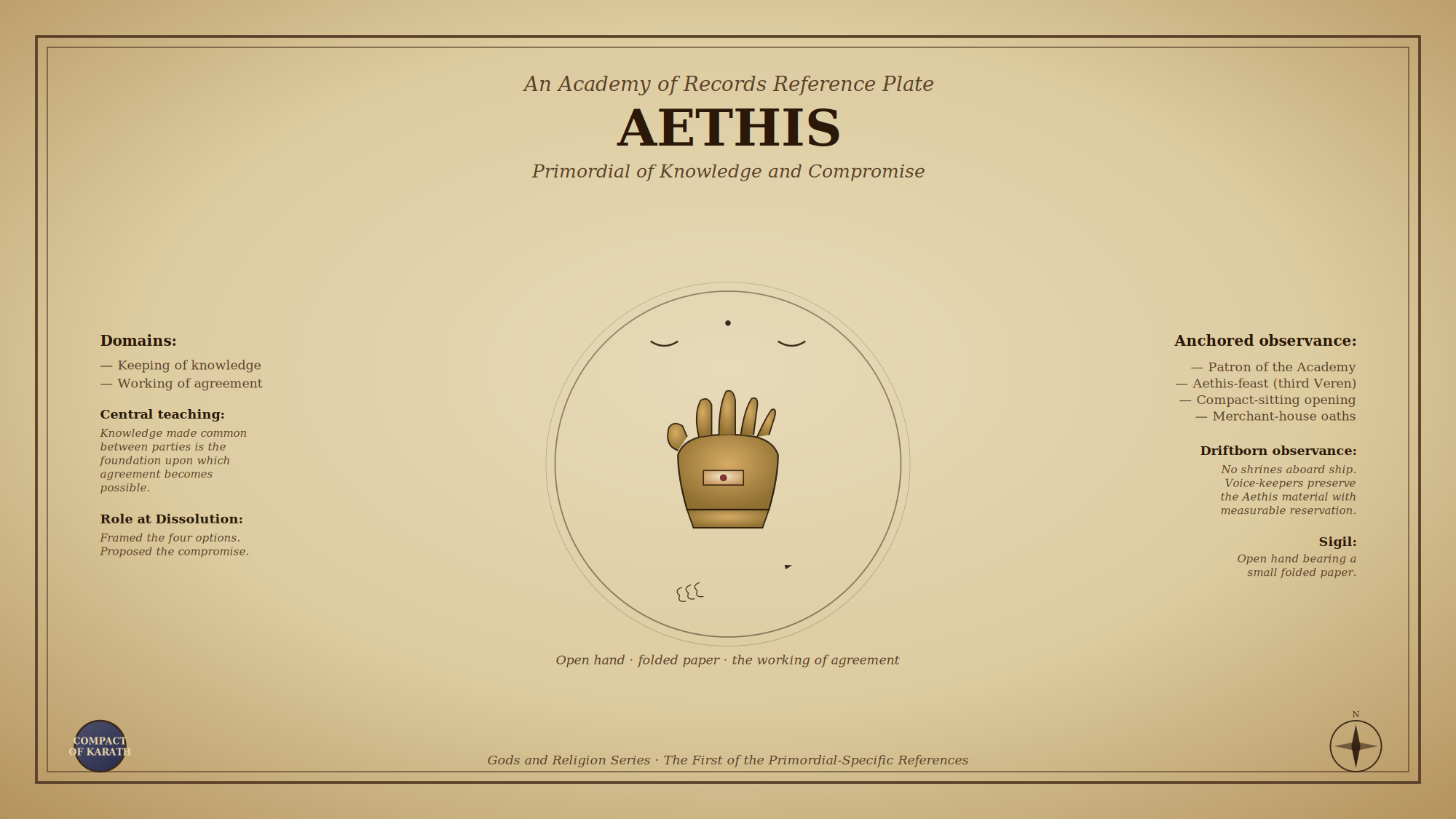
An Academy of Records reference article. Part of the Gods and Religion series.
Aethis is the Primordial of knowledge and of the negotiated settlement. Within the post-Dissolution pantheon, Aethis holds a particular institutional prominence: the framing of the four options that the Primordials debated for twenty years was Aethis’s, and the compromise that became the Dissolution itself was Aethis’s proposal. Anchored civic religion treats Aethis with the standing accorded to the figure who shaped the present age, while Driftborn voice-keeper tradition holds Aethis with measurable reservation. This article treats Aethis as a deity within the broader cosmology; readers seeking the Dissolution event itself should consult the relevant subsidiary article in the Gods and Religion series.
——— ◇ ———
Attributions and domains
Aethis’s domain is twofold and held to be inseparable: the keeping of knowledge, and the working of agreement. These two are joined by the principle that knowledge made common between parties is the foundation upon which agreement becomes possible, and that agreement which is not founded upon shared knowledge is mere temporary truce. Anchored Aethis-doctrine considers this principle the central teaching of the deity.
In practice, Aethis is the Primordial invoked at any moment when knowledge passes between persons in a binding form: the swearing of oaths, the witnessing of contracts, the formal teaching of an apprentice by a master, the recording of testimony in Compact court, the publication of scholarly findings. Aethis is held to be present in the act of formal transmission. A statement made under Aethis is not made lightly.
——— ◇ ———
The Dissolution
The four options Aethis framed for the deliberation are preserved in fragmentary form in the Academy’s restricted archive. The full text of the framing is not publicly available, but the broad shape of the four positions has been the subject of scholarly commentary for centuries. Aethis’s own preference was for the fourth option: the compromise by which the Primordials would withdraw their direct presence from the world. Six of the seven Primordials accepted this position. Thessik dissented.
Anchored doctrine holds that Aethis acted as the gods’ principal architect — that the Dissolution itself, rather than any of the alternatives, was the outcome Aethis judged best for the Coast and its peoples. Driftborn voice-keeper tradition is more cautious. Some Driftborn material preserves Aethis’s framing as the act of a figure who chose between difficult options without certainty, rather than the act of a figure who possessed and acted upon the right answer. Both traditions agree that Aethis was the architect; they differ on whether the architecture was wise.
——— ◇ ———
Anchored civic religion
Aethis is the patron of Anchored scholarly institutions and of the Academy of Records in particular. The Academy’s great Lecture Hall preserves an Aethis-shrine that is maintained by the History department and that is the site of the formal opening of every Academy session, every Master’s appointment ceremony, and every public scholarly award. The shrine itself is not open to public view between observances, but the Lecture Hall is.
Annual Aethis-feast falls in the third week of Veren and is observed across Karath in proportion to a citizen’s involvement with scholarly or contractual life. The Compact’s annual sitting is opened with an Aethis-invocation. The Bureau of Records observes the feast by suspending normal operations. Public processions through the Middle City carry the Aethis-mark — an open hand bearing a small folded paper — and the day’s central observance is held in the Academy plaza.
Smaller Aethis-shrines are maintained in most Karath merchant houses, where they serve as the formal site for the swearing of contractual oaths.
——— ◇ ———
Driftborn reservation
Driftborn voice-keepers preserve the Aethis material but do not accord Aethis the central place that Anchored religion does. Their account holds that the Aethis compromise resolved the deliberation but cost the Coast something whose absence the Driftborn have continued to feel across the centuries since. What was lost is described differently by different voice-keepers. Driftborn tradition has not produced a unified doctrine on this point and, by custom, does not consider unification of doctrine to be the appropriate response to a question of this kind.
Driftborn ships do not maintain Aethis-shrines. The Driftborn observance of contracts and oaths invokes the older form, in which agreement is held to be witnessed by Ohn rather than constructed by Aethis. This is one of the durable points of distinction between Anchored and Driftborn religious practice.
——— ◇ ———
What Aethis is not
Across the centuries, the institutional centrality of Aethis in Anchored civic religion has produced certain ordinary misunderstandings that the Academy treats with patience and consistent correction.
Aethis is not the chief of the Primordials. Seven Primordials are not arranged hierarchically; the framing of the deliberation does not, in the canonical accounts, confer rank.
Aethis is not the patron of secrecy. The teaching of Aethis is the principle of made-common knowledge. Knowledge held privately, in the Aethis-doctrine, does not yet possess the quality the deity is held to embody.
Aethis is not a god of conclusion. The teaching of Aethis is the principle of the negotiated settlement, which is held to be a continuing condition rather than a finished state. A settlement that has stopped requiring active maintenance is, in the Aethis-doctrine, a settlement no longer being held.
——— ◇ ———
This article is a Free-tier entry of the Academy of Records’ Gods and Religion series. Readers are directed to the companion article on the Seven Primordials and Ohn for the broader cosmological framework, to the Dissolution reference for the historical event Aethis is most strongly associated with, and to the Academy of Records reference for the institutional setting within which Aethis-doctrine is principally preserved.