An Academy of Records public reference article. On the texture of civic participation in Anchored communities — the assemblies, obligations, reputations, and quiet sanctions that compose public life outside the frame of formal law.
——— ◇ ———
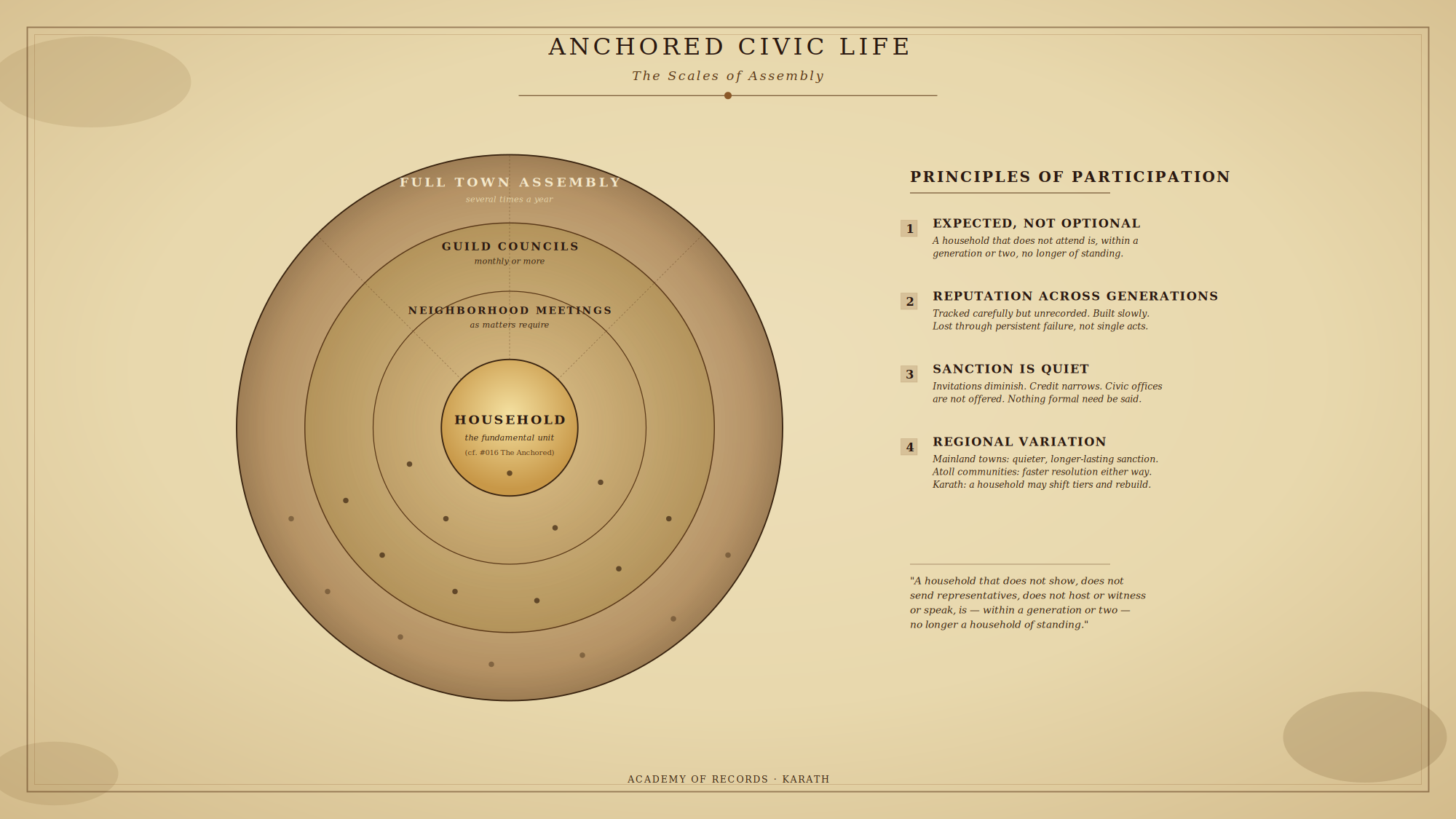
Anchored communities expect participation. A household that does not show at assemblies, does not send representatives to guild meetings, does not host or witness or speak when the community's practice calls for it is, within a generation or two, no longer a household of standing. This article treats the everyday texture of that participation — the forms it takes, what is expected of whom, and what happens when the expectation is not met. The political architecture within which civic life operates is treated in the article on the Anchored and, in its specifically legal dimensions, in the forthcoming article on Anchored law; this article is concerned with the practice rather than the framework.
——— ◇ ———
Assembly Culture
Most Anchored communities are small enough that civic assemblies are meaningful events. A mainland town of three or four hundred households meets in full assembly several times a year to address matters affecting the whole community: shared watercourses, disputes exceeding the capacity of the ordinary courts, decisions about public works, the admission or recognition of new households. The assembly is open to adult members of all recognized households, and attendance is expected rather than optional. A household that consistently fails to send a representative is noted. A household that actively declines to participate has chosen, in practical terms, to step outside the community's decision-making life.
Smaller gatherings — guild councils, neighborhood meetings, market-day discussions among merchant-house members, the specialized assemblies of craft or trade bodies — operate by similar logic at smaller scale. An adult member of a community typically attends several such gatherings a month, as matters of consequence to her particular trade, neighborhood, or standing come up. Atoll communities, whose small populations make assembly dense, tend to blur the distinction between civic and social gathering; mainland towns maintain a clearer separation; Karath, at the coast-wide scale, formalizes the distinction through specific institutions.
Reputation and Standing
Civic reputation is tracked carefully, though not formally recorded outside specific contexts. A household is, in the view of its neighbors, either in good standing, in difficulty, or in decline, and the judgment is made from accumulated observation rather than from any single act. Paying debts promptly, attending assemblies, honoring agreements, contributing to shared civic needs when asked, taking the civic offices a household in standing is expected to take — all of these build the reputation that allows a household to operate with the confidence of its community. Failure in any of these is, individually, recoverable; persistent failure across several is not.
Apprenticeship is a civic act as much as a commercial one. To take an apprentice is to vouch for the household's capacity to train and to assimilate; to place a child as an apprentice is to extend the household's network of relationships. The Coastal apprenticeship system is one of the principal mechanisms by which civic reputation is built across generations, and its workings are treated in more detail in the article on Coastal education.
When Participation Fails
Civic sanction, when it occurs, is ordinarily quiet. A household that has declined into poor standing finds invitations diminishing, commercial credit narrowing, civic offices not offered, marriages harder to arrange. Nothing formal need be said; the community acts on its cumulative judgment without announcement. Severe exclusion — the refusal of most households to deal with a household judged to have broken civic trust — is uncommon but documented, and is usually recoverable only across several generations of demonstrated restoration.
The specific forms of this sanction vary by region. Mainland towns tend toward quieter, longer-lasting forms. Atoll communities, whose small populations cannot support prolonged exclusion, often produce faster resolution either toward restoration or toward the effectively-forced departure of the household from the atoll altogether. Karath, at its scale, allows a household to shift neighborhoods or even tiers and begin rebuilding; smaller communities do not afford that possibility.
——— ◇ ———
This article is classified as a short public reference of the Academy of Records, Karath. It should be read alongside the foundational article on the Anchored, the article on daily life in Karath, and the forthcoming references on Anchored law, on Coastal education, and on specific civic institutions.