An Academy of Records public reference article. On the legal framework of the Anchored — the Karath Compact, the codes it contains, the courts that apply it, and the relationship of Anchored Law to the jurisdictions beyond it.
——— ◇ ———
Anchored Law is the legal framework under which the settled peoples of the Shifting Coast conduct their public life. It is codified principally in the Karath Compact, descended from which, in various regional forms, are the compacts and municipal codes of most other Anchored settlements. It is enforced by the Port Watch, adjudicated by a hierarchy of courts, and revised — slowly, and by explicit procedure — by the Karath Compact's annual session and by the assembly actions of the settlements that have adopted Compact-derived frameworks of their own. This article describes the system in its broad form. Readers seeking particular statutes, specific court procedures, or the jurisprudence of specific settlements are directed to the more specialized Academy references on each.
——— ◇ ———
Sources and Authority
Anchored Law draws its authority from three distinguishable sources. The first is the Karath Compact itself, a codified and continuously maintained body of statute whose origins predate the Dissolution and whose continuous enforcement makes it the oldest working legal system on the known Coast. The second is common law — the accumulated decisions of Anchored courts, which are binding in the settlement where decided and strongly persuasive elsewhere. The third is regional compact — the legal frameworks of non-Karath Anchored settlements, which are typically derived from the Karath Compact but contain local variations, sometimes significant, reflecting regional custom and the practical circumstances of smaller ports.
The Karath Compact is the senior authority where jurisdictions overlap. A contract written in a smaller port is presumptively governed by that port's compact; the same contract, if adjudicated at Karath, is governed by the Karath Compact in areas of conflict. Most long-distance commercial contracts specify Karath jurisdiction deliberately, and this is one of the principal reasons Karath's courts handle a volume of adjudication well in excess of what Karath's local commerce alone would require.
Anchored Law is not a divine code. The Anchored civilization is post-Dissolution, and its Law has no claim of derivation from the gods. Some older statutes originate in pre-Dissolution practice, and the pre-Dissolution god Ithros was traditionally associated with law and stone; but current Anchored Law is understood as a human institution, answerable to the assemblies that maintain it. This is a fact most Anchored jurists will note when explaining the system to outsiders, because it is frequently misunderstood.
——— ◇ ———
The Three Codes
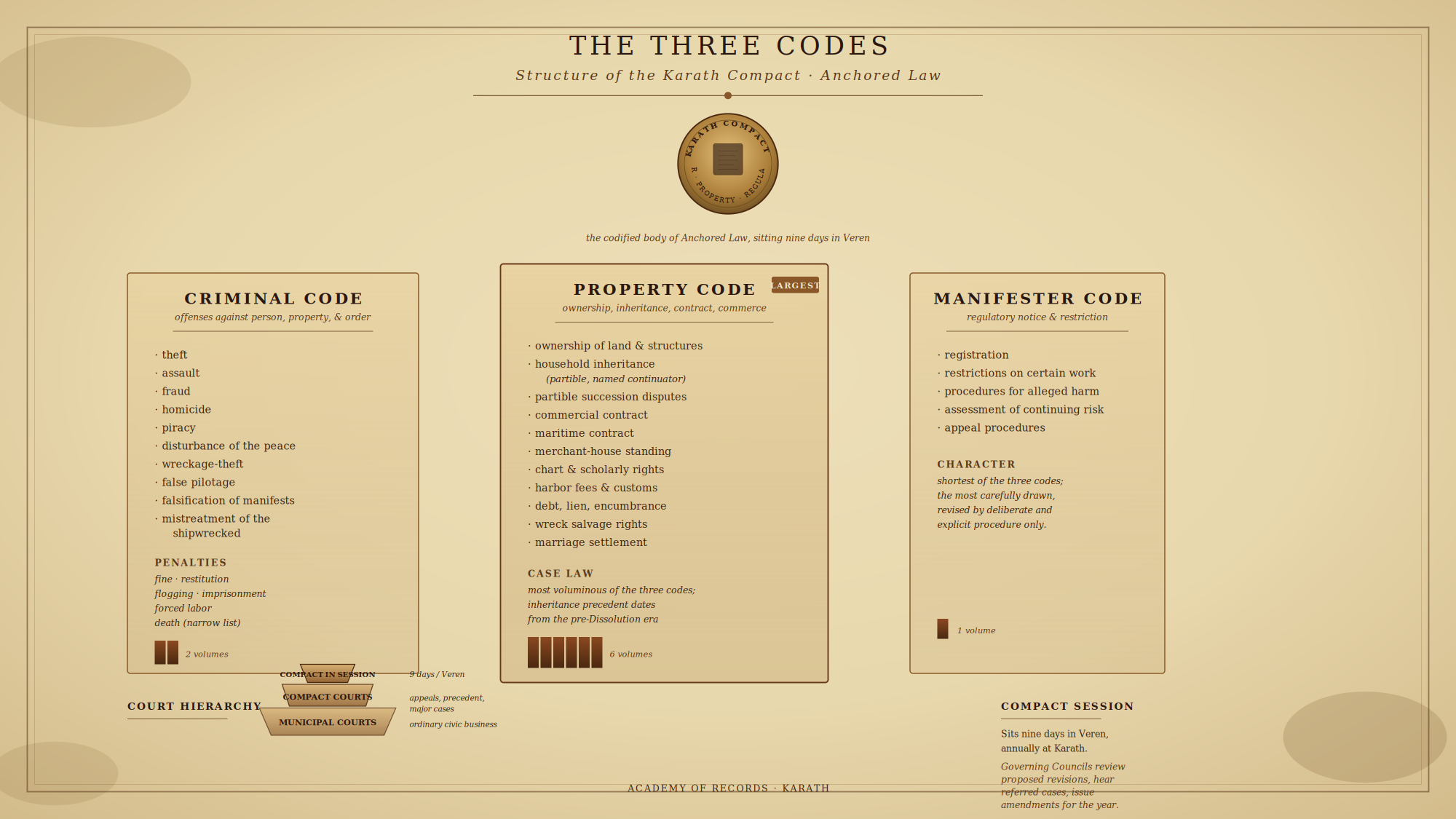
Karath Compact statutes are organized into three principal codes, under which most of its specific provisions are arranged.
The Criminal Code addresses offenses against person, property, and public order. Its categories of offense are broadly familiar to any legal tradition — theft, assault, fraud, homicide, piracy, disturbance of the peace — with specific provisions for offenses particular to a maritime civilization: wreckage-theft, false pilotage, falsification of cargo manifests, and the mistreatment of shipwrecked persons. Penalties range from fine and restitution to flogging, imprisonment, forced labor in the harbor works, and — for a narrow list of the gravest offenses — death. Of the three codes, the Criminal Code has been the most often revised; most of its current provisions are post-Dissolution in form, though the underlying principles are older.
The Property Code addresses ownership, inheritance, contract, and commercial dealing. It is the largest of the three codes and the most detailed, running to several volumes of statute and some centuries of accreted interpretation. Anchored common law on inheritance — the partible pattern with named continuator — is codified here, and the body of case law on commercial contracts is the single most voluminous area of Coastal jurisprudence. The Property Code's stability is the condition under which most Coastal commerce is conducted, and its reputation for predictability is among the chief reasons merchant houses from distant ports write their contracts to be adjudicated at Karath.
The Manifester Code addresses legal questions arising from manifestation — that is, from the appearance of powers in individuals that Anchored Law classifies as requiring regulatory notice. This code is the shortest of the three and the most carefully drawn. Its provisions establish registration requirements, restrictions on certain work, and procedures for cases in which a manifester's presence is alleged to have caused harm or to pose a continuing risk to others. Full content of the Manifester Code is available through the Compact's public record and is frequently consulted; the Academy's introductory reference on it will be found in the relevant specialized article.
——— ◇ ———
Courts
Anchored judicial proceedings take place in a hierarchy of courts graded by the gravity of the matter at hand.
Municipal courts handle the ordinary civic business of each settlement: small contracts, minor property disputes, low-offense criminal matters, and routine administrative adjudications. Municipal court sessions are public, convened by local magistrates, and held on most working days. A municipal court's ruling is binding within its jurisdiction and appealable to the next level.
Compact courts — sometimes called "great courts" — handle matters of significant property value, major criminal cases, appeals from municipal decisions, and cases in which the application of the Compact's codes is unclear or contested. Compact courts sit at Karath and, in modified form, at the principal other Compact-derived settlements. Their rulings on points of Compact interpretation are broadly influential across Anchored jurisdictions.
The Karath Compact in session is the highest authority. The Compact sits for nine days in Veren each year. During its session the Governing Councils review proposed revisions to the codes, hear cases that have been referred upward from the Compact courts on grounds of first-impression or systemic significance, and issue rulings and amendments that become part of the body of Anchored Law for the year following. Between sessions, the Compact's daily authority is administered by the Councils in their ordinary capacity.
Proceedings at all levels make extensive use of scribes. Every court proceeding is recorded in writing by at least one scribe of the court; major proceedings are recorded by two or three, cross-checking. Karath-trained scribes, whose work is considered presumptively correct in most Coastal courts unless specifically challenged, are central to the system's functioning. Much of what makes Anchored Law reliable as a framework is that its record is reliable as a document.
——— ◇ ———
Enforcement: The Port Watch
The Port Watch is the enforcement arm of Anchored Law at each Anchored settlement. It is a civic body, answerable to the local assembly or council, distinct from the judiciary it serves. At Karath, the Watch is a sizable institution with operations across the three ports and the civic tiers; at smaller settlements, the Watch may consist of no more than a dozen officers. Watch officers are identified by a slate-colored coat and a baton carried at the belt. Working officers carry worn leather batons; ceremonial officers, at formal civic occasions, carry ornamental batons that are not used for enforcement.
The Watch's authority extends to investigation, apprehension, and the maintenance of public order. It does not extend to adjudication — an officer of the Watch does not try cases. A suspect apprehended by the Watch is held and presented to the appropriate court, where a magistrate hears the matter. This separation is deliberate and considered essential to the system's integrity.
Watch officers are trained in the principal codes and in the procedural requirements of apprehension and evidence-keeping. The quality of this training varies by settlement; Karath's Watch is considered the most rigorously trained, and officers from smaller settlements not infrequently travel to Karath for advanced instruction.
——— ◇ ———
Limits of Jurisdiction
Anchored Law governs the Anchored settlements and the waters formally under each settlement's jurisdiction. It does not govern the open sea, the unclaimed shores, or the mobile communities of the Driftborn. A matter arising at sea between two Driftborn companies, for example, is not an Anchored matter and is not heard in Anchored courts. A matter arising between an Anchored party and a Driftborn party is heard in whichever jurisdiction the parties agree to. Where no agreement is reached, the matter is heard in the Anchored court with the strongest connection to the facts at issue, with such accommodations for Driftborn practice as the court considers appropriate.
The relationship between Anchored Law and Driftborn custom is, in practice, cooperative more often than contested. Most Driftborn companies maintain working understandings with the Anchored ports they frequent, and most Anchored ports accept the practical realities of dealing with a population that does not live under Anchored Law and has no intention of adopting it. Disputes that cannot be resolved cooperatively are rare, and are typically addressed at the port level rather than at the Compact.
Within the Anchored settlements themselves, Anchored Law's reach is comprehensive but not absolute. It does not govern private conscience, does not mandate religious observance, does not dictate household practice except where the practice produces public harm. It is a framework for public life, not a doctrine of private virtue. Anchored jurists are generally clear on this distinction, and the system's long stability is owed in part to the fact that it has not, historically, been asked to do more than it can reliably do.
——— ◇ ———
This article is classified as a standard public reference of the Academy of Records, Karath. It should be read alongside the foundational article on the Anchored and the related articles on Karath, on Coastal Settlements, and on the specialized references for each of the three Compact codes. Readers interested in the Manifester Code specifically, in the history of the Karath Compact, or in the comparative law of non-Karath Anchored settlements are directed to the relevant articles in this series.