Sera Vellis sat at her desk in the Languages room and watched Master Velesh take the passage out from under her hand.
He didn’t ask. He didn’t apologize. He walked down the row of desks the way he always did at mid-morning, as though he were checking the progress of the third-year translations. When he reached her desk he simply set two fingers on the sheet of paper she had been working on, lifted it, turned, and walked back toward his own office with her six months of work held casually between his second and third knuckle.
She sat very still.
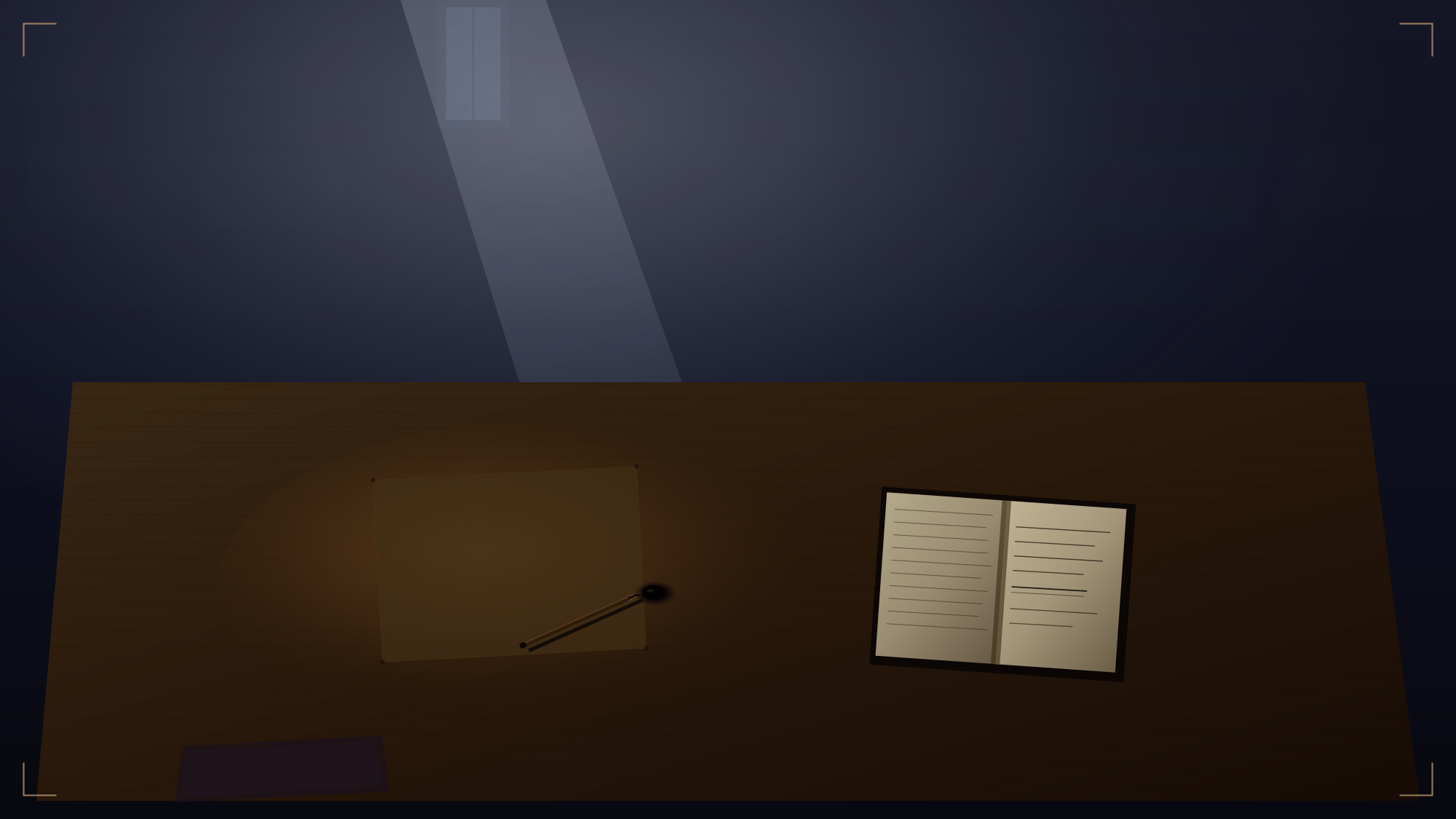
Her pen was still on the desk in front of her. A small pool of ink had formed where the nib had been resting — she had stopped moving it the moment his shadow had fallen across her shoulder. She picked the pen up now and wiped it on the cloth she kept under her elbow, because the cloth was what she always did after using the pen, and doing what she always did was what was going to keep her face from doing anything her face shouldn’t.
She looked down at her page of notes.
The notes were still there. He hadn’t taken the notes.
That was information. It was a great deal of information, and her mind was already sorting through what it meant. She made herself stop sorting for a moment so that she could breathe. One count in. One count out.
The Academy Hall of the Languages department had very high ceilings and very thin windows, and the winter light came through the thin windows in long pale columns that fell across the rows of desks and the heads of the seventeen other junior scholars working around her. In the pale light, nothing looked different from how it had looked five minutes ago. Nothing was different, to anyone watching. Master Velesh had simply collected a page. Junior scholars had pages collected from them constantly. It was the most ordinary gesture in the room.
Sera picked up her pen and began a new line on her notes as though she were continuing the work.
She was not continuing the work.
What she was doing was writing down, in the personal abbreviation system she’d developed for herself in her second year, the sequence of questions she needed to answer before the end of the day. She wrote: knew or knows. where. who told. when started. when moves.
She underlined when moves.
Then she capped the pen, because Master Velesh’s office door — a door she had been watching out of the corner of her eye for six months — had just closed.
——— ◇ ———
She worked through the rest of the morning.
A stack of new translation assignments sat on the supervisor’s table by the window. She walked over and took one with the same unhurried manner she had watched other third-years take them for the last two and a half years. It was a merchant inventory from Tri-Port, seventeen years old, in provincial Tri-Port mercantile shorthand. Boring work. Nobody would wonder why she had picked it up, because she was known for doing boring work well, and the work had the useful property of being absorbing for the hand while leaving most of the mind free for other things.
Her mind was working.
She knew, in the way she knew most things, by process of elimination. Master Velesh had not taken the passage by mistake — he didn’t make that kind of mistake, not about papers, not about which paper was on which desk. He had taken it deliberately. He had taken it this morning and not a month ago or a month from now, which meant something had changed between a month ago and today. Something had told him to go and take the sheet.
What could have changed? Who would have told him?
She worked through the possibilities the way she would work through a difficult paragraph, setting each one next to the others and asking which fit.
The one that fit was the one she had been trying, for six months, not to think about.
She had not been careful enough with Janne.
Janne worked three desks over — another third-year, assigned to the same row as Sera. At the last department gathering, Janne had stopped by the cheese platter and asked — casually, casually, Sera had thought at the time — what Sera was translating.
“The long one?” Janne had said. “The one you’ve been on since summer?”
“Restricted-archive filler,” Sera had answered. “Dull as a hymnal.”
“Oh,” Janne had said. And had changed the subject to the weather on the coast.
That had been the lie Sera had prepared. She had told it cleanly. Janne had let it drop.
Now, sitting and translating a Tri-Port merchant inventory and pretending her morning was ordinary, Sera understood that Janne had not been asking casually at all. Janne had been watching Sera’s face when she said restricted-archive filler. And Janne had seen enough.
Sera was not angry.
Anger would be useful later. Anger was for the hours after she had left the Academy, when she could afford it. Right now she needed to be a person who was translating a Tri-Port merchant inventory, who was not panicking, and who — most importantly — was not acting in any way that would make the person about to start watching her notice that she knew she was being watched.
Her hand moved across the page. Her translation was neat and correct. Her letterforms weren’t shaking, which she checked, because she had long ago learned to check.
That was good. That was useful information about herself, and she filed it away.
——— ◇ ———
The noon-bell rang.
The junior scholars closed their books and stood, and some of them filed out to the common refectory for the midday meal, and some sat at their desks and ate the bread and cheese they had brought from home. Sera was a bring-from-home scholar. She had been one since her first year, partly because the refectory food was expensive and her stipend was not, and partly because she did her best thinking alone. Today the bread and cheese were in her satchel, and her satchel was under her desk, and she did not move for them yet.
She watched Master Velesh’s office door.
He came out after six minutes. He did not look toward her. He walked to the main staircase with the unhurried stride of a man going somewhere specific and not in any hurry to get there. Sera watched the back of his robe disappear down the stairs and counted in her head until she was sure he was two floors below.
Then she stood.
She walked to the window at the east end of the Languages room. The window overlooked the High City’s lower quarter, the roofs of the Middle, and, beyond them, the faint grey horizon of the Karath harbor. She stood there for perhaps thirty seconds. Anyone watching her would have seen a junior scholar taking a brief break to look at a view she probably looked at every day.
What she was actually doing was counting the shapes at the far end of the hall.
There was a man at one of the reading tables whom she had never seen before.
He was reading, or pretending to read, a bound volume that Sera recognized from this distance as a common first-year reference. He wore junior-scholar robes, and the robes were correct in every detail, and he was not a junior scholar. Sera had seen every third-year and most second-years in the Languages department across two and a half years, and she had not seen him. He was older than a first-year. The skin around his eyes was the wrong age for a first-year.
Something cold moved in her stomach.
Her hand had tightened on the window-ledge without her asking it to, and she felt the pressure of her thumb against the wood before she registered that she had stopped breathing. She made herself breathe — one count in, one count out — and the cold thing in her stomach moved lower and settled into the part of her she had taught herself to think of as useful. Fear was information. It meant her body had understood something her mind had only started to understand. She filed it.
Sera looked at the horizon for three more seconds. Then she turned from the window and walked back to her desk. She picked up her satchel, took out her bread and cheese, laid them on a napkin on the corner of the desk, and began to eat.
And she thought about Sethra.
——— ◇ ———
It was the first time all morning that she had let herself do it.
Sethra had been a senior scholar at the Archive — not Sera’s supervisor, but the person in the Academy whom Sera had most wanted to be. There was a particular laugh Sethra had made, a short incredulous hah, when a junior scholar produced a translation that was so confident and so wrong that it deserved the kind of correction that was also a kindness. Sera had heard that laugh directed at her own work once, in her first year. She had never forgotten it.
What followed had been an hour at Sethra’s desk, with a cup of the strong black Tri-Port tea Sethra kept in the Archive breakroom. They had discussed where the translation had gone wrong and where it had gone interestingly wrong — which, Sethra had taught her, were not the same thing. They had shared that tea a hundred times in the year and a half that followed.
Sethra had brought Sera the passage six months ago.
Vellis, she’d said, in the half-dry way she said things. I think you might find this interesting. I think you might find this a great deal more interesting than you’ll want to find it.
Then, two days ago, Sethra had died at the Second Port.
Sera had heard it from a second-year. The second-year had been crying. Sera had not cried, because the second-year was going to tell someone that Sera Vellis had not reacted, and Sera had decided, in that moment, that what Sera Vellis would be known for not reacting to would — from this point on — be something worth watching. She’d been careful to look numb, not calculating.
She had nearly cracked yesterday morning.
She’d been making tea in the Archive’s small breakroom, the way she had every morning for a year and a half. Her hand had reached for the tin that Sethra kept beside the kettle — the strong black Tri-Port blend, the one she had shared with Sera a hundred times.
The tin had been gone.
Of course it had been gone. Sethra kept it in her satchel when she left work, and Sethra’s satchel had gone wherever her body had gone. The empty space on the shelf where the tin had lived had ambushed Sera like a person stepping out of an alley. She had stood there with her hand halfway up and her throat tightening, and she had understood, very clearly, that she was going to cry. Right there. In the breakroom. Where someone could walk in.
She hadn’t cried.
She had made her tea, drunk it, and gone back to her desk. She had been sloppy for an hour afterward, and that was information, and she had filed it.
Sera chewed her bread now and thought about what Sethra had known.
Sethra had known she was going to die. That was the thing Sera had been turning over since yesterday. Sethra had known, and Sethra had written to her — a letter that had reached Sera’s boarding house on the morning Sethra’s body was found, which meant Sethra had sent it either the night before or the morning of.
The letter had named one person. Not the woman Sethra had gone to warn — Sethra hadn’t named her. The letter had named, in Sethra’s clean Academy hand, a single man at the harbor. A name Sera had repeated to herself three times before she burned the letter, because the paper would be gone in a minute and the name would need to be hers.
Cassian Vor. Captain of the Grey Tide. Third Port.
Sera had burned the letter.
She had eaten her bread and cheese while watching it go.
——— ◇ ———
The afternoon was the longest she had ever lived through.
She finished the Tri-Port inventory and filed it with the other completed translations. She picked up the next assignment in her tray — a routine grammatical check of a translation a second-year had submitted last week — and settled into it. The man at the reading table stayed at the reading table. He turned a page now and then. He didn’t look toward her desk, but his shoulders had the careful stillness of shoulders concentrating on not looking toward a particular thing.
She wrote her corrections out in her neat hand.
She thought, in the back of her mind, about the hiding place.
The passage she had been working on for six months had existed in two places. The copy had lived in her desk, rolled in a sheath with the ordinary notes for her current assignment. That was what Master Velesh had taken. The copy had been the bait. Sera had understood, six months ago — not consciously, but with the kind of half-aware foresight with which she made most of her real decisions — that the thing she was working on would eventually be found. When it was found, she wanted what they found to be the copy and not the original.
The original was in the rafters of the coal-cellar of the boarding house where she rented her room.
It was in a tin box, inside another tin box, inside a third tin box. The outer tin was labeled Yarn — Ansa Vellis — not for use in the handwriting of an older woman, which was a handwriting Sera had taught herself to imitate with some effort. Ansa Vellis was her distant cousin. Ansa Vellis had retired from the Academy twelve years ago and was known in her old Languages department for sending parcels of things she no longer needed to relatives she liked. Nobody would open a tin labeled as old yarn from an elderly relative. Nobody had.
The original had been in that tin for five months and twenty-one days.
Sera worked through the grammatical check at her usual steady pace. At ten past five, she closed her pen. At a quarter past five, she stood, picked up her satchel, nodded to the other third-years still working, and walked toward the stairs at the main end of the hall.
The man at the reading table did not stand.
She had not expected him to. He was the watcher. Watchers watched.
She walked down the main staircase, through the central rotunda, and out through the enormous bronze-bound main doors. She nodded to the porter. The porter nodded back. She went down the six steps to the High City plaza.
The plaza was full of people. Scholars leaving at the end of the day. Students arguing. Two old men playing stones on a bench. A woman selling hot wine from a cart at the edge of the fountain. The evening had the particular cold that winter evenings in Karath had — not sharp, not biting, just present — and the sea mist was beginning to roll up from the harbor into the High City streets.
Sera walked across the plaza and into the nearest side street.
She did not go home.
——— ◇ ———
She went to a laundry house three streets away, where she’d had her robes cleaned once in her first year.
She walked in through the front. Out through the back. Then through the alley behind it, turning left at the dyer’s shop. Four blocks down a lane too narrow for a horse, and she came out in the Middle City.
When she was sure she had not been followed, she went to the boarding house by the long route.
She let herself into the coal-cellar through the back entrance by which the coal-man delivered. She climbed onto the low ledge above the coal-bins and reached into the rafters. The outer tin was still there. She took it down, put it into her satchel under the bread-napkin and under the afternoon’s papers, and left through the back entrance the same way she had come in.
She did not go up to her room.
She thought about it, standing in the alley. She thought about the books on the shelf above her bed. About the clean shirt folded on the chair for tomorrow. About the half-written letter to her aunt in Tri-Port that had been sitting on her table for a month, because she hadn’t known how to tell her aunt that she was happy. She would have liked to take the letter. She would have liked to finish it.
But going up the stairs meant being seen by the landlady, and being seen by the landlady meant the landlady would remember what time Sera had come in, and that information would cost Sera something later.
She let the letter go.
She walked out of the boarding house’s back alley into a Karath evening.
——— ◇ ———
The lamps were being lit along the Middle City’s main thoroughfare.
Sera stood at a corner where the road branched. One way went up to the High City — to the Academy, to the Languages room, to the desk she had sat at for two and a half years. To the chair she had thought of as hers. To the specific light that came through the specific window at the specific hour she knew best.
The other way went down. Toward the Second Port and, beyond it, the Third Port, and the harbor, and a man she had never met.
Up was her life.
Down was someone else’s.
She stood at the corner for perhaps ten seconds. Long enough for anyone watching from a distance to see her pause. Not long enough for anyone to think she was uncertain about which way to go.
She was uncertain.
She had been uncertain since the moment Master Velesh’s fingers had closed on her morning’s work, and she would be uncertain for the rest of her life, probably, about the thing she was about to do. But Sethra had not been uncertain when she wrote the letter. Sethra had not had time to be uncertain. Sethra had picked one name out of the Karath harbor and written it down on good Academy paper in her clean hand.
Sera was going to take that name seriously because Sethra had taken it seriously. Because the last gift a dead friend gives you is the thing you do with what they left.
She went down.
In her satchel, under the outer tin of old yarn that was not old yarn, was the passage that Sethra had given her six months ago and had not lived to see completed. Under the passage, folded small, was the name she had repeated to herself three times on the morning she’d burned the letter.
Cassian Vor. Captain of the Grey Tide. Third Port.
Sera walked down through the Middle City in the long blue dusk.
She did not look back.
——— ◇ ———
END OF CHAPTER 4.