An Academy of Records public reference article. On the rhythm of work, meals, and civic life in the Coast's principal city.
——— ◇ ———
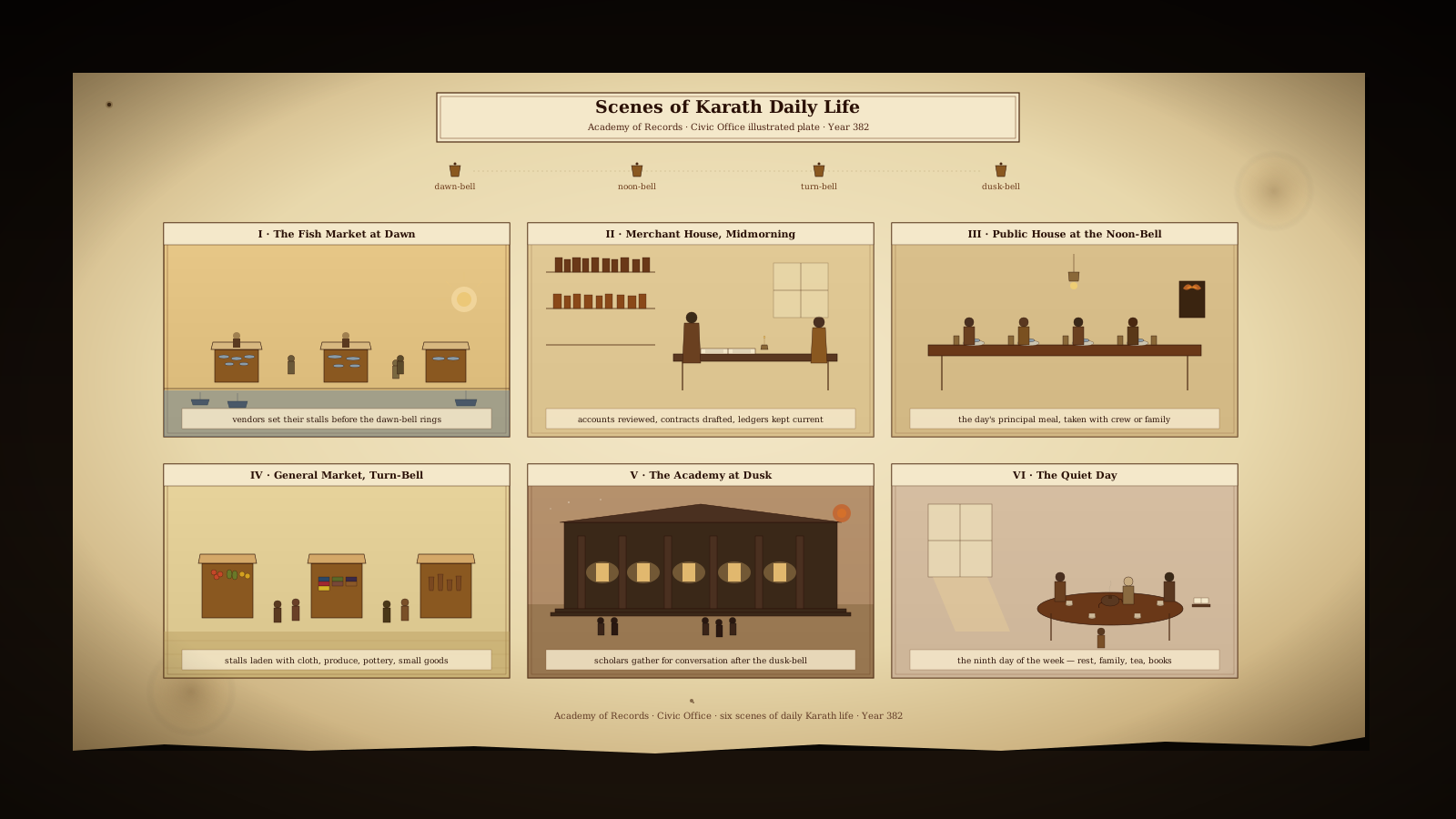
To live in Karath is to live by the bells. The city's dawn-bell rings from the Port Watch tower at first light and is answered, within a quarter of an hour, by bells from the Academy, the Harbor Master's office, and the principal temple precincts. The noon-bell, the turn-bell of mid-afternoon, and the dusk-bell divide the working day. Bells for storm warnings, incoming vessels, and civic announcements punctuate the quarters between. A Karath-dweller who has never heard another city's silence is sometimes surprised, upon traveling, to discover that not all cities are awake to their own time.
This article describes the texture of daily life in Karath for the approximately one hundred and twenty thousand Coastal Anchored who make up the city's population. It is not exhaustive. A full treatment of Karath's civic life would fill many volumes, and in several respects does. What follows is the everyday surface a visitor would notice in the first days of a stay.
——— ◇ ———
The Tiers and Who Lives There
Karath is built on three broad terraces of basalt rising from its harbor. Each tier has its own character, and most Karath residents identify themselves by the tier they live on before they identify themselves by anything else.
Karath's lower tier is the working harbor: docks, warehouses, fish-markets, net-yards, the Harbor Master's office, the principal customs houses, the Port Watch barracks. It is also where most of the city's laboring population lives, in dense rows of two- and three-story stone dwellings interleaved with workshops and shared courtyards. This tier is loud at every hour, smells of salt and smoke and the daily business of a commercial port, and contains perhaps forty percent of the city's population.
Above it, the middle tier is the city's residential and commercial heart. Merchant houses of standing, the principal markets, most of the religious precincts, the municipal courts, and the civic assembly hall are here. Middle-tier streets are wider, better-kept, and quieter. This is where most Karath-dwellers who are not directly working the harbor live. Roughly fifty percent of the city's population lives on this tier.
At the top, the upper tier is institutional and elite. Academy buildings occupy the eastern half; the Observatory, the Compact hall, and several of the older temple precincts occupy the western half. Elite residences surround these institutions. This is the smallest tier in population — perhaps ten percent of the city — and the quietest. Upper-tier residents consider their quiet a privilege; lower-tier residents consider it a sign of remove.
Movement between tiers is by three broad stone staircases and four inclined ramps that carry goods and carriages. A fit adult walks between tiers in fifteen to twenty minutes. The ramps are busier in the morning and at dusk; the staircases are preferred at other times.
——— ◇ ———
The Day
Karath's working day begins at the dawn-bell and ends at the dusk-bell. Most laboring and commercial work occupies the full span between, with a break of perhaps an hour around the noon-bell for the principal meal of the day. Scholarly and clerical work follows a more variable pattern, typically beginning later and extending further, but most Karath institutions observe the civic bells as the nominal bounds of work.
Children of the lower and middle tiers attend school or tutoring arrangements for the morning portion of the working day and are expected to assist in family work for the afternoon. Children of upper-tier households typically follow a longer and more formal schooling pattern. Advanced Academy students, regardless of tier of origin, follow the Academy's own schedule.
Meals are structured around the bells. Most Karath households take a light morning meal shortly after the dawn-bell, a substantial midday meal at or near the noon-bell, and a lighter evening meal before or after the dusk-bell. The midday meal is the social meal; most working people eat it at home or at a nearby public house with family or crew. The evening meal is more variable and is often taken quietly.
——— ◇ ———
The Week
Karath observes a nine-day civic week. Eight days are working days; the ninth day, called the quiet day, is observed by most institutions as a day of rest, and by most working people as a day of reduced activity and family time. The markets operate on the first eight days of the week. The courts, the Compact when in session, and the Academy's clerical offices close on the quiet day. The Port Watch and the Harbor Master's office maintain reduced staff. Religious precincts generally hold their principal observances on the quiet day, though practice varies by tradition.
Quiet day is not a universal rest; essential work — cooking, child-care, emergency repairs, commerce by arrangement — continues. But the city is noticeably slower on the ninth day, and the bells ring fewer announcements. Most Karath-dwellers consider the quiet day one of the pleasures of the Karath year.
——— ◇ ———
Markets and Commerce
Karath's principal markets are located on the middle tier, arranged around three major plazas. The Fish Market runs daily in the morning, closing at the noon-bell, and is supplied by the lower-tier docks. The General Market runs throughout the working day and trades in household goods, produce, cloth, tools, and small crafts. The Upper Market, a smaller affair on the upper tier, trades in books, fine goods, imported wines, and specialty items; it operates on a more leisurely schedule.
Commercial transactions at all markets are conducted primarily in Karath's coined currency, though barter and credit are common for known parties. Merchant-house scrip circulates freely in commercial quantities, and most Karath residents maintain some form of account with at least one merchant house.
Together, the three markets constitute the Coast's principal commercial node. Goods bound for most atoll ports and for the mainland Anchored settlements pass through Karath; Driftborn companies carry a substantial fraction of that traffic.
——— ◇ ———
Food and Drink
Karath's daily food is characterized by the abundance of fish and the relative scarcity of meat. A typical middle-tier household eats fish, in some form, at most meals. Grain for bread is imported from mainland Anchored settlements and from atoll agriculture; it is a staple and a reliable indicator of commercial conditions, since grain prices track closely with shipping conditions in the Inner Sea. Olives, cheese, seasonal vegetables, preserved fruits, and eggs fill out the Karath diet.
Principal beverages are beer, brewed locally, and water drawn from the city's fresh-water cisterns on the upper tier. Wine is imported and is consumed at formal occasions and by those who can afford it; spirits are uncommon and generally imported from specific mainland regions. Tea of various leaf-types is drunk in most households after the midday meal.
Public houses — perhaps sixty or seventy in number across the three tiers — serve as the principal sites of informal social life. Most offer simple meals, beer, and a place to sit. Each has its regular clientele, and most Karath adults have at least one public house they frequent by habit.
——— ◇ ———
Dress
Karath's daily dress is practical and layered. The base garment for both men and women is a linen undershirt or tunic, over which most wear a wool tunic or draped garment appropriate to the season. In colder months, a wool cloak is added; in warmer months, the wool layer is omitted. Footwear is leather sandals for most work and weather, leather boots for the coldest weeks.
Dress signals standing in Karath, but not through rigid codes. Color — particularly the quality and depth of dye — is the principal signal: deep indigo, rich madder-red, and the distinctive Karath saffron-yellow are associated with households of means. Laboring people typically wear unfigured wool in natural tones. Scholars and civic officials often wear darker, more formal garments of simple cut. Formal occasions call for draped cloaks of more elaborate design and color; weddings in particular are occasions for the most elaborate dress a household can manage.
——— ◇ ———
Evening and Social Life
After the dusk-bell, Karath's pace slows but does not cease. The public houses remain open for several hours; scholars often gather at specific establishments near the Academy for conversation and debate. The temple precincts hold evening observances for those traditions that maintain them. Markets are closed, but the general streets remain active for perhaps two hours past dusk before settling into evening quiet.
Karath has no theater in the formal sense, but storytellers, musicians, and occasional troupes of performers work the public-house circuit, particularly in the lower and middle tiers. Private gatherings in households — meals shared across neighboring families, discussion circles among scholars, card games among merchant-house members — constitute the principal form of Karath evening social life.
——— ◇ ———
Closing
Karath is, for its residents, a city of rhythms. The bells mark the day, the quiet day marks the week, the seasons mark the year, and the harbor marks everything. A Karath-dweller who has lived long in the city acquires a sense of when something is wrong — a bell out of sequence, a market unexpectedly thin, a tier too quiet — that is not easily transmitted to visitors. The texture of life here is, in the end, the accumulation of that sense, lived across many years among the same walls.
——— ◇ ———
This article is classified as a standard public reference of the Academy of Records, Karath. Readers seeking more detailed treatment of specific institutions, neighborhoods, or aspects of Karath life are directed to the relevant articles in this and subsequent categories.