An Academy of Records public reference article. On the extinct languages of the Shifting Coast — the pre-Dissolution corpora, the post-Dissolution attrition, the scripts not yet read, and the Academy's honest account of what can and cannot now be recovered.
——— ◇ ———
A dead language, in the Languages department's working definition, is one that no living person speaks as a first language. By this standard, the Coast has a number of dead languages. These are distributed unevenly across two broad periods: the pre-Dissolution corpus, which is old, partial, and continuously studied; and the post-Dissolution record of extinctions, which is more recent, better documented, and in most cases understood in outline even where full reconstruction is not possible.
This article treats each in turn, describes the Academy's methods for working with dead-language material, discusses the separate category of inscriptional languages that have not yet been identified, and closes with an account of what has been permanently lost. The companion article on the living languages of the Coast should be read first.
——— ◇ ———
Periodization
The Dissolution serves, for linguistic purposes, as a useful rather than an absolute divide. Languages that were spoken before the Dissolution and that persisted in some form afterward are not dead in the ordinary sense; they are the ancestors of the living Anchored and Driftborn language families, and are treated in that framework. What concerns this article are languages that ceased to be spoken either before the Dissolution and without living descendants, or after the Dissolution in the course of documented attrition.
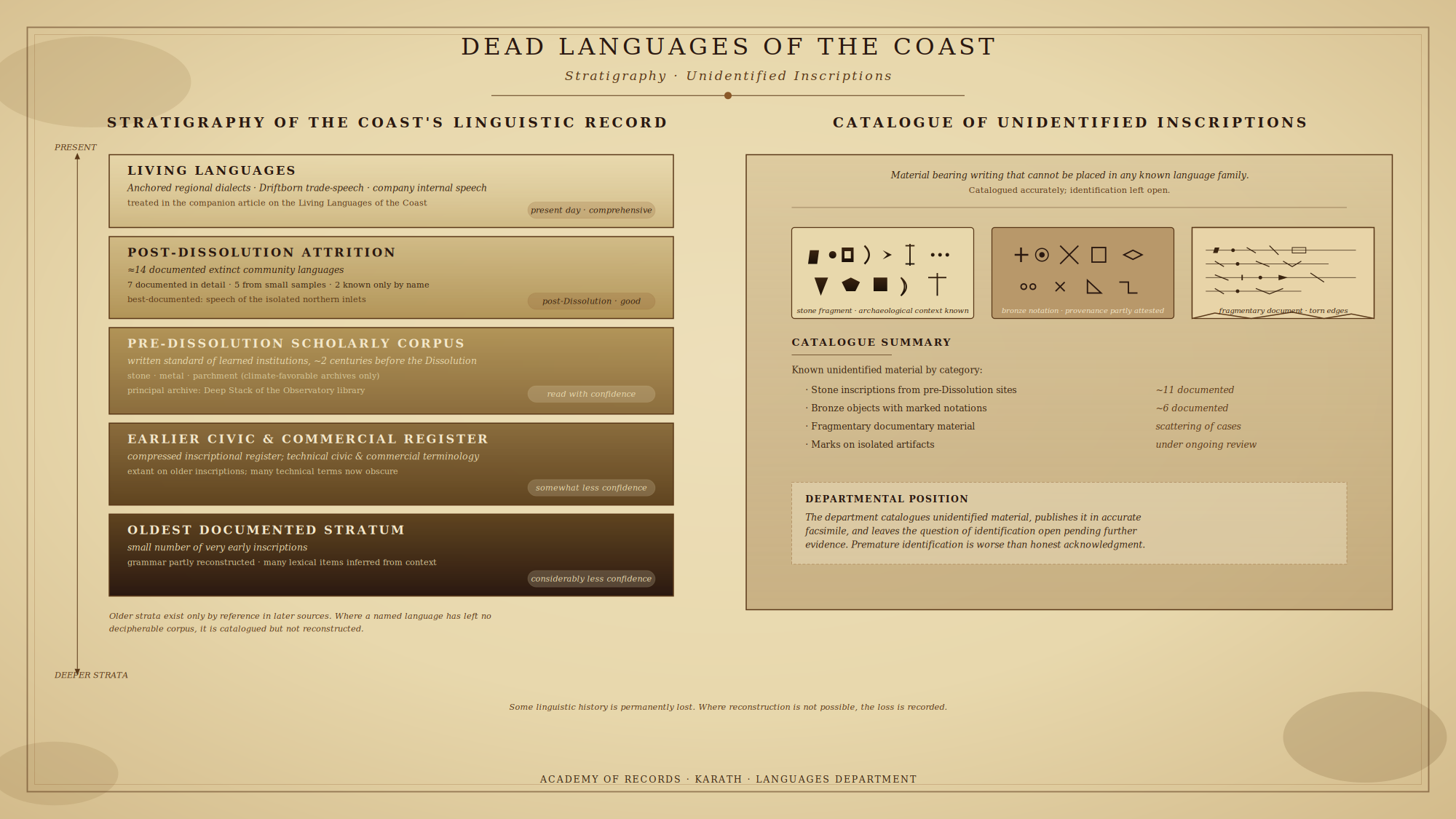
Pre-Dissolution dead languages form the older stratum. Several distinct languages are known to have been spoken on the Coast in the centuries before the Dissolution, some of which appear in the Academy's oldest inscriptional and documentary record, and some of which are known only by reference in still-older sources. The most substantial of these is the pre-Dissolution scholarly language, which served as the written standard of the Coast's learned institutions in the two centuries before the Dissolution. It is not spoken anywhere today, but its corpus is extensive, and it is read with confidence by Academy scholars trained for the purpose.
Post-Dissolution dead languages form the more recent stratum. These are languages that were spoken as first languages within the documentary period after the Dissolution but are no longer spoken today. Most such cases involve small regional or community languages that gave way, over the course of a generation or two, to the expanding Anchored dialect network. A smaller number involve Driftborn company traditions that died with the dissolution of the companies that carried them. Academy records cover each documented case in varying completeness.
——— ◇ ———
The Pre-Dissolution Corpus
The surviving written material from before the Dissolution is unevenly distributed. Stone inscriptions are the best-preserved category and the most broadly accessible; metal inscriptions, particularly on bronze objects, are the second. Parchment and palm-leaf documents from before the Dissolution have survived in small numbers, almost exclusively in climate-favorable archives. The Academy's principal pre-Dissolution archive is the Deep Stack of the Observatory library, which holds material ranging from the mid-pre-Dissolution centuries through the first decade after the Dissolution itself.
Three broad language strata are distinguishable in this material. The late pre-Dissolution scholarly language, already mentioned, is the most abundantly represented. It is a conservative, formal written register that differs from its spoken contemporaries in much the way a formal scholarly register differs from ordinary speech today, and the Academy's reading of it is, for most purposes, straightforward. The earlier civic and commercial register, which appears on older inscriptions, is more compressed, uses a number of now-obscure technical terms for civic offices and commercial arrangements, and is read with somewhat less confidence. An oldest documented stratum, represented by a small number of very early inscriptions, is read with considerably less confidence; the grammar is partly reconstructed, many lexical items are inferred from context rather than known, and scholarly editions of this material carry explicit annotations of their own uncertainty.
Beyond the documented material, occasional references in the scholarly corpus indicate the existence of additional pre-Dissolution languages that the Academy has not been able to recover. Some of these are named in the sources; others are described only as "the older speech" or "the speech of the earlier shore." Whether these references denote distinct languages, dialects of the known strata, or literary conventions of the writers who used them is, in most cases, unsettled.
——— ◇ ———
Methods of Reconstruction
Academy work on dead languages proceeds by a combination of established methods. The principal methods are four.
Comparative analysis uses the living descendants of a language family, where descendants exist, to reconstruct features of the ancestor language. This method is most useful for the very oldest strata of Anchored speech, whose descendants are the three main regional dialects of the living Anchored family, and for the reconstructed proto-Driftborn language, which is inferred from the internal speech of current Driftborn companies.
Internal analysis uses the attested forms of a dead language to reconstruct its grammar, its sound system, and its lexical inventory from evidence contained within the surviving corpus itself. This method is most useful for languages, like the pre-Dissolution scholarly language, that are attested in sufficient volume to support it.
Contextual and contact-based analysis uses the appearance of a dead language's words or constructions in other languages — as loan-words, as calques, as quoted material — to recover lexical and grammatical information not available from the original corpus. This method is particularly useful for the less-abundantly attested languages.
Archaeological and documentary correlation uses non-linguistic evidence — the archaeological context of an inscription, the dated provenance of a document, the attested historical circumstances of a particular settlement — to supplement linguistic reconstruction where linguistic evidence alone is insufficient. The Academy's historical department contributes substantially to this work.
All of these methods carry their own characteristic sources of error, and the Academy's published reconstructions are ordinarily accompanied by assessments of confidence that distinguish secure from conjectural claims.
——— ◇ ———
Post-Dissolution Extinctions
The period since the Dissolution has seen the attrition of a number of regional and community languages. Most were small and local to begin with, and most passed out of use in the course of the gradual expansion of the Anchored dialect network across the Coast's settled regions. Academy records cover approximately fourteen such languages, of which seven are documented in some linguistic detail, five are known only from small samples, and two are known only by name.
The best-documented extinct language of this period is the speech of the isolated northern inlets, a cluster of closely related community languages of the cold-water settlements that were absorbed into the Anchored dialect network during the fifth through seventh centuries after the Dissolution. The Academy's record of these languages is substantial, owing to a single scholar's sustained ethnographic effort in the last generation before their extinction; the published grammar and lexicon remain standard references for this material.
Other extinct post-Dissolution languages are documented with varying completeness. Several Driftborn company traditions that dissolved during the same period are known to have carried internal speech forms that are no longer attested in any living company. What survives of these forms is what voice-keepers of neighboring companies preserved in their own traditions, and what later Academy scholars transcribed from those traditions at secondhand.
A smaller number of cases involve languages that appear in the record briefly and then do not appear again. In these cases the Academy's record is inevitably thin, and the article on each such language is ordinarily limited to the surviving samples, the circumstances of their recording, and the scholarly speculation that can responsibly be offered.
——— ◇ ———
Inscriptional Languages Not Yet Identified
A separate category concerns inscriptional material — script, writing, or marked notation — that appears on surviving artifacts but that the Languages department has not yet been able to place within any known language family. These cases are rare but persistent. A handful of stone inscriptions from specific pre-Dissolution sites, a smaller number of bronze objects with marked notations, and a scattering of fragmentary documents from a variety of archaeological contexts bear writing that is unambiguously writing. The marks are systematic, recurrent, and evidently significant — but they cannot currently be read.
The department's standard practice in such cases is to catalogue the material, record its physical context in detail, publish the inscriptions in accurate facsimile with whatever analytical observations can be offered, and leave open the question of identification pending further evidence. Some such material has been under study for several centuries without resolution. The department's position is that premature identification is worse than honest acknowledgment of the limits of current knowledge, and that future scholarship, with the benefit of evidence not yet available, is better served by a record that does not assert what it cannot support.
On occasion, inscriptional material that was long unidentified has been placed — through the discovery of bilingual inscriptions, through archaeological correlation with datable contexts, or through the accumulation of comparative evidence from adjacent languages. Such cases the Academy considers encouraging but does not extrapolate from. Each unidentified inscription is, in the department's working view, its own problem.
——— ◇ ———
What Is Permanently Lost
Some portion of the Coast's linguistic history cannot be recovered. Languages spoken in oral traditions that left no written record, and that had no living speakers at the time of any Academy documentation, are permanently lost in the sense that their specific forms cannot be reconstructed. What remains of them is, at most, the trace they may have left in the languages that succeeded them — loan-words, structural features, place-names — and this trace is often insufficient to support anything more specific than the observation that a language once existed.
The Academy's position on this permanent loss is the standard position of responsible scholarship. Loss is acknowledged, its extent is estimated where estimation is possible, and the record of what has been lost is itself a form of scholarly honesty. The Languages department maintains a standing catalogue of attested language-loss events, with the best available reconstruction of each case's scope; the catalogue itself is partial, and the department's published commentary on it is explicit about the partiality.
——— ◇ ———
This article is classified as a standard public reference of the Academy of Records, Karath. It should be read alongside the companion article on the living languages of the Coast, the foundational article on the Dissolution as historical event, and the specialized references on pre-Dissolution scholarly writing and on post-Dissolution regional linguistic history.