An Academy of Records public reference article. On the customary and ceremonial practices of the Driftborn — their life-cycle rites, their lunar and navigational observances, and the oral forms by which binding agreements are made.
——— ◇ ———
Driftborn custom is as various as the companies that practice it. No two companies observe exactly the same set of ceremonies, use exactly the same forms, or assign exactly the same weight to each element of custom they maintain. What is true of one company is frequently not quite true of another, and the Academy's record of Driftborn ceremonial life should be read throughout with this caveat in mind.
Nevertheless, certain structural features recur widely enough across companies to be described in general terms. This article describes those features, drawing on what Driftborn voice-keepers and voices have chosen to share with Academy observers over the centuries. The companion articles on the Driftborn and on Driftborn mobile settlements should be read first; this article assumes familiarity with the company, the roles of voice and voice-keeper, and the Kira Moot. Readers wishing detailed treatment of a specific company's customs are directed to the voice-keeper of that company, where access can be arranged.
——— ◇ ———
Custom as Oral Tradition
Driftborn custom is carried in voice. Where the Anchored codify practice in statute, case, and record, the Driftborn codify it in what is remembered, recited, and transmitted from one generation of voice-keepers to the next. This is not an informal arrangement. Voice-keeping is the company's most demanding and most honored work, and a voice-keeper is expected to hold, in ordered memory, the full body of the company's customary practice — the forms, the occasions, the permitted variations, and the reasons.
One consequence is that custom and story are, for the Driftborn, a single body of knowledge. A ceremony cannot be cleanly separated from the account of its origin, the pattern of its transmission, or the generations of voice-keepers who have carried it. To ask a voice-keeper for the form of a ceremony, without asking for its story, is considered by most Driftborn traditions an incomplete request. Academy scholars learn early, when working with voice-keepers, to make room for the story.
Another consequence is that practice is revisable but not casual. A voice-keeper may, over the course of a long tenure, receive or issue small adjustments to a ceremony's form. These adjustments are themselves remembered — who made them, under what circumstances, with what authority — and become part of the transmitted tradition. What looks, to an outsider, like an unchanging oral form is in most cases a continuously maintained one.
——— ◇ ———
Life-Cycle Rites
Birth at sea is marked by a ceremony most companies call, in various dialect forms, the giving of a first name. An infant born aboard is brought, within a tide or two of birth, to the voice-keeper's vessel and given a personal name that will be the infant's through childhood. The ceremony is ordinarily brief and is attended by the family, the voice-keeper, and such other company members as custom in that company includes. Specific form varies widely from company to company.
Coming-of-age, in most Driftborn traditions, is not fixed at a single age but marks the acceptance of specific competences. A young Driftborn is recognized as an adult of the company at the point at which the voice-keeper judges the young person to have acquired the relevant adult portion of the company's tradition. The age of recognition is usually between fifteen and eighteen, but ranges in documented cases from twelve to the middle twenties. The ceremony of recognition is public within the company, witnessed, and marks the young person's transition from a child of the company to a member of it.
Marriage among the Driftborn is ordinarily performed at the Kira Moot, though smaller ceremonies at convocations or at anchorages also occur. A marriage between members of different companies involves a choice — which company the couple will join — that is usually settled before the ceremony is performed. The marriage ceremony itself varies by company; a form common across many traditions involves the exchange of objects that have traveled with each partner, as testimony to their separate pasts now being joined. Marriage with an Anchored partner is uncommon but documented, and follows whichever ceremonial form the joining party's tradition specifies.
Death at sea, on a Driftborn vessel, is marked by forms that reflect the impossibility of conventional burial. Most companies consign the body to the sea after a ceremonial period — ordinarily a single tide — during which the company gathers. The voice-keeper speaks such of the deceased's story as the tradition preserves, and final words are offered by those who knew the deceased closely. The place of the consignment is noted in the company's tradition and is remembered. Some companies return to such places on subsequent passages; others do not. Death at an anchorage or at an Anchored port permits other forms, including burial ashore where Anchored custom allows, though consignment to the sea remains preferred in most traditions.
——— ◇ ———
Lunar and Navigational Observances
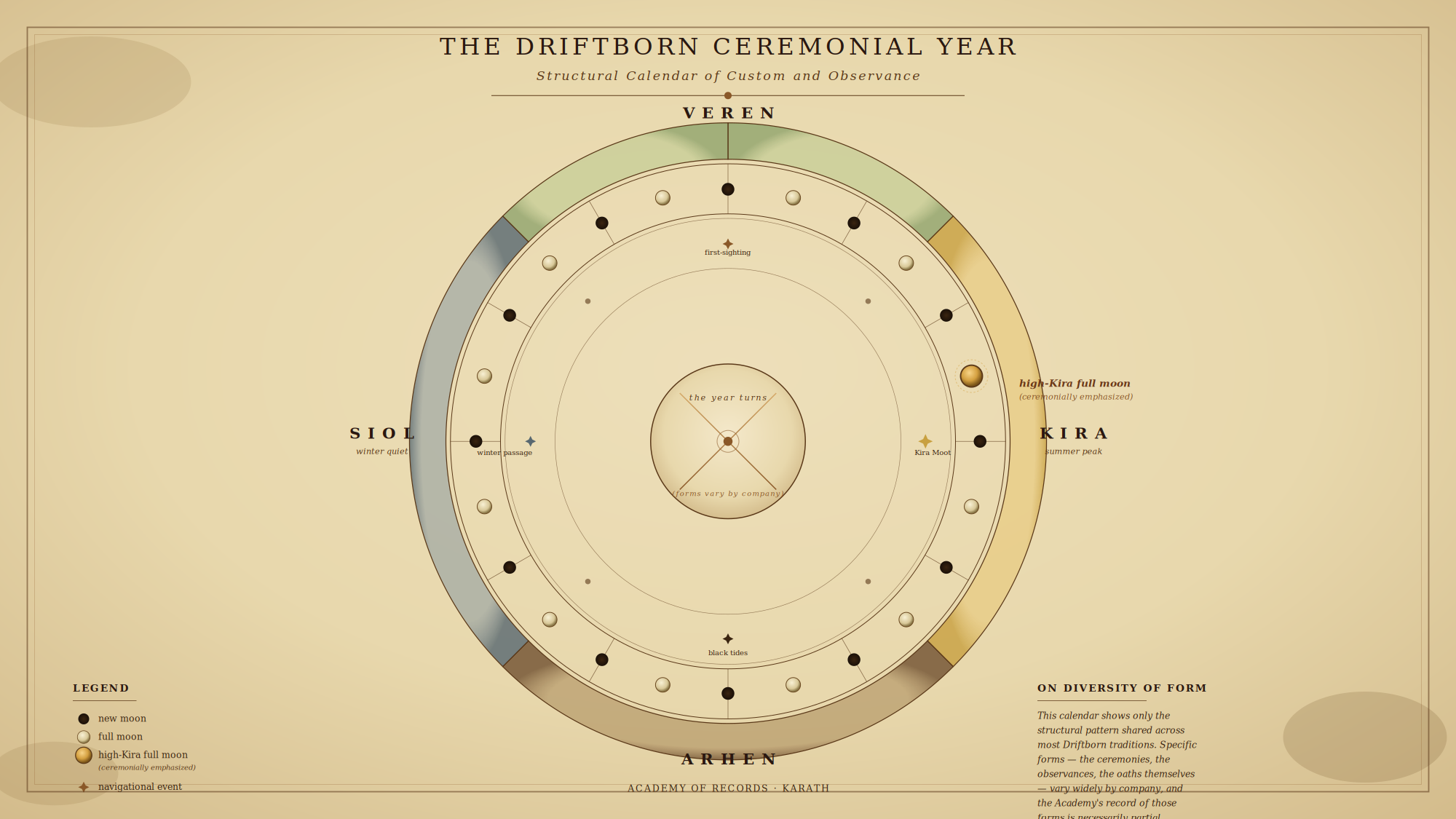
Driftborn ceremony is oriented primarily to the moon and to the sea, rather than to the seasonal quarters that structure Anchored religious practice. Most companies observe ceremonial forms at the new moon and at the full moon. Certain full moons — especially those of high Kira, when the weather is most reliable and the Moot either approaching or just past — carry particular weight across most traditions. Teska herself, as the Anchored name the moon, is a continuous ceremonial presence in Driftborn life rather than an object of worship; companies align significant life-cycle events, voice-keeper transmissions, and major decisions with her full phases, choosing within the annual cycle according to the specific tradition of the company.
Specific navigational events are also ceremonially marked. First sightings of particular constellations at the turn of the season — the returning of a star long absent, or the passing of a star into its rest — are noted by many companies with brief observances. Passages through specific waters — the first crossing of a year's Inner Sea, the entry into a long-known company anchorage, the return from winter shelter — are similarly marked. These observances are ordinarily brief and are folded into the work of the day rather than conducted as separate occasions.
Tidal cycles, too, carry ceremonial weight. The turn of the neap and the spring, the great tides of each season, and the black tides of Arhen all figure in various company traditions. The black tides in particular are observed with care by most companies; their arrival coincides with the withdrawal into sheltered waters, and the observances associated with them are often among the quietest and most reflective of the year.
——— ◇ ———
Company-Specific Rites
Certain ceremonies mark transitions within the company itself. The accession of a new hand — selected by the company's ongoing consent — is typically marked by a form of public acknowledgment at the next gathering of the company, whether at anchorage, at convocation, or at the Moot. The form varies. What remains constant is that the ceremony is public to the company, and that the new hand takes up the role with the company's witnessed assent.
Succession of a voice-keeper is among the most weighted occasions in Driftborn life. A voice-keeper ordinarily trains a successor across many years, and the formal transmission of the company's tradition from senior voice-keeper to junior is an extended process, often taking the span of a Moot or longer, during which the tradition is recited and received in full. Most companies consider this transmission the single most important ceremonial work they perform. Academy observers are almost never present; the Academy's account of voice-keeper succession is assembled from the reports of voices and voice-keepers willing, afterward, to describe the outline of what occurred.
Incorporation of new members into a company — by marriage, by transfer from another company, or in the rare case of a person picked up at sea — is also ceremonially marked. The forms vary, but a common structural feature is that the new member hears, from the voice-keeper or the voice, some portion of the company's tradition appropriate to the occasion. This is both a welcome and an instruction: the new member is being given the beginning of what will eventually become their own share in the company's knowledge.
——— ◇ ———
Oaths and Binding
The Driftborn do not commit agreements to writing as the Anchored do. When a promise must be made binding, the form is an oath spoken in the presence of witnesses. The oath may be spoken in the presence of the voice-keeper, and sometimes with specific ceremonial elements — the touching of a particular object, the utterance of specific phrases, the involvement of the moon or the tide. The specific forms vary. What they share is publicity and memory: an oath is witnessed, and the witnesses are expected to remember it.
An oath between companies is ordinarily witnessed by the voices of both and, where possible, by a third-company voice as well. Such oaths are taken seriously; a Driftborn who is known to have broken an oath carries the reputation, and the reputation travels. This is one of the informal mechanisms by which the Driftborn maintain stability across a population that has no written law and no central governance.
An oath between a Driftborn party and an Anchored party is a somewhat different matter. Most Anchored jurisdictions treat the Driftborn oath as a form of binding declaration admissible as evidence in court, though not equivalent to a signed contract. Most Driftborn companies treat the Anchored signed contract as binding in return, within the limits that practical circumstances permit. The cooperative arrangement between the two legal traditions is pragmatic rather than principled, and has worked, for the most part, well enough.
——— ◇ ———
Hospitality
Custom governs the reception of visitors to a company, whether the visitor is from another company, from an Anchored port, or — rarely — from elsewhere. The general form is that a visitor is met by a member of the company designated for the purpose, given a meal and a place to rest aboard a suitable vessel, and introduced to the voice if the visit is of any consequence. Prolonged visits permit participation in the company's daily work at the discretion of the hand. Departure is formal: the visitor's leave is taken, gifts are sometimes exchanged, and an account of the visit enters the company's record as maintained by the voice-keeper.
Hospitality from Anchored hosts at winter-shelter ports follows similar principles from the other side. Most long-standing arrangements between specific companies and specific ports have developed customary forms over generations: which quay is reserved for a particular company, what hospitality is extended on arrival, what ceremonies of parting are observed when the company resumes its annual circuit. Such customs are often as elaborate and specific as any maintained within the companies themselves.
——— ◇ ———
What Unites, What Divides
Driftborn customs and ceremonies vary widely in form. Two companies may perform a birth ceremony, a marriage, a voice-keeper succession in ways that, to an outside observer, appear almost unrelated. What unites them, across the variation, is a set of structural commitments: that custom is carried in voice, that practice is witnessed by the company, that promises made are remembered by those who heard them, and that the story of a form cannot be separated from the form itself. Within these commitments, the diversity of Driftborn ceremonial life is considerable — and, to most Driftborn, desirable. A company's tradition is its own, and its particular forms are among the things that make it recognizably itself.
The Academy has documented what companies have chosen to share, and the record is necessarily partial. A full treatment of Driftborn customs and ceremonies would be the work of the voice-keepers themselves, and no such treatment has been compiled in a form the Academy can cite. This article, like the other Academy references on the Driftborn, should be taken as an outside-observer's summary of a practice that remains, in most of its fullness, known only from within.
——— ◇ ———
This article is classified as a standard public reference of the Academy of Records, Karath. It should be read alongside the foundational article on the Driftborn and the related articles on Driftborn mobile settlements, on the Kira Moot, on seasonal rhythms, and on the Driftborn oral tradition.