An Academy of Records public reference article. On the settlement forms of the Driftborn — their fleets, their anchorages, and the great gatherings that assemble a temporary people from a scattered one.
——— ◇ ———
A settlement, as the Anchored use the word, is a place with people in it. The word presumes fixity — that the place is what stays while the people come and go. The Driftborn conception is reversed. Among the Driftborn, the people are what stays; the place, in Anchored terms, does not. A Driftborn settlement is a set of relationships that happens to be, at any given moment, somewhere.
This article describes the settlement forms that follow from that reversal. It treats the fleet as a community in motion, the anchorage as a temporary foothold, and the great assemblies — most notably the Kira Moot — as the coast-wide occasions on which the Driftborn become, briefly, a visible people. The companion article on the Driftborn themselves should be read first; this article assumes familiarity with the company, the role of the voice and the hand, and the basic facts of Driftborn social organization.
——— ◇ ———
The Fleet as a Settlement
A Driftborn company underway is best understood not as a set of vessels in motion but as a neighborhood that has chosen to keep its relative positions while traveling. The ships of a company sail together, work together, and maintain, through long practice, a spatial order that Anchored observers have described as a kind of floating street plan.
The lead vessel of a company is typically the hand's ship, though the arrangement varies. From its position — generally at the forward or windward edge of the fleet — the hand can signal the others by flag, by lantern at night, or by messenger in close formation. Behind or to leeward are the company's larger work vessels, carrying the principal fishing gear, trade goods in transit, or the bulk of stores. Smaller vessels, including those used for inshore work or for communication with shore, typically take the flanks or the rear.
Within this rough order, individual vessels have known roles. One ship may be the voice-keeper's vessel, where ceremonial instruction and the transmission of tradition are conducted. Another may be the principal cooking vessel, where combined meals are prepared on days of anchored rest. Another may be the primary nursery vessel, where children below a certain age are supervised by assigned adults. These specializations are not rigid, and smaller companies do not maintain all of them — but most larger companies do, and the distribution of functions across vessels is as much a mark of company tradition as the routes the fleet sails.
What binds the fleet is not proximity at every moment but the shared schedule of rejoining. Vessels underway are often separated by hundreds of paces or more, and communication between them during travel is limited. At anchor, or during the regular company halts, the vessels close up, lash together where practical, and resume the connected social life that travel interrupts.
——— ◇ ———
Daily Life Aboard
Life aboard a working Driftborn vessel is determined more by the work than by cultural preference. The day is divided into watches — typically four of six hours each, though specific arrangements vary — and crew rotate through sleep, work, and preparation accordingly. Most adults on a vessel are competent in most of its work; specialization exists but is less pronounced than aboard Anchored ships, where distinct ranks and trades are more rigidly observed.
Meals at sea are functional. The principal meal is usually taken by the off-watch at or near mid-afternoon, when the day's work permits a longer pause. Smaller meals occur around the watch changes. On days when a whole company is at rest together — usually at an anchorage or on a ceremonial day — a larger combined meal is prepared on the cooking vessel, and portions are carried to each ship by small boat. These combined meals are among the most socially significant events in Driftborn life, and are the occasions on which a company most resembles, in its own estimation, a village.
Children are raised in rotation. Teaching — of language, of sea-craft, of tradition, and of the company's specific work — begins young and continues through adolescence. By the age of twelve or fourteen, most Driftborn children can steer, read weather, handle lines, and recite a portion of their company's traditional material.
Sleeping arrangements are close and shared. Most Driftborn sleep in hammocks or low berths in common quarters; private sleeping space is rare, and on smaller vessels does not exist. This is not a deprivation in the Driftborn estimation. Privacy of thought is valued; privacy of body, less so.
——— ◇ ———
Anchorages
A company at anchor is in a different condition from a company underway. The vessels are close, often lashed, and the community resumes its full social form. The anchorage itself may be a sheltered bay, the lee of an island, a Driftborn-favored stretch of coast, or a dedicated reception berth at an Anchored port with which the company has a standing relationship.
Most companies make use of several known anchorages across their annual circuit. A typical company will return to the same winter shelter year after year, will work a known sequence of fishing anchorages through Kira, and will know a handful of smaller shelters to be used in storm, in celebration, or in ceremonial need. Companies with long tradition maintain named relationships with specific anchorages — a stretch of coast might be "the company's" in the sense that no other company would use it without permission during the weeks traditionally allotted. These understandings are maintained by custom, confirmed periodically at convocations or the Moot, and observed without written record.
To an Anchored observer, a Driftborn anchorage is striking for its lightness of footprint. A company may occupy an anchorage for weeks without leaving permanent structures behind. Cooking is done aboard; waste is carried out or carefully controlled; no dwellings are erected ashore. This tradition is not merely practical — it is a deliberate practice of leaving the place able to be what it was, so that it can be returned to without diminishment.
——— ◇ ———
The Kira Moot
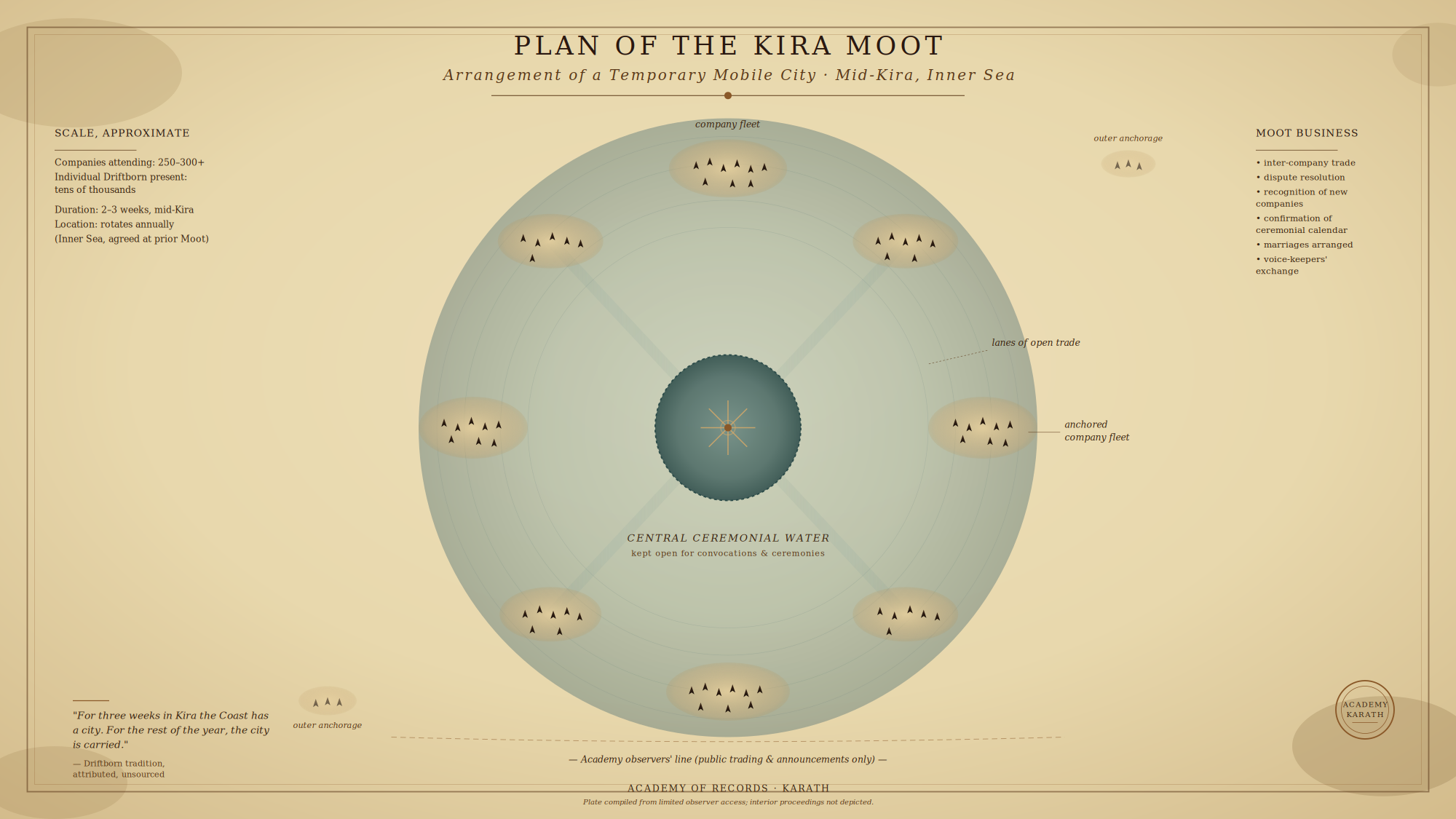
The Kira Moot is the largest and most formal Driftborn assembly, held for two to three weeks in mid-Kira at a rotating Inner Sea location agreed upon at the previous year's Moot. It is attended, in most years, by a significant majority of the Coast's registered companies — typically two hundred and fifty or more — and by several tens of thousands of individual Driftborn. For the duration of the assembly, the chosen anchorage becomes, in effect, the largest mobile settlement on the Shifting Coast: a temporary city, constituted of lashed and anchored fleets, larger in population than many permanent Anchored towns.
The Moot's physical arrangement follows patterns of long practice. Companies anchor in the order they arrive, within a roughly circular formation around a central ceremonial water that no vessel occupies. The central water is the venue for formal convocations, announcements, and the great ceremonies of the Moot. Ringing the anchored companies, temporary open-water markets form along lanes of small craft carrying trade goods between ships. Children of participating companies are permitted to cross between vessels under loose supervision, and during the Moot it is not unusual for a child to befriend another child whose company they will not see again for years.
Business conducted at the Moot is both practical and civic. Trade between companies is substantial: specialized goods, navigational knowledge, fish stocks, news of distant waters. Disputes are aired and, where possible, resolved; recognition is extended to newly constituted companies, and withdrawn from companies judged to have dissolved. The ceremonial calendar for the year ahead is confirmed. Marriages are arranged or solemnized. Voice-keepers of different traditions meet, compare, and exchange — the one occasion in the year at which the full oral tradition of the Driftborn is, however briefly, in proximity with itself.
Academy observers are admitted to the Moot on a limited basis. Record of the trading and public announcements is permitted; record of the ceremonial and internal proceedings is not. What the Academy knows of the Moot's interior life is what the Driftborn have chosen to share, and this article accordingly reflects that limitation.
——— ◇ ———
Dissolution, Merger, Succession
A Driftborn company is not a permanent institution. Companies come into being, endure for spans ranging from decades to centuries, and pass out of recognized existence through three broad patterns.
Dissolution occurs when a company loses its tradition — through catastrophe, through failure to transmit voice-keeping, through a loss of members beyond the threshold of continuity. A company in dissolution is recognized as such by the Moot; its vessels may continue to sail, but it is no longer considered a company in the tradition-bearing sense. Merger occurs when a weakened company joins a stronger one, bringing its vessels and remaining members into the larger company's fold; the joining company's tradition may be absorbed, adapted, or set aside, as negotiated at merger and confirmed at the next Moot. Succession is the ordinary process by which a company maintains itself across generations, and is the condition most companies occupy for most of their history.
——— ◇ ———
The Settlement That Is Also the People
An Anchored visitor at a Driftborn anchorage, seeing the lashed fleet and the shared work of a community at rest, will often say afterward that the place seemed, for the days of the visit, like a village. The Driftborn do not dispute this; the word is a reasonable approximation. What they do observe, sometimes to Anchored listeners and more often to each other, is that the village the visitor saw is not the place. The village is the company. When the fleet weighs anchor and the vessels separate into their traveling order, the village has not been dissolved. It has only resumed its ordinary condition, which is to be carried.
The Anchored build dwellings to persist; the Driftborn build relationships to persist, and treat dwellings as temporary and necessary expedients. Both peoples are concerned with continuity. They disagree about what the proper vehicle of continuity is.
——— ◇ ———
This article is classified as a standard public reference of the Academy of Records, Karath. It should be read alongside the foundational article on the Driftborn and the related articles on the Anchored, on Coastal Settlements, and on the Inner Sea.