An Academy of Records public reference article. On the staple foods of the Shifting Coast — what the Coast eats, where it comes from, how it is preserved, and how the food supply shapes the patterns of life.
——— ◇ ———
A narrow and stable inventory feeds the Coast. Four or five principal staples, joined by a manageable range of seasonal and regional additions, support both the settled populations of the Anchored ports and the mobile companies of the Driftborn. This inventory has changed little across the documented centuries, and the commercial and cultural arrangements built around it are among the most durable institutions of Coastal life. This article treats those staples in overview, describes the specialized contributions of each region, explains the preservation practices that are central to the whole system, and closes with a brief treatment of the conditions under which the system has, on occasion, failed.
——— ◇ ———
The Coastal Larder
Fish is the dominant protein of the Coast. It is eaten fresh where it can be, salted, dried, or smoked where it must be, and carried as a preserved commodity between ports in quantities that the Harbor Master's office of Karath alone tracks to the nearest shipment. A typical adult on the Coast eats fish — in some form — at most meals. Different regions favor different catches: the Inner Sea supports species that winter in its sheltered waters, the outer waters yield larger pelagic fish, the shelf fisheries of the atolls produce their own characteristic inventory. Moving through the market and the caravan networks, the collective result is a fish-based food system more stable than most inland grain systems of comparable scale.
Grain is the staple carbohydrate. It is grown principally in the southern atoll chains, on the agricultural stretches of the mainland Anchored coast, and — in smaller quantities — in the pocket valleys of the Iron Coast. Karath imports the bulk of its grain by sea; most other settlements either grow enough for their own use or import the balance. The principal grains are a hardy winter wheat, two varieties of barley adapted to different soil conditions, and a minor millet used primarily in the outer atolls. Bread is baked daily in most settlements; grain in the form of porridge, stews, and flatbread accompanies most meals.
Olive oil is the cooking oil of the wealthy and the middling-prosperous; fish oil serves the working populations and the harbor districts; rendered fat, typically from sheep or goats, serves in the poorer rural communities. This trichotomy is broadly stable across the Coast, with the specific proportions varying by settlement.
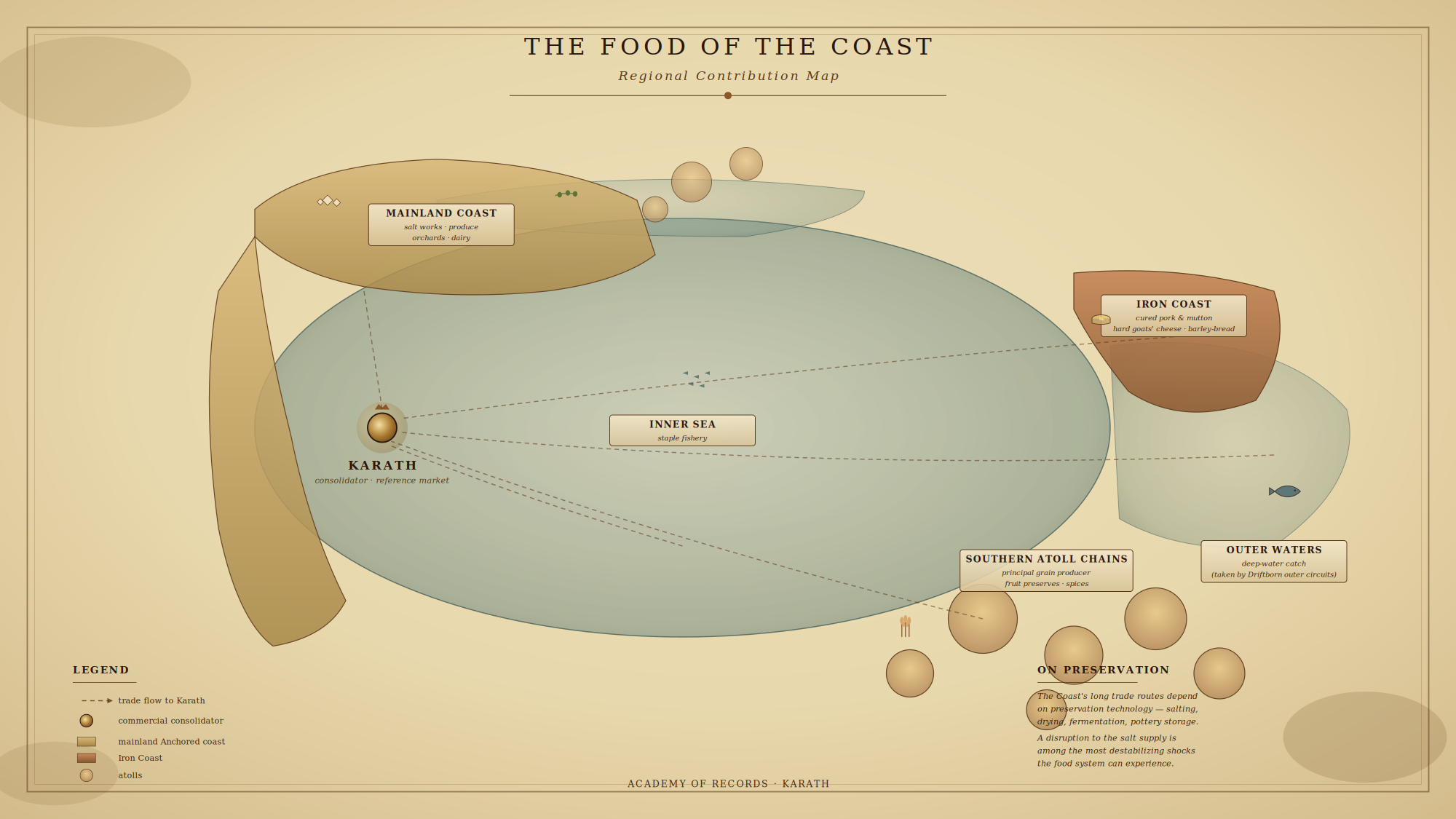
Salt is produced principally at the salt works of the mainland Anchored coast, where shallow evaporation beds yield the year's principal harvest in late Arhen. Its importance is disproportionate to its cost: the preservation of fish, meat, and vegetables across the year, and the long-distance trade that depends on that preservation, are only possible because salt is cheap enough to be used generously. A disruption to the salt supply — historically uncommon, but documented on several occasions — is among the most destabilizing shocks the Coastal food system can experience.
Seasonal vegetables and fruit fill out the diet. The mainland Anchored settlements maintain kitchen gardens and small orchards; the atolls grow specialized warm-climate produce; Karath imports what its tiered urban geography does not allow it to grow. Preserved fruit — dried, candied, or pickled — is a significant trade item in its own right. Cheese, produced mainly in the inland hill country and in the Iron Coast's pastoral zones, is a protein staple for populations at a distance from the sea. Eggs are universal where poultry can be kept, which is most settled places and many larger Driftborn vessels.
——— ◇ ———
Regional Specializations
Although the Coast's staples are broadly uniform, each region contributes something distinctive to the wider food economy.
The southern atoll chains are the Coast's principal grain producer. Their warm-season agricultural cycles are shifted a full season earlier than those of the mainland, allowing atoll grain to reach Karath's market at a time when mainland stocks are at their seasonal low. Several atoll communities specialize further in particular grain varieties, in fruit preserves, and in spices and flavorings not grown elsewhere on the Coast.
The mainland Anchored coast produces the bulk of the Coast's salt, the most consistent vegetable and orchard output, and a substantial share of cheese and dairy. Mainland settlements are also the principal source of the hard cured sausages that appear in Karath's upper-tier markets and in the inventories of long-voyage vessels.
The Iron Coast, despite its name and its principal reputation as a copper-working region, maintains a small but highly regarded specialty food economy. Iron Coast pastoral communities produce hard goats' cheese, preserved pork and mutton of notable quality, a specific variety of small barley-bread that keeps unusually well, and several fruit preserves that travel particularly well at sea.
The outer waters contribute the largest fish, the finest salted preserves, and the occasional specialty catch — including several species that appear only in the deep waters and that reach the mainland markets only in small quantities. Most of this catch is taken by Driftborn companies on the outer circuits and brought to Anchored ports for sale.
Karath itself is not primarily a food producer. Its contribution to the food economy is that of consolidator and distributor. The Tri-Port handles the movement of food among the Coast's producing regions, and the Karath markets serve as the reference point for pricing across the network.
——— ◇ ———
Preservation
Food preservation is the central technology of Coastal cuisine. A maritime civilization with long trade routes and a substantial population distant from fresh supply cannot feed itself without reliable methods for keeping food from spoiling, and the Coast has developed a range of such methods over the centuries of its documented practice.
Salting is the most important. Fish, meat, and some vegetables are packed in salt — either dry-packed in jars or immersed in brine — and kept for periods ranging from weeks to years depending on the preparation. The salted fish of the Inner Sea is a staple export; the salted pork of the Iron Coast is a specialty; the brined vegetables of the mainland gardens fill out household larders across the settled regions.
Drying supplements salting and is used where salt is not available or where the character of the food is better preserved by drying alone. Dried fish, dried fruit, and dried grain products are staples; smoked fish, which combines drying with light curing over wood smoke, is a regional specialty of the northern Anchored coast.
Fermentation is used principally for fish sauces, for specific vegetable preparations, and — in a separate tradition — for cheese and beer. Fermented fish sauce, produced chiefly at a small number of mainland establishments, is a cooking ingredient of considerable importance in Anchored cuisine and appears in most household kitchens.
Pottery storage underlies nearly all of the above. The Coast's universal use of fired clay for storage, cooking, and transport is partly a reflection of material abundance — clay is everywhere, stone ovens are efficient — and partly a practical response to the preservation problem. A sealed clay jar, properly prepared, keeps its contents reliably for months in the Coast's climate; the same jar, once emptied, is ordinarily reused for years.
——— ◇ ———
The Anchored Table and the Driftborn Table
Anchored food practice varies across the Coast's many settlements, but the broad pattern is consistent. Most Anchored households take three meals a day, structured around the civic or working day. The principal meal, ordinarily at midday, is the social meal, eaten with family or crew and often extending over an hour or more. The composition of the meal follows the regional staples: fish in some form, bread, a preserved or seasonal vegetable, cheese or eggs where available, oil or fat for dressing. Karath's specific version of this pattern is treated in the article on daily life in that city.
Driftborn food practice differs in its rhythms rather than in its ingredients. Most of the same staples appear on board, adapted to the conditions of ship life: salted and dried fish in quantity, grain in the form of flatbread or porridge, preserved vegetables, cooking oil stored in sealed jars, salt in quantity. What differs is the structure of preparation. Larger Driftborn vessels maintain a dedicated cooking vessel within the fleet, and significant combined meals — the days when a whole company eats together at anchorage — are among the most socially important events in Driftborn life. Between such gatherings, food preparation on working vessels is functional, simple, and geared to the watch schedule. The article on Driftborn mobile settlements treats the social dimensions of Driftborn meal practice more fully.
——— ◇ ———
Drinks
Water from fresh-water cisterns, springs, and, on some islands, collected rainfall is the ordinary beverage of the Coast. Wells are common in most settled regions; in Karath, the upper-tier cisterns are the principal municipal water supply.
Beer is brewed throughout the Anchored settlements, with local varieties characteristic of particular towns. Most beer is consumed close to where it is made; a smaller number of established breweries produce for the broader Coast market. Wine is grown principally on the warmest of the southern atolls and on the sheltered mainland slopes; most wine on the Coast is imported from these regions and reaches ordinary tables only on formal occasions. Spirits are uncommon on the Coast, confined to a handful of specialty producers and generally considered a minor category.
Tea, brewed from various leaf types cultivated principally in the atoll highlands, is a near-universal afternoon drink. Most Coastal households keep tea; its preparation and service have a range of regional customs that the Academy's ethnographic records treat in some detail. A hot infusion of salt-grass, a coastal plant widely available, is a working-class drink of the harbor districts and the outer settlements.
——— ◇ ———
Scarcity and Food Security
The Coastal food system is stable but not invulnerable. Several patterns of disruption recur in the Academy's historical record.
Shipping disruptions, whether from extended storms in the Inner Sea or from failures in specific long-distance trade routes, affect Karath and the consumer settlements most directly. Grain prices are the most visible index of such disruption, and a season of bad shipping weather can push Karath grain prices sharply upward within weeks. The city's grain reserves, maintained since before the Dissolution, exist precisely to cushion such shocks.
Fishing failures of localized but significant kinds are recorded at irregular intervals across the Coast. Most are recoveries within a season or two; a small number have required extended adjustment of regional diets. The Academy's fisheries records extend back several centuries and permit some forecasting of such events, though forecasting is not the same as prevention.
Salt supply interruptions are rare but consequential when they occur. The Arhen evaporation harvest is reliable but weather-dependent, and an especially wet autumn has, on a handful of occasions, reduced the annual yield sharply enough to affect preserved-food production across the whole Coast. The Academy considers the salt supply a strategic matter and treats it in the civic policy literature accordingly.
Long-term famines of the kind recorded in older pre-Dissolution accounts have not occurred within the documented post-Dissolution period. The Coast's distributed food system, with its multiple staple sources and its preservation-heavy infrastructure, has absorbed the shocks of the last several centuries without producing that kind of failure.
——— ◇ ———
This article is classified as a standard public reference of the Academy of Records, Karath. It should be read alongside the articles on daily life in Karath, on the Anchored and the Driftborn, on the seasonal rhythms of the Coast, and on the specialized references for trade and commerce and for agricultural practice.