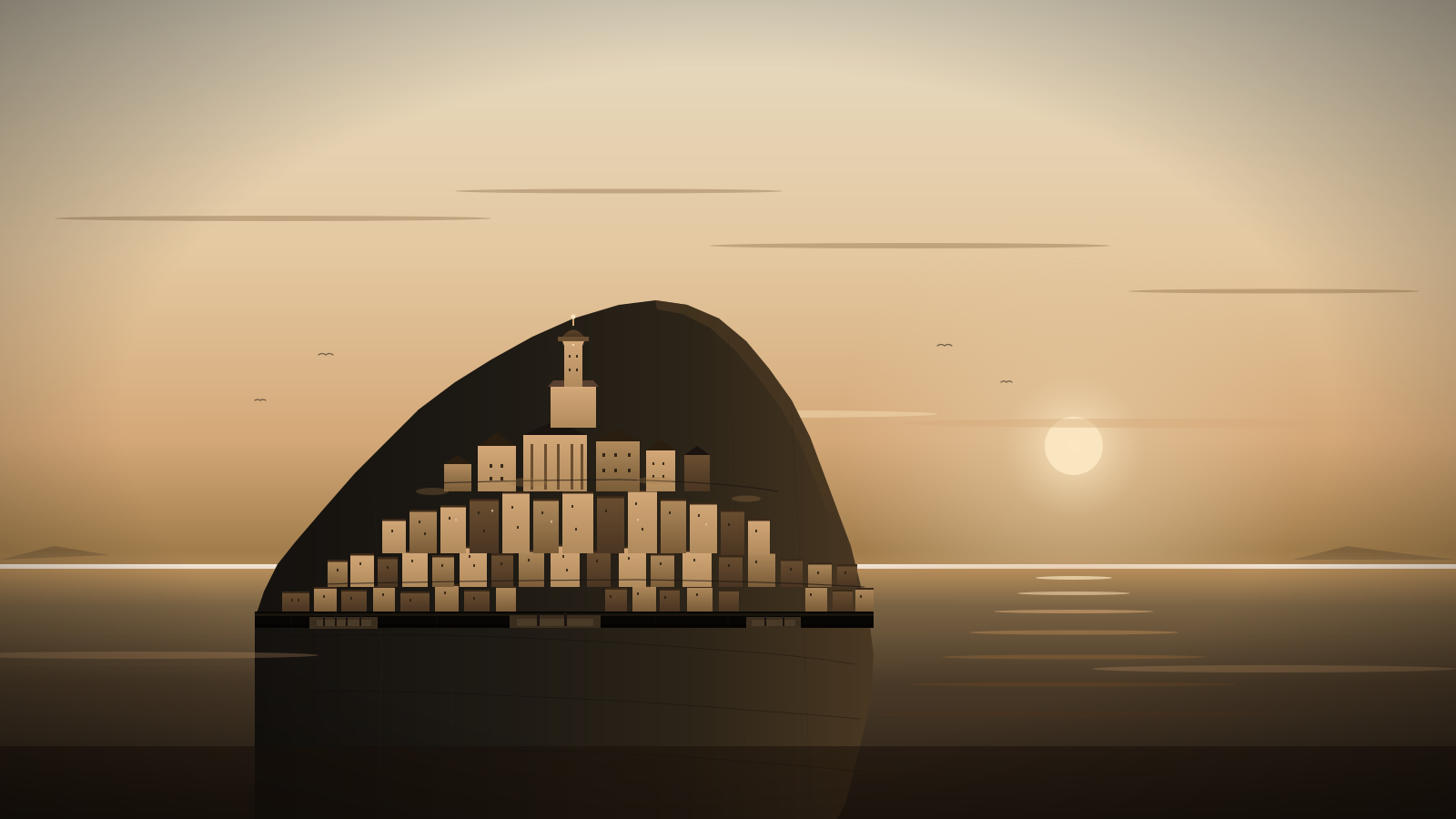
The first city of the Anchored. A port that refused to sink.
——— ◇ ———
Karath is the largest Anchored settlement on the Shifting Coast and the administrative center of the Academy of Records. Built on a wedge of black basalt that geological evidence suggests has not moved in at least ten thousand years, Karath is among the oldest continuously inhabited cities in the known world. Its population of approximately one hundred and twenty thousand makes it roughly eight times larger than the second-largest Anchored port, and its harbor handles more legitimate trade volume than all other Coastal ports combined.
The city is famous for two things. It does not sink. And it does not forget.
Geography and Situation
Karath occupies the southern face of a basalt outcropping that rises sharply from the sea. Its oldest buildings sit on terraces cut directly into the rock; its newer districts spread outward along the lower slopes and onto stone platforms anchored into the shallows. The city's water-line, marked by a continuous wall of black granite blocks set in the fourth century after the Dissolution, has not been altered in nearly three hundred years — a claim no other Coastal port can make, and a point of considerable civic pride.
Three harbors serve the city — known collectively as the Tri-Port, though natives simply call them First, Second, and Third. They face in different directions and handle different kinds of traffic. First Port, the oldest, faces south toward the open Inner Sea and handles deep-water trade: grain from the southern atolls, copper from the Iron Coast, salt, oil, dried fish. Second Port, built into a natural cove on the eastern face, accommodates the small fishing fleets and passenger vessels that work the near islands. Third Port, newest and most crowded, was cut into the western cliff four centuries ago and houses the majority of the city's private merchant ships. Each port has its own customs house, its own harbormaster, and its own idiosyncrasies that visitors learn quickly or regret.
The City Above the Water
Karath is built in tiers. The lowest level, Harborside, comprises the three ports and the warehouses, customs houses, and counting rooms that serve them. Above it rises the Middle City, where most of the population lives and works: the markets, the craft districts, the residential blocks, the taverns. Above that sits the High City, reserved for the Governing Councils, the old noble houses, and the Academy proper. And above that, on the exposed western ridge, stands the Observatory — the oldest temple of Selura on the Coast and the traditional seat from which Karath's navigators calculate the shifting charts that the rest of the Coast still buys from them.
Architecturally, Karath is distinctive. Its construction is almost exclusively stone. Wood is permitted for doors, shutters, and furniture, but structural wood is illegal within the city walls — a law that has not been repealed since before the Dissolution. Roofs are tile or slate. Streets are paved. Even the poorest quarters use stone construction, though the quality varies. A Driftborn visitor tends to find the result oppressively permanent — every building a statement that Karath has no intention of going anywhere.
Overall, the impression is of a place that has been calculating its own survival for a long time.
The People
Karath's population is predominantly Anchored, though the city has always maintained a significant Driftborn minority — typically seven to ten percent of the total, concentrated around Third Port and in a few specific neighborhoods in the Middle City. There are also substantial populations of mixed descent, of long-settled immigrants from the Iron Coast, and of the small but influential Academy-affiliated scholars who come from across the Coast to study and are granted partial civic privileges after a residency of seven years.
The city operates under a codified legal framework known as the Karath Compact — the oldest continuously enforced legal system in the known world, maintained and interpreted by the Governing Councils. The Compact covers everything from property rights to harbor fees to the treatment of manifesters, and it has the reputation, among Coastal ports, of being the most predictable legal system available: strict, slow, and consistent. Merchants from the outer atolls frequently travel to Karath to have contracts adjudicated there, even when the contracts concern ports hundreds of leagues away.
Daily life in Karath runs on tides and bells. The public bells in each of the three ports ring on the hour, every hour, day and night — a habit that foreign visitors find either reassuring or maddening. The bells are maintained by the Watch, and their accuracy is guaranteed by a timekeeping mechanism in the Observatory that the Academy guards jealously. Meetings, ship departures, legal appointments, marriages, and even funerals are scheduled by bell. "On the sixth bell of third watch" is a phrase any Karathi child understands.
Economy and Trade
Karath's wealth comes from three sources. First, trade: its Tri-Port handles nearly forty percent of all registered maritime commerce on the Shifting Coast, and its merchant houses dominate long-distance trade in grain, copper, textiles, and cured fish. Second, charts: the Academy of Records maintains and publishes the official navigation charts that nearly every captain on the Coast carries, and the subscription fees for updated charts flow directly into the city's treasury. Third, law: Karath's courts charge fees for adjudicating contracts written elsewhere, and the volume of such adjudication is considerable.
Beyond these three, Karath also maintains a smaller but significant trade in scholarly labor. Scribes, copyists, translators, and legal clerks trained in Karath command higher fees across the Coast than those trained anywhere else. This is partly a matter of quality and partly a matter of prestige; a document prepared by a Karath-trained scribe is considered, in most Coastal courts, presumptively correct unless specifically challenged.
History in Brief
Karath's founding is traditionally dated to the year 1138 before the Dissolution, though archaeological evidence suggests human settlement on the basalt outcropping extends back several thousand years earlier. The city-as-institution — with its walls, its first codified legal code, and its first Governing Council — is commonly attributed to the reign of Telor the Builder, whose tomb lies beneath the oldest surviving section of the Observatory. Whether Telor existed as described, or whether he is a composite figure assembled from multiple early rulers, remains a matter of scholarly debate.
After the Dissolution, Karath survived where many other Anchored settlements did not. Its basalt foundation protected it from the Bleed disturbances that reshaped much of the Coast in the first century after the gods left. Its grain stores protected it from the famines that followed. Its laws, already old by then, provided the framework around which the post-Dissolution Anchored civilization gradually reconstituted itself. Modern Anchored governance, in most of its forms across the Coast, descends in one way or another from the Karath Compact.
Founded in Karath in the year 47 After Dissolution, the Academy of Records began as a small society of scholars attempting to preserve what could be preserved of the pre-Dissolution record. Over the following three centuries it grew into the dominant intellectual institution of the Coast, and its presence is the single most distinctive feature of modern Karath — visible in the city's architecture, audible in its bell-counted days, and enforced, quietly but firmly, in its laws.
What Visitors Notice First
Three things.
The ringing of bells, everywhere, always. A traveler from a quieter port can go days in Karath without noticing the bells, and then suddenly cannot sleep.
The absence of wood. After a few days in the city, returning to any other port feels like stepping into a forest.
And the water line. It does not move. The sea rises and falls against the same granite blocks it has touched for three hundred years, and the effect — once it is noticed — is strange enough that some visitors remember nothing else about their first night in Karath.