An Academy of Records public reference article. On the integrated system by which Anchored households form, raise children, transmit property across generations, and manage the endings that ordinary life produces.
——— ◇ ———
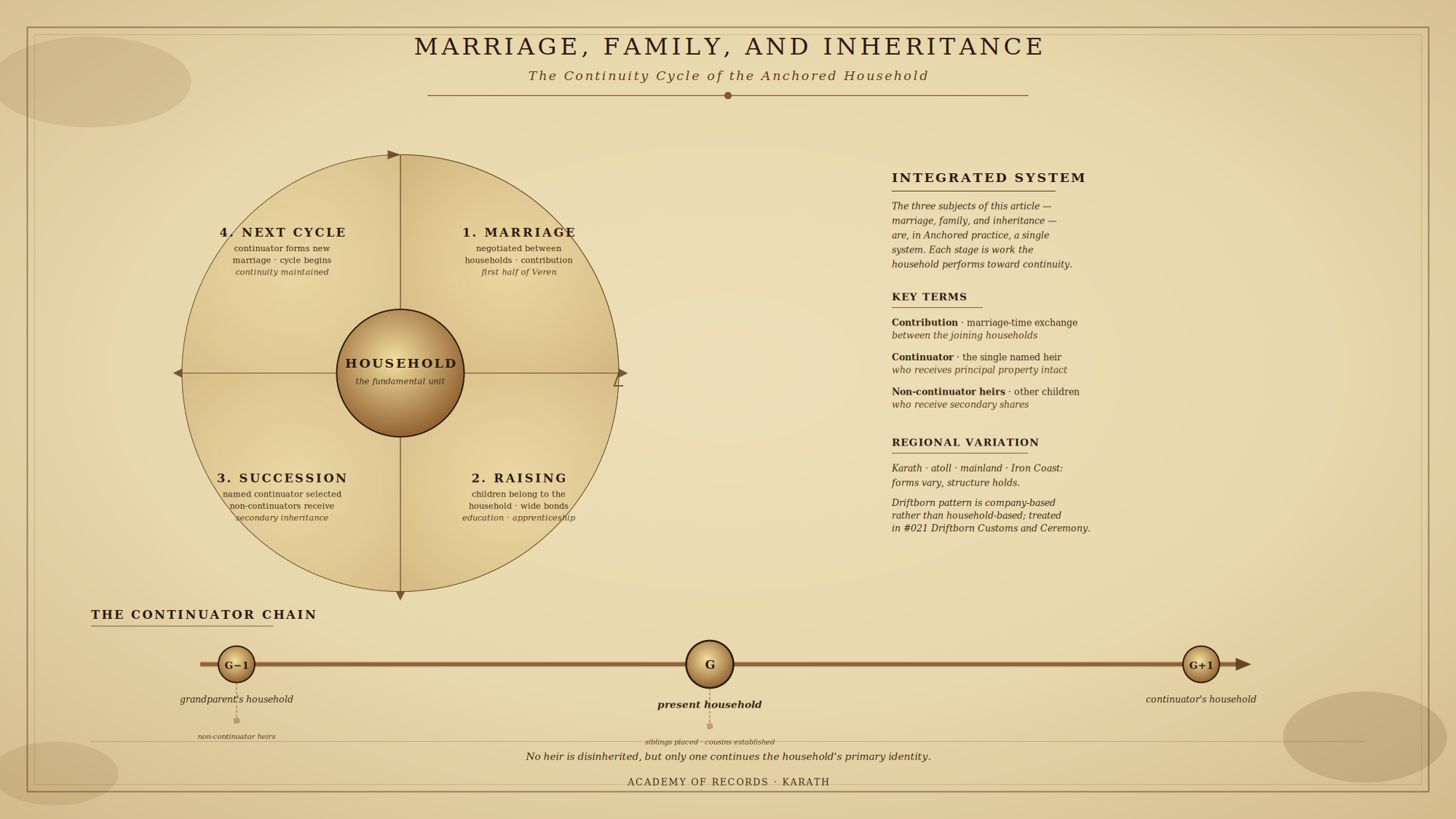
The three subjects of this article are, in Anchored practice, a single system. Marriage forms the household; the household raises the children; the property and standing of the household pass to the named continuator and, in secondary form, to other heirs; the cycle begins again with the next generation's marriages. An Anchored household understands each of these stages not as separate events but as elements of the work of continuity, which is the work the household exists to do. This article treats the stages in turn, acknowledges the regional variations that matter, and closes with a brief note on the contrasting Driftborn pattern, which is treated more fully elsewhere.
——— ◇ ———
Marriage as Household Act
Marriage is negotiated between two households, solemnized with the consent of the joining parties, and accompanied by a formal exchange called the contribution — a movement of property, goods, or specified future obligations from each household to the new one being formed. The contribution varies in scale and composition. A middle-tier Karath marriage may involve household furnishings, a portion of commercial scrip, and continuing relationships with each natal household. An atoll marriage may involve less movable property but more formal commitments concerning land use, fishing rights, and the apprenticeship arrangements of children not yet born. Most marriages are celebrated in the first half of Veren.
Children and the Household
Children are raised as members of the household rather than solely of their parents. A child may spend significant periods of her early years in the care of a grandparent, an aunt, or an older cousin as the household's circumstances warrant; this is unremarkable and is not understood as parental absence. Formal education is ordinarily the household's responsibility, through whatever combination of tutoring, apprenticeship, or Academy enrollment the household can arrange. Each child receives a personal name at birth and carries the household's identifying name throughout life, with the specific name-forms varying by region and by local tradition.
The Continuator
The principal feature of Coastal inheritance is the named continuator — the single heir to whom the household's principal property passes intact at the succession. The continuator is selected by the head of household on criteria that vary by household but characteristically combine suitability for the work the household does, demonstrated responsibility, relationships with the community, and the practical judgment of the selecting head. The continuator is frequently but not always the eldest; selection on other grounds is common enough to be unremarkable. Most households attempt to settle the selection during the head's lifetime and to witness it publicly, both to prevent disputes and to give the chosen continuator time to prepare.
Non-continuator heirs are the other children of the household, and in some cases other household members. They receive secondary inheritance in forms that vary by region and household: specified portions of the movable property, cash equivalents, established apprenticeship positions, trades set up at the household's expense, or residual shares of common household assets such as fishing gear, workshop tools, or scrip reserves. The principle is that no heir is disinherited, but only one heir continues the household's primary identity.
Succession and Its Disputes
Succession disputes are heard by Anchored civic courts, and the body of common law on inheritance is among the oldest and most elaborate areas of Coastal jurisprudence. Most disputes concern the validity of a continuator designation, the distribution of non-continuator shares, or the handling of property the deceased head held in partnership. Courts prefer settled designations made in the head's lifetime and unanimous ones over contested ones, but will adjudicate contested cases on established principles.
Ending and Ending-Later
Divorce is permitted in Anchored law but is uncommon and generally stigmatizing for both households involved. Widowhood is common and produces a range of customary arrangements, including the widow's remarriage into another household, her retention of the household's leadership where appropriate, or her return to her natal household with an agreed portion of the marriage contribution. Regional variation is substantial.
Driftborn marriage, family, and inheritance operate on different principles — company-based rather than household-based, with tradition transmitted orally and property of a kind that does not usually require continuator selection in the Anchored sense. The specific Driftborn forms are treated in the article on Driftborn customs and ceremony.
——— ◇ ———
This article is classified as a short public reference of the Academy of Records, Karath. It should be read alongside the foundational article on the Anchored, the articles on Anchored civic life and on trade and commerce, and — for the Driftborn contrast — the articles on the Driftborn and on Driftborn customs and ceremony.