An Academy of Records public reference article.
On the musical traditions of the Shifting Coast, Anchored and Driftborn, and the forms through which each is transmitted.
——— ◇ ———
Music is practiced across the entire Coast, in forms that differ sharply between the Anchored and Driftborn traditions but which have influenced one another across many centuries of contact. Neither tradition is singular. Each contains regional variety, specialized forms, and sacred-adjacent repertoire that is not ordinarily performed outside its own context. This article describes each tradition in its general shape and notes where the two meet.
——— ◇ ———
Anchored Music
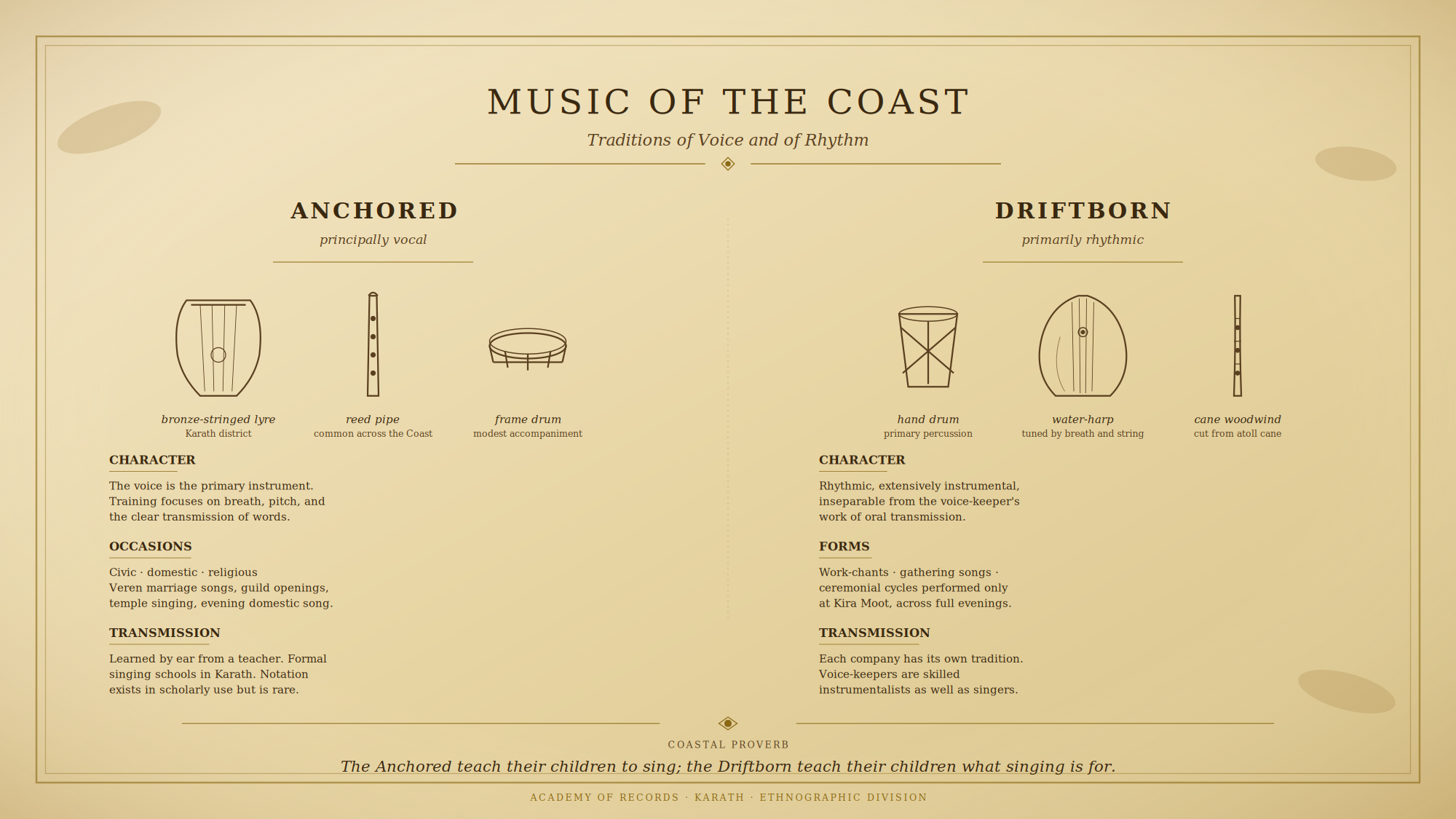
Anchored music is principally vocal, with modest instrumental accompaniment. The voice is treated as the primary instrument, and the classical Anchored training focuses on breath, pitch, and the transmission of words without distortion. Instrumental music exists, but it is in most contexts a support for singing rather than its own performance tradition.
The characteristic Anchored instruments are the small frame drum, the reed pipe, the plucked bronze-stringed lyre of Karath district, and the long-necked three-stringed instrument of the atoll tradition whose name varies by region. Written notation exists in scholarly and liturgical contexts but is not widely used; most Anchored musicians learn by ear from a teacher. Karath maintains a handful of formal singing schools at which advanced training is available, and several of the city’s older temple precincts continue to train choirs in the older liturgical repertoire.
Occasions for music are civic, domestic, and religious. A marriage celebration in Veren includes several songs specific to the exchanging households; a guild assembly may open and close with a short sung formula; a temple observance in its older form involves substantial unaccompanied singing. Domestic music is common — a workshop, a kitchen, or a quiet household in the evening is more likely to be filled with singing than with silence, and the repertoire is enormous. The Academy’s ethnographic division has recorded over four thousand distinct Anchored songs across its working collection, and the collectors themselves estimate that this figure represents perhaps a third of the songs in active circulation.
——— ◇ ———
Driftborn Music
Driftborn music is the inverse in emphasis: primarily rhythmic, extensively instrumental, and inseparable from the voice-keeper’s work of oral transmission. Where Anchored music serves occasions, Driftborn music is often the occasion itself.
Every company has its own tradition, and the musical portion of that tradition is frequently the most distinctive — a company’s songs, performed at gatherings, identify it as surely as its vessels. The song of the seven names preserved by Brinnlath Company (described in the article on the Driftborn) is an example of the form; each long-established company carries at least one equivalent. Songs vary enormously in length, from short work-chants sung during ordinary vessel labor to ceremonial cycles that unfold across a full evening and are performed only at Kira Moot gatherings.
The characteristic Driftborn instruments are percussion of several kinds (hand drums, deck-struck rhythms, a small tuned rattle common to Inner Sea companies) and woodwinds cut from a species of cane that grows along the atolls. Most distinctive of all is the string instrument Academy observers call the water-harp — a resonant plucked instrument tuned by the player’s own breath as much as by its strings. Voice-keepers are ordinarily skilled instrumentalists as well as singers; the training of a voice-keeper includes the mastery of whatever instrumental forms the company’s tradition requires.
——— ◇ ———
Where the Traditions Meet
Contact between the two traditions has produced a recognized body of shared repertoire, most of it associated with the ports where Driftborn and Anchored commerce intersect. Karath’s harbor districts in particular have generated songs whose origins cannot be assigned to either tradition unambiguously. Several such songs have entered both canons in different forms — recognizably the same song, sung to different tunes, with lyrics that have diverged across two or three generations.
The Coast’s proverb holds: the Anchored teach their children to sing; the Driftborn teach their children what singing is for. Both cultures, asked separately, have claimed the proverb as their own.
——— ◇ ———
Maintained by the Ethnographic Division of the Academy of Records, Karath.