An Academy of Records public reference article. On the cycles of civic, agricultural, and commercial life through the Coastal year.
——— ◇ ———
Coastal life organizes itself around the four seasons — Veren, Kira, Arhen, Siol — and around the specific character each brings to the work of ordinary people. This article describes the seasonal rhythms of Anchored and Driftborn life as they are broadly practiced across the Shifting Coast: when things happen, why they happen then, and how the Coast's institutions accommodate the turn of the year. Specific meteorological treatment of each season is available in the separate article on the weather.
——— ◇ ———
Veren — Spring
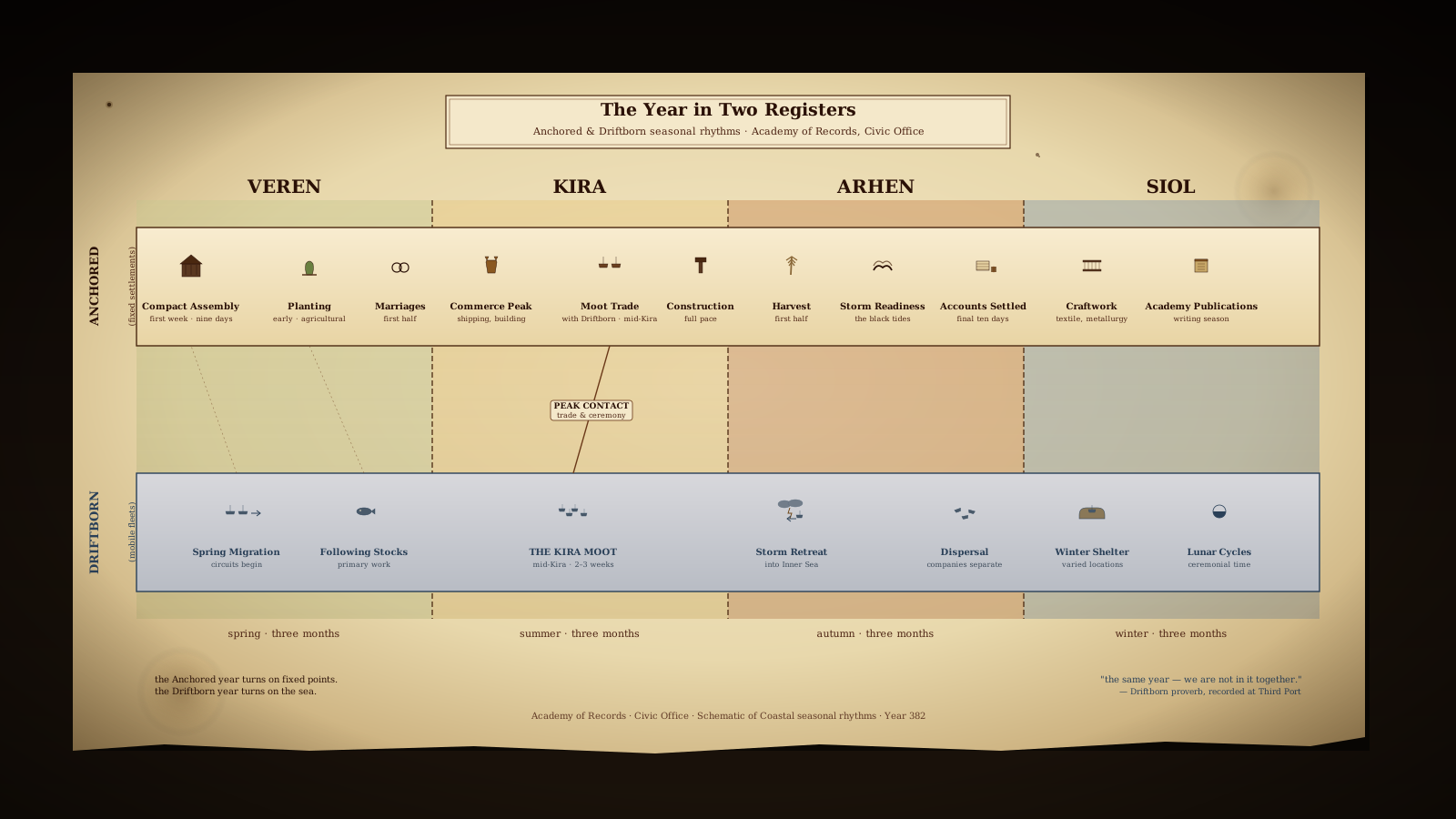
Veren begins with the first full thaw following Siol's cold clarity, typically around the equinox, and extends for approximately three months. It is the season of beginnings. Anchored agricultural communities break ground and plant the year's grain. Shelf fishing reopens after the quiet of late winter, as migrating stocks return to productive waters. Commercial shipping between Karath and the atoll ports resumes on its regular schedule. In the first week of Veren, the Karath Compact's annual assembly convenes and sits for nine days, addressing civic matters of Coast-wide significance. Most other Coastal civic bodies hold their annual reviews in the same window, partly by tradition and partly for convenience.
Veren is also the season of marriage, for reasons that are partly practical — the weather settles, travel is easier, food supplies are turning over — and partly customary. Most Coastal weddings occur within Veren's first half. Academy staff registers show the same pattern among their own people, who are not exempt from custom.
——— ◇ ———
Kira — Summer
Kira follows Veren and runs for approximately three months. It is the Coast's busiest season by every measure the Academy tracks: commercial shipping volumes peak, fishing yields are highest, construction work reaches its full pace, and inter-regional travel is at its easiest. The southwestern winds are reliable, the days are long, and the weather holds. For a majority of working people on the Coast, the habits of Kira define the working year — earning, producing, building, harvesting early crops.
The Kira Moot — the largest annual Driftborn gathering, described in greater detail in the separate article on Driftborn mobile settlements — assembles in mid-Kira at a rotating location in the Inner Sea. For the two to three weeks of the Moot, a significant fraction of Driftborn commercial and ceremonial life is compressed into a single site, with effects on wider Coastal shipping that Academy observers track with some care. Its effect on the Anchored commercial calendar is mostly positive — trade between Anchored and Driftborn communities peaks during and immediately after the gathering.
——— ◇ ———
Arhen — Autumn
Arhen opens with a sharp shift in the prevailing winds and the arrival of the first of the black tides — the autumnal storm systems that define the season's character. It runs for approximately three months. The agricultural harvest falls in Arhen's first half, and this is its dominant civic concern: the grain in, the salt works taking the year's final evaporation, the last productive fishing before the stocks move deeper, the construction projects completing before weather closes in. Arhen ends, by civic tradition, with the closing of commercial accounts for the year. Most Coastal merchant houses settle their debts and reconcile their ledgers in the final ten days of Arhen, and the habit is consequential enough that the Karath courts expect a doubling of civil filings in that period and staff accordingly.
Arhen is also the season of organized religious observance among most Anchored communities, though the particular forms vary considerably by region and by tradition. The Academy maintains no position on these observances beyond noting their occurrence.
——— ◇ ———
Siol — Winter
Siol is the cold, clear, and commercially quiet season — three months during which most commercial shipping reduces sharply and much Anchored activity moves indoors. Craftwork flourishes: the textile trade, the fine metallurgies, the scholarly copying that keeps Karath's archive supplied. Academy publications are largely compiled and issued during Siol, when staff attention can be sustained on writing rather than on fieldwork.
Siol is the quiet season, but not the empty one. Coastal tradition holds that the work of Siol — the indoor, slow, careful work — is what distinguishes the Coast's civilization from the civilizations of less fortunate regions, where weather does not enforce a pause. The Academy has not tested this claim against comparative evidence but does not formally dispute it.
——— ◇ ———
The Driftborn Year
Driftborn seasonal practice differs from the Anchored year described above in several respects. The seasonal names are shared, but the activities assigned to each season are organized around mobility rather than around fixed settlement. Driftborn fleets migrate through the year on seasonal circuits — following fish, avoiding the worst of Arhen's storms by moving into the Inner Sea, converging at the Kira Moot and dispersing afterward, wintering at sheltered locations that vary by company and by tradition.
The Driftborn ceremonial year is also structured differently. Several Driftborn observances align with the Anchored calendar, but others follow cycles that do not — lunar cycles, generational cycles, or cycles of passage related to specific navigational events. A more detailed treatment of Driftborn seasonal practice appears in the separate article on that subject, which readers interested in the full pattern are directed to consult.
——— ◇ ———
This article is classified as a short public reference of the Academy of Records, Karath. Specific meteorological patterns of each season are treated separately, as are the detailed civic calendars of Karath and the seasonal circuits of the principal Driftborn companies.