An Academy of Records reference article. Part of the Gods and Religion series.
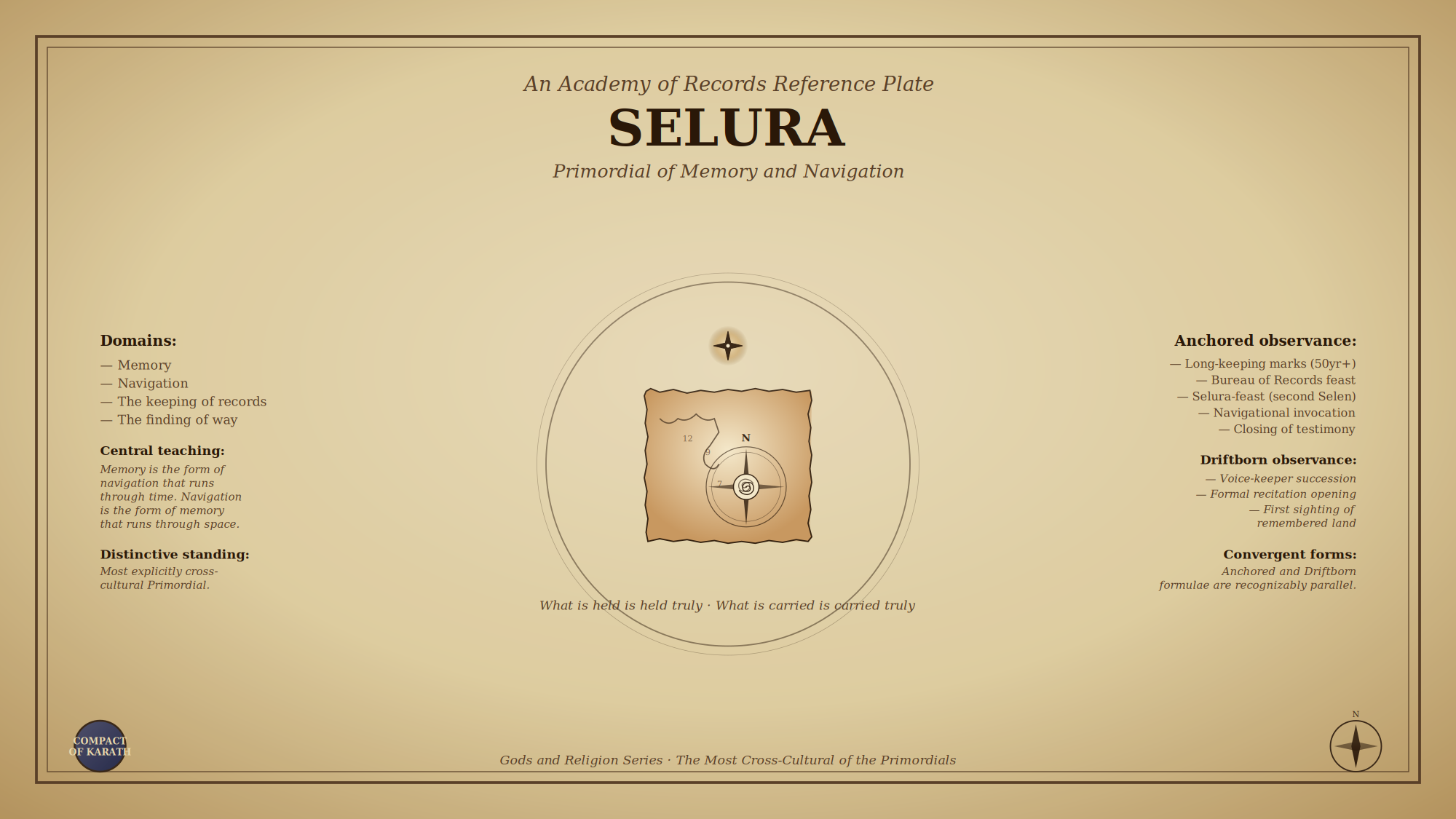
Selura is the Primordial of memory and of navigation — the linking of place to recollection, of past to present, and of one position to the next. Of the Seven Primordials, Selura holds the distinction of being the most explicitly cross-cultural: Anchored archive-keepers and Driftborn voice-keepers both invoke Selura, often using formulae that are recognizably parallel across the two traditions. Selura’s worship is moderate in scale but uncommonly stable, sustained by the practical needs of both cultures for the keeping of records and the safe finding of way. This article treats Selura as a deity within the broader pantheon; readers seeking the specific institutional contexts of Selura-observance should consult the Academy of Records and the Driftborn Customs and Ceremony references.
——— ◇ ———
Attributions and domains
Selura’s domain is the joining of two activities the post-Dissolution Coast holds as related: the keeping of memory, and the finding of way. Selura-doctrine teaches these to be a single concern in two aspects. To remember a place rightly is to know how to return to it; to navigate a way truly is to remember the path well enough to retrace it. Memory is the form of navigation that runs through time; navigation is the form of memory that runs through space. Selura’s particular concern is the discipline by which both are kept faithfully.
Specific domains within the Selura-canon include archives and the keeping of records, navigational charts and the practices of way-finding, the formal preservation of oral testimony, the witness given by recall, and the link between a place and the events it has held. Stars are recognized as Selura’s, particularly in their fixed-position aspect; tides are not — tides are Veyra’s, with Selura concerned only with the navigator’s recollection of tide-tables, not with the tides themselves.
——— ◇ ———
The cross-cultural distinctive
Among the Seven Primordials, Selura is the one whose Anchored and Driftborn traditions most closely resemble each other. An Anchored archive-keeper opening a long-keeping volume and a Driftborn voice-keeper opening a formal recitation perform observances that, while distinct in setting and material, share a striking similarity of form. Both invoke Selura by name. Both follow the invocation with a formal acknowledgement of the keeper’s responsibility. Both close the opening with a phrase whose Anchored and Driftborn versions are recognizably parallel: what is held is held truly (Anchored) and what is carried is carried truly (Driftborn).
Academic theology has not produced a settled account of why Selura’s domain alone has this convergent observance. Three positions are commonly held. First, the parallel-tradition hypothesis holds that the two cultures arrived at similar forms independently because the underlying activity (faithful preservation) is the same. Second, the common-source hypothesis holds that both traditions descend from a pre-Dissolution Selura-observance whose details are partially preserved in both cultures’ canons. Third, the quiet-dialogue hypothesis holds that Anchored archive-keepers and Driftborn voice-keepers have, across the post-Dissolution centuries, occasionally exchanged observance practice in informal ways that the formal canons of either tradition do not record. Academy doctrine holds the second hypothesis as most plausible but does not insist on it.
——— ◇ ———
Anchored Selura-observance
Anchored Selura-observance is institutional and concentrated in record-keeping practice. Within the Academy of Records, every long-keeping volume — that is, any volume held to a retention period exceeding fifty years — bears a Selura-mark on its first page, set there at the volume’s opening and renewed at fifty-year intervals. Maintenance of long-keeping marks is the responsibility of the Academy’s Bureau of Records.
Bureau practice observes the annual Selura-feast in the second week of Selen. This feast is a working observance rather than a festival: the Bureau spends three days reviewing the long-keeping inventory, replacing volumes whose marks have come due for renewal, and inducting new clerks into Selura-practice. Public access closes during the feast.
Specific Anchored Selura-observances also include:
The navigational invocation, spoken by Anchored ship-pilots before consulting a chart in earnest. Its brief formula concludes with Selura’s marking holds. Pilots use the invocation as a working courtesy rather than a Compact-licensed requirement.
Scribe’s morning observance, observed by Academy clerks whose work involves the production of records meant to last. Brief, private, performed at the scribe’s workstation before the day’s writing begins.
Closing of testimony, recited at the conclusion of formal Compact-court testimony when the witness’s account has been entered into the long record. Selura is invoked as the keeper of what has been said.
——— ◇ ———
Driftborn Selura-observance
Driftborn Selura-observance is communal and concentrated in the voice-keeper tradition. Selura is invoked at the opening of every formal recitation by which a voice-keeper transmits the company’s preserved oral record. Driftborn-Selura form parallels the Anchored archive-opening: the deity is named, the keeper’s responsibility is acknowledged, and the closing phrase what is carried is carried truly is given.
Most significant of the Driftborn Selura-observances is the voice-keeper succession. When a voice-keeper grows aged or is otherwise unable to continue in role, the company convenes a succession-ceremony at which the voice-keeper transmits the preserved oral record to a designated successor. Such ceremonies are conducted under Selura’s name and may take days to complete, depending on the volume of material to be transmitted. Driftborn voice-keeper successions are held as among the most solemn occasions of company life.
Selura is also invoked at the first sighting of remembered land — when a Driftborn ship returns to a port the company has visited before, the helmsman speaks Selura’s name as the port’s headland comes into view. This brief observance acknowledges that the place is being remembered correctly and that the return is owed to that remembering.
——— ◇ ———
What Selura is not
Selura is not the patron of forgetting. Doctrine of Selura is the discipline of faithful preservation; what fails to be preserved is held to fall away from Selura’s domain rather than to be claimed by it. Forgetting, in Selura-doctrine, is not a deity’s act but an absence of the appropriate observance.
Selura is not the patron of navigation in the seamanship sense. Veyra’s domain covers the working life of the ship; Selura is concerned only with the recollection of route that allows a path once found to be found again. Pilots invoke both deities at appropriate moments without confusion.
Selura is not held to favour Anchored or Driftborn observance over the other. Convergence of the two traditions is, by Selura-canon, the closest the post-Dissolution Coast has produced to a shared religious practice — the deity is held to receive both observances without distinction.
——— ◇ ———
This article is a Free-tier entry of the Academy of Records’ Gods and Religion series. Readers are directed to the Seven Primordials and Ohn for the broader pantheon, to the Academy of Records for the institutional context of long-keeping practice, to Driftborn Customs and Ceremony for the voice-keeper tradition, and to Veyra for the related deity of the sea and the working ship.