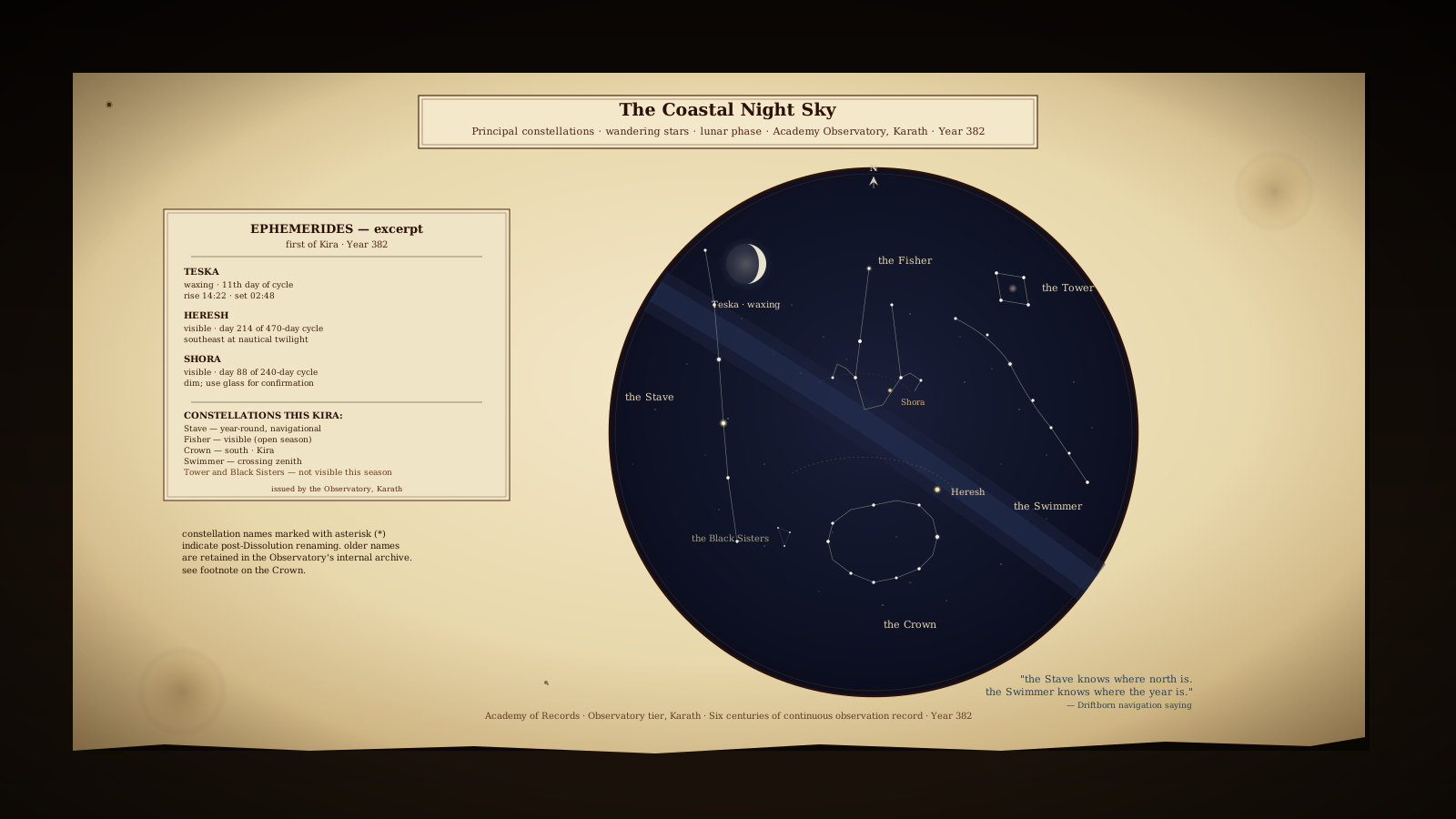
An Academy of Records public reference article. On the night sky visible from the Coast, and on what the Academy and the Driftborn have made of it.
——— ◇ ———
The sky above the Shifting Coast has been observed and recorded for at least as long as any other feature of the Coast's geography. Academy astronomers work from the Observatory tier of Karath, which was built on its elevation for exactly this purpose, and maintain continuous observation records extending back more than six centuries. Driftborn navigators have a different relationship to the sky — theirs is primarily practical rather than documentary — but the body of Driftborn star-knowledge preserved in oral tradition is, by the Academy's own estimate, considerably older than any Academy record.
What follows is a brief overview of the principal celestial features visible from the Coast. Readers seeking the Academy's annual ephemerides or its detailed star catalogues are directed to the Observatory's publications.
——— ◇ ———
The Sun and the Moon
The sun rises and sets as one would expect, with seasonal variations in angle and daylight length that the Academy has tabulated and that any almanac publishes. Its light is, by the Academy's color-measurement standards, slightly warmer than the sunlight of certain inland regions — a difference attributed to the Coast's characteristic atmospheric moisture. This observation is practical rather than mystical; it affects certain dyeing and pigment trades and little else.
The moon — called Teska in Anchored usage and the White Eye in Driftborn tradition — follows a cycle of approximately twenty-nine days from new to new. Its phases are tabulated by the Observatory and appear in every Coastal almanac. Its influence on tides is, as on any coast, the primary practical concern; the ceremonial significance of the moon in Driftborn tradition is treated in the article on Driftborn customs and is not further addressed here.
——— ◇ ———
The Principal Constellations
Six constellations are recognized in Academy publication as the principal named groupings of the Coastal night sky. Several additional constellations exist in regional or occupational traditions, and the Academy's full catalogue lists forty-three, but the six below are shared across the Coast and are taught to every Coastal child who learns the sky.
The Stave is a long, nearly-straight chain of six bright stars running roughly north to south. It is the Coast's principal navigational constellation: its upper end points within a few degrees of true north year-round, and it is visible every night of the year except during the brightest phases of Teska. Coastal navigators of every tradition use the Stave as their primary celestial reference.
Seven stars arranged in a humanoid posture with what is interpreted as a net form the Fisher. The Fisher rises in late Veren and sets in early Arhen, its visible season matching almost exactly the productive fishing year. Coastal tradition holds that the Fisher's presence in the sky marks the open season.
A ring of nine stars appearing in the southern sky during Kira is called the Crown. Its name is of post-Dissolution coinage; Academy records indicate the constellation's older name referenced a figure from the pre-Dissolution religious tradition, and the Crown was renamed after the Dissolution to remove that reference. That older name is recorded in the Observatory's internal archive and is not in general use.
A long, sinuous chain of stars that appears to move through the sky across the year more noticeably than any other constellation is the Swimmer. Driftborn navigators track the Swimmer's position as one of their primary celestial indicators for seasonal transitions and tide patterns; the Academy has investigated the connection between the Swimmer's position and tidal timing and has found it meaningful, though not more accurate than direct tide prediction.
Four bright stars in a compact square grouping form the Tower, which rises at dawn during Siol and is otherwise not visible. Its brief visible season makes it the winter constellation par excellence, and it features in most Coastal Siol observances.
Three stars in a tight triangular cluster make up the Black Sisters, visible only in the clearest nights of deep Siol. They are the faintest of the six principal constellations, and their visibility is considered a marker of exceptional atmospheric clarity. Driftborn tradition holds that the Black Sisters should be greeted when first seen in a Siol; the Academy has not taken a position on the practice.
——— ◇ ———
The Wandering Stars
Two objects classified by the Academy as wandering stars have been tracked continuously since the Observatory's earliest records. The first, called Heresh, follows a regular path across the sky of approximately four hundred and seventy days and is visible to the naked eye for about half of its cycle. The second, called Shora, has a shorter cycle — roughly two hundred and forty days — and is correspondingly dimmer. Both are tabulated in the annual ephemerides.
Anchored navigators use the wandering stars primarily for long-distance confirmation of position; their slow and regular motion makes them useful reference points for voyages of weeks rather than days. Driftborn navigators use them for the same purpose, and their traditions concerning the wandering stars are broadly consistent with the Academy's tabulated positions, differing mainly in interpretation rather than observation.
——— ◇ ———
Celestial Anomalies
A small number of observed phenomena do not fit the ordinary pattern of Coastal astronomy. The Academy classifies these as celestial Bleed effects and catalogues them separately. The most common is the doubling — a rare occurrence in which a star appears briefly as two stars, either stationary or slowly separating and rejoining, for periods from several minutes to several hours. Doublings are infrequent — the Observatory records perhaps one per decade — and no predictive model for them exists. Driftborn tradition has accumulated a considerable body of interpretation concerning doublings, which the Academy has filed in the field-research archive without endorsement.
——— ◇ ———
This article is classified as a short public reference of the Academy of Records, Karath. The Observatory's annual ephemerides, full constellation catalogue, and observational archive are available to readers on request. Driftborn celestial tradition is treated in the separate article on Driftborn navigation.