An Academy of Records reference article. Part of the Factions series.
The Academy of Records is the principal scholarly institution of Anchored Karath and, by long standing, of the wider Shifting Coast. It administers the Coast’s most extensive archives, conducts and publishes the Coast’s principal scholarly research, trains the next generation of Coastal scholars, and performs a small number of regulatory functions delegated to it by the Karath Compact.
This article treats the Academy as an institution. Readers seeking the Academy’s individual departments, its principal publications, or specific archive references are directed to the relevant subsidiary articles. Readers seeking the Academy’s relationship to Anchored Law and the Karath Compact should consult those references first.
——— ◇ ———
Foundation and standing
Founded at Karath in the long settlement period following the Great Shift, the Academy was chartered alongside the First Compact and the early structures of Anchored governance. Its charter was granted by the Compact’s first councillors and has been renewed at every subsequent revision of the Compact. Without interruption since the year of its founding, the institution has continued to fulfil the scholarly functions for which it was first established.
Standing among the Coast’s institutions is unrivalled. The Academy is older than every other Anchored institution save the Compact itself and the Order of Vyn, both of which were chartered in the same period. It is funded principally by Compact endowment, supplemented by tuition from non-stipended students, by sales of its principal publications, and by income from the small portion of its archive made commercially available to merchant houses.
——— ◇ ———
Structure and ranks
Departments are the Academy’s organizational unit. Each is headed by a Master and staffed by senior scholars, junior scholars, and supporting clerical and archival personnel. Department divisions reflect the Academy’s working domains: among the principal departments are Languages, Hydrography, Astronomy, Cartography, History, Natural Philosophy, Law, and the broad domain referred to in Academy publications as Manifestation Studies. Other smaller departments handle specialized subjects of historical or regional importance.
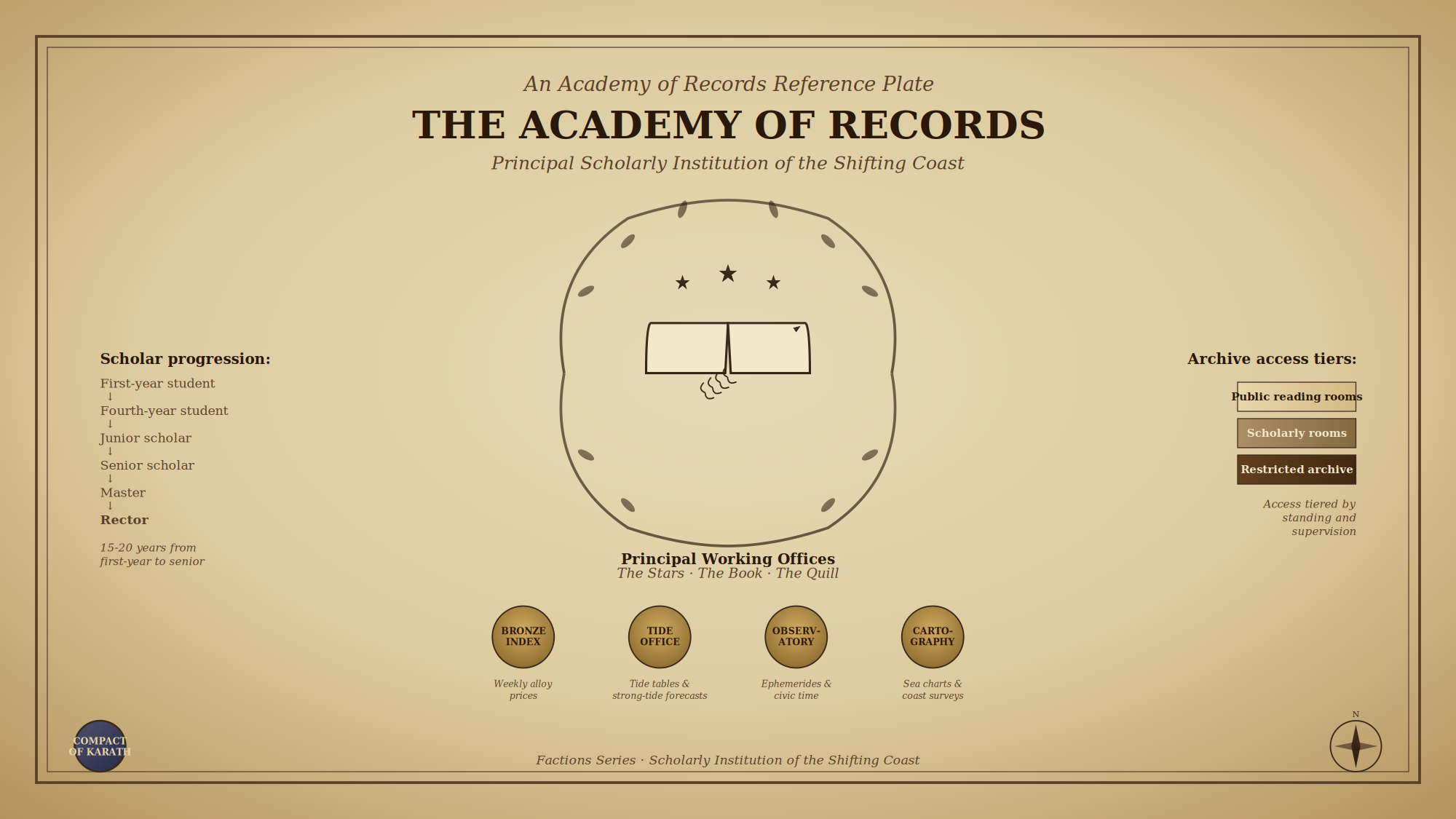
Scholar ranks proceed in a recognized progression. First-year through fourth-year students complete the Academy’s foundational programme, which combines classroom work, archive familiarization, and supervised research. Junior scholars — those who have completed the foundational programme and are conducting independent research under supervision — typically hold this rank for between four and seven years. Senior scholars are those whose work has been formally recognized by their department’s Master and who hold independent research authority. Masters lead departments and serve on the Academy’s governing council. Above the Masters is the Rector of the Academy, an appointed position drawn from the senior Masters by their own vote, serving a term of seven years.
From first-year admission to senior scholar, the full course of study and apprenticeship typically requires fifteen to twenty years. A scholar who reaches senior rank by the age of forty has had a notably accelerated career; one who reaches it by fifty is on a more typical trajectory.
——— ◇ ———
Working offices
A number of working offices operate within the Academy and produce the publications and records by which Coastal civic and commercial life is regulated.
A weekly alloy-price index, published by the Bronze Index Office, sets the working prices for bronze, copper, tin, and lead across the Coast. The Index is the single most consequential commercial publication on the Coast and is regarded by merchant houses as authoritative.
Within the Hydrography department, the Tide Office produces and publishes annual tide tables for every established Coastal port. Tables are issued each winter for the following year and revised as conditions warrant. Tide Office staff also issue strong-tide forecasts in the days approaching a tidewater event and maintain the appendix of hydrographic anomalies updated each season.
From its dedicated tier of upper Karath, the Observatory of the Astronomy department maintains continuous observation records extending back more than six centuries. It publishes annual ephemerides, the daily-bell schedule by which Karath’s civic time is set, and detailed star catalogues consulted by navigators across the Coast.
A separate Cartography Office produces and maintains the Coast’s principal sea charts, surveys disputed coastlines, and updates published maps as the geological record warrants. Its published charts cover most of the Inner Sea and the inhabited coast; charts of the deep waters beyond the Trench are limited and, in some cases, restricted from public sale.
As the Academy’s clerical centre, the Bureau of Records maintains the institution’s own administrative records, copies official documents on request, and provides certified extracts from public archives.
——— ◇ ———
The Archive
Formally called the Karath Archive of Records, the Academy’s Archive is the principal documentary collection of the Coast. Its holdings include manuscripts dating from the founding period, a substantial portion of the surviving pre-Dissolution texts, the complete published runs of the Bronze Index and the Tide Office’s tables, and copies of every Compact judgment and law-revision since the First Compact.
Access to the Archive is tiered. The public reading rooms are open to any Karath-dweller during published hours and contain the Academy’s commercial-grade reference materials, current publications, and a substantial portion of the historical record at general-public level. The scholarly reading rooms require junior-scholar or higher standing and contain the working research materials of the Academy’s departments. The restricted archive holds materials whose distribution is, by Compact regulation or by Academy policy, controlled.
Access to restricted material requires the supervision of a Master and is governed by procedures established by Academy regulation. Restricted reading rooms are physically separate from the public and scholarly rooms, and are typically located on a separate level of the Academy’s principal Archive building. The procedural details of restricted-archive access are not made public.
——— ◇ ———
Scholar travel writs
A scholar of any rank who wishes to leave Karath for purposes connected to research must apply for a scholar travel writ, issued by the Academy’s Bureau of Records on application from the scholar’s department. The writ states the scholar’s name, rank, intended destination, and approximate duration; it serves as identification for Watch and Harbor Master purposes and as authorization for the scholar to access scholarly courtesies at allied institutions. Scholars who travel without a writ travel as private persons, without Academy standing.
Senior scholars typically apply for and receive writs without difficulty. Junior scholars require their supervising senior’s endorsement. Students do not travel under writ during their foundational years except as part of supervised expeditions.
——— ◇ ———
The Karath campus
Academy buildings occupy the eastern half of Karath’s upper tier, on grounds set aside in the founding period. The principal Archive building, the great Lecture Hall, the Observatory tier, the Tide Office’s working hall, and the residences of the senior Masters are arranged around a central plaza. Foundational programme students reside in tier-built dormitories on the campus itself; junior and senior scholars typically live in upper-tier residences nearby.
During daylight hours, the campus is open to the public, with public reading rooms, the Lecture Hall’s public sessions, and several archive viewing days posted each season. In working practice, the institution is not a closed scholar’s enclave.
——— ◇ ———
Relationship to the Compact and other institutions
As a Compact-licensed institution, the Academy reports through its Rector to the Compact’s annual sitting in Veren. Academy charter, departmental additions, and Compact-delegated regulatory functions are reviewed at that cycle. The Academy is not a body of governance — it does not legislate, does not adjudicate, and does not enforce — and the formal independence of its scholarly work from civic interference is one of the durable principles of Coastal institutional life.
In its working relationships, the Academy interacts most frequently with the Karath Compact (regulatory oversight, Compact-court documentary requests) and with the Harbor Master’s Office (the Tide Office’s tables, vessel-related Cartography work). It also works closely with the Port Watch, whose records-keepers consult Academy archives for historical reference, and with the Order of Vyn on matters of the Manifester Code, which Academy Manifestation Studies scholars and Order monitoring officers understand jointly. Academy scholars also work formally with Driftborn voice-keepers on matters of mutual interest, though such collaboration is, by tradition, conducted on terms set by the voice-keepers themselves.
——— ◇ ———
Reputation
Among the Anchored, the Academy is regarded with the respect ordinary citizens reserve for institutions older than living memory. Its publications are trusted, its tables are consulted, its scholars are believed when they speak within their domain. Karath-dwellers regard the Academy as one of the foundational institutions of the city and would consider its absence unimaginable.
Scholarly reputation, internally, is more mixed. Departmental rivalries are an ordinary feature of Academy life. Master-level disputes occasionally rise to the Rector’s attention. The Academy’s institutional culture treats such disputes as matters to be resolved through procedure rather than as failings, and the long-standing custom of the institution is that disputes settled in the Academy stay in the Academy.
A most-noted public failing of the institution is the slowness with which its archive responds to outside requests. The Bureau of Records will fulfil any legitimate request, but the time required to do so is, by Coastal commercial standards, considerable. Several attempts at administrative reform on this point have been made over centuries. None has measurably accelerated the process.
——— ◇ ———
This article is a Free-tier entry of the Academy of Records’ Factions series. Readers are directed to the companion articles on the Karath Compact, the Port Watch, the Harbor Master’s Office, the Order of Vyn, and the principal Academy publications for the institutional context within which the Academy operates.