An Academy of Records public reference article. On the rooted peoples of the Shifting Coast — their identity, their organization, and their way of being.
——— ◇ ———
The Anchored are, by their own account and by the Academy's, the people of the Shifting Coast who consider themselves rooted. They live in specific places and understand their lives in relation to those places. They build in stone, farm in soil, bury their dead in named ground, and pass their names down along inherited houses. Their civilization is organized around the premise that one belongs somewhere — that the accident of where one was born and the choice of where one lives are the same question, answered in the same word.
This is the Anchored self-understanding. The Driftborn understanding of them differs in several important respects, and the Academy's treatment of that difference appears in the companion article on the Driftborn and in the later comparative piece on cross-cultural perception. Readers should bear in mind that the present article is written from within Anchored civilization by Anchored scholars, and that its claims about Anchored identity are of the kind that any culture's scholars make about their own people — informed but not neutral, detailed but not uncontested.
——— ◇ ———
Who and Where
Anchored population across the Coast is approximately three hundred and fifty thousand to four hundred thousand, distributed across perhaps one hundred and eighty settlements of civic notation plus an uncounted number of smaller hamlets, isolated households, and specialized outposts. This distribution is described in detail in the article on Coastal Settlements. For the purposes of cultural description, the relevant groupings are three.
The Karath district accounts for roughly a third of the Anchored population and the large majority of Anchored civic, commercial, and scholarly activity. Karath-district Anchored culture is, accordingly, the version of Anchored culture best documented and most frequently described in publication. Readers should not mistake it for the only version.
The atoll Anchored are Anchored communities that have established themselves on the larger islands of the atoll chains, most prominently at Ilmatha and at the smaller ports of the Islands of Kessa. Atoll Anchored culture shares its fundamentals with the Karath tradition but has distinct regional variations in dialect, diet, religious observance, and civic custom. Atoll communities are, for historical reasons, older than most of the mainland towns beyond Karath itself, and their sense of their own antiquity is a point of some quiet regional pride.
The mainland Anchored are the communities of the Iron Coast, the northwestern mining district around Dun Verelith, and the dispersed hamlets along the agricultural coast. Mainland Anchored culture is more agricultural and more craft-oriented than the commerce-focused Karath style. It is also the most regionally varied; what passes for typical Anchored custom in one mainland community may differ noticeably from the custom of another fifty leagues away.
——— ◇ ———
Social Organization
Anchored society is not legally stratified in the sense that some ancient societies are recorded to have been — there are no inherited titles backed by law, no formal castes, no classes of person whose rights differ from those of any other. What exists instead is a system of status grounded in household standing. A person's standing in an Anchored community is primarily a function of their household's long-term reputation for reliability, productivity, and honorable dealing. Wealth matters, but not as much as a traveler from elsewhere might assume; a poor household of long standing outranks, socially, a rich household whose reputation is uncertain.
Household standing accumulates across generations and is, in practice, difficult to change rapidly in either direction. A family that has been in a community for four hundred years has a weight in civic matters that no newcomer, however successful, can match in less than three or four of their own generations. The effect is conservative. Anchored communities change slowly, and this slowness is often explicitly valued.
Work itself falls into broad categories that carry their own prestige. Scholarly work at the Academy is considered the most distinguished. Civic service on the Compact, in the Port Watch, in the Harbor Master's office, and in other institutional capacities is respected. Commercial merchant houses and master-craft shops carry strong standing when of long reputation. Skilled trades — metallurgy, shipwrighting, fine textile work — are respected. Ordinary fishing, farming, and laboring work is not disparaged, but carries less standing than the others. The system is not rigid; movement is possible, and within a single household one commonly finds people working at several different levels of standing simultaneously.
Women and men participate broadly equally in Anchored public life, though with some regional variation. Karath-district and atoll Anchored societies are formally egalitarian; certain mainland communities retain older patterns in which specific civic offices are held predominantly by one gender or the other, not by prohibition but by custom.
——— ◇ ———
Family and Household
The Anchored household is the fundamental unit of social, economic, and civic life. It is not precisely the same thing as the modern family in some societies the Academy has corresponded with. An Anchored household includes not only parents and their children but often grandparents, unmarried adult siblings, cousins on the father's or mother's side depending on local custom, and in some cases long-term servants and apprentices who are considered household members for most practical purposes.
Marriage is, in most Anchored communities, a matter arranged between households rather than concluded between individuals alone, though individual consent is required and enforced. Most Anchored marriages join two households of comparable standing; marriages across significant standing differences are possible but rare and typically require particular circumstances. Veren — specifically the first half of spring — is the season in which most marriages are celebrated, for reasons both practical and traditional.
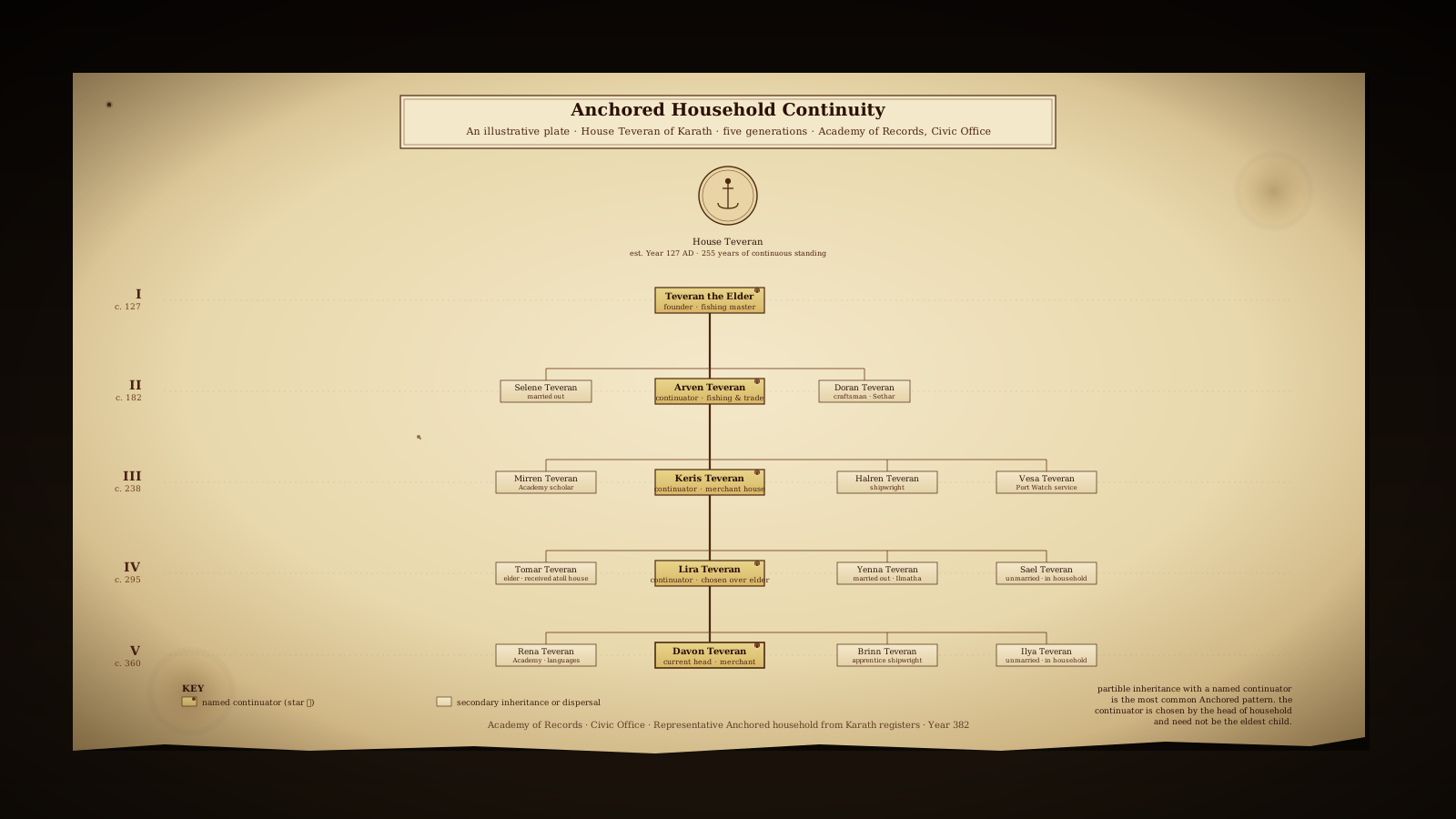
Inheritance patterns vary by region. The most common Coastal pattern is partible inheritance with a named continuator — the household's principal property passes intact to one named heir, while other heirs receive secondary holdings or monetary equivalents. The continuator is not always the eldest, though often is; the selection is a matter for the head of household and is usually settled, where possible, before death. Disputes over succession are heard by Anchored civic courts, and the body of common law on inheritance is one of the oldest and most detailed areas of Coastal jurisprudence.
Children are raised as belonging to the household rather than solely to their parents. It is unremarkable for an Anchored child to be raised for years at a time by an aunt, a grandparent, or an older cousin if circumstances warrant. The practical effect is that Anchored children tend to form wide bonds across their natal household before they form narrower bonds outside it.
——— ◇ ———
Religion and Observance
Anchored religious practice since the Dissolution has no unified form. Different communities, different households, and often different individuals within a single household observe different traditions. This variety is itself a post-Dissolution phenomenon; pre-Dissolution Anchored religion, insofar as the Academy has reconstructed it, centered on a set of deities now referred to collectively as the Primordials and is treated in the separate article on Coastal religious history.
Contemporary Anchored religious practice includes several broad tendencies. Some Anchored communities maintain formal temple precincts honoring specific named figures — some of these figures being former Primordials retained in local observance, others being later figures whose cults have emerged since the Dissolution. Other communities practice what might be called ethical observance, marking the turn of the year and significant life events without formal invocation of specific beings. A small minority holds to explicitly pre-Dissolution forms of Primordial worship; these communities are generally respected by their neighbors, though rarely emulated. A similar minority holds to what might be called philosophical skepticism — a position that the Dissolution's lesson is that religious invocation of specific beings is not what it was once assumed to be, and that practice should be reformed accordingly.
The Academy, as an institution, maintains no position on religious matters beyond recording what is observed and documented. Individual Academy scholars hold the full range of Anchored religious views; this is not considered a professional concern so long as it does not affect scholarly work.
——— ◇ ———
Language, Education, and Civic Life
The Anchored languages of the Coast are closely related — related enough that educated speakers of any regional variety can communicate with educated speakers of any other, with some effort. Karath's urban dialect is the commercial and scholarly standard, and most Anchored children above the age of ten can understand it even where it is not their home speech. Driftborn trade-speech, which differs substantially from Anchored language, is treated in the companion article.
Basic literacy is expected of adult Anchored and is broadly achieved. Most Coastal communities maintain schools or tutoring arrangements that teach reading, writing, basic arithmetic, and — in wealthier communities — history, geography, and an introduction to Academy scholarship. Advanced education is concentrated at the Academy in Karath but is not restricted to Karath-born children; the Academy's enrollment draws from every Anchored community on the Coast, and bursaries are available for promising students from any background.
Civic life is organized around assemblies — from the annual Karath Compact at the coast-wide scale, down to town assemblies, neighborhood meetings, and guild councils at smaller scales. Anchored political culture is assembly-based by deep preference; major decisions are rarely taken without some form of collective consultation, and even in cases where individual authority is theoretically sufficient, Anchored leaders generally find it prudent to secure assent broadly before acting.
——— ◇ ———
The Anchored and the Driftborn
Anchored understanding of the Driftborn is, like Driftborn understanding of the Anchored, more complex than casual observers assume. A simplified picture does exist: the Anchored regard the Driftborn as rootless, as transient, as fundamentally unserious, while the Driftborn reciprocate by regarding the Anchored as stationary, as parochial, as imprisoned by their own houses. This picture has some basis in the commonest everyday attitudes of each community toward the other. It is not the full picture.
Most Anchored communities maintain long-standing working relationships with specific Driftborn companies. Trade is constant. Intermarriage, though uncommon, is not unheard of; the usual pattern is that a Driftborn-Anchored marriage produces a household that is practically Anchored, with the Driftborn partner's family ties maintained at a distance. The reverse pattern — Anchored individuals joining Driftborn companies — is rarer but documented.
Anchored and Driftborn views of one another are treated at length in the separate comparative article and are not further developed here.
——— ◇ ———
What "Anchored" Means
The word Anchored is, in the oldest Coastal usage the Academy has documented, a reference to the literal practice of anchoring a ship — of committing it to a specific place, of declining, for a time, to drift. That a people would come to identify themselves by this term suggests something about how the Anchored understand their relationship to place and to choice.
To be Anchored, in the fullest cultural sense, is to have accepted that one is somewhere. It is to have accepted that one belongs there, that one's life is organized around staying there, and that one's obligations extend both backward through the ancestors whose work made the place possible and forward through the descendants who will continue it. This is not a claim about superiority to other ways of being. Most Anchored, when asked, will acknowledge that the Driftborn way has its own virtues. It is, rather, a claim about the kind of life the Anchored themselves are trying to live — a life of accumulation, of continuity, of being somewhere long enough to matter to that place.
That this way of being has costs as well as benefits is a matter that every thoughtful Anchored scholar eventually addresses. The costs are, broadly, those of conservatism — slowness to change, resistance to innovation, the weight of inherited obligation. The benefits are those of continuity — stable institutions, deep local knowledge, the possibility of a civilization that remembers what it has been. Whether the exchange is worth making is a question the Anchored have not formally settled and probably cannot, since it is the question their whole way of life consists in answering.
——— ◇ ———
This article is classified as a foundational public reference of the Academy of Records, Karath. It should be read alongside the companion article on the Driftborn and the subsequent articles on specific aspects of Anchored life. Readers interested in specific Anchored communities, in the history of the Anchored peoples, or in particular Anchored institutions are directed to the relevant articles in this series and in the Institutions and History categories.