An Academy of Records public reference article. On a cave-network folklore of the Coast, its recurring features, and the evidence for and against its existence.
——— ◇ ———
Editor's note: This article was not part of the original reference series. It was added to the reference catalog in the present year at the request of senior archival staff, in response to repeated inquiries from readers about a folk-tradition the Academy has not previously addressed in its public writings. The article's inclusion should not be taken to imply that the Academy now endorses the tradition's central claims. The Academy's formal position remains as set out in the final section.
——— ◇ ———
The Bone Deep is the name, in Coastal vernacular tradition, of a cave network of undetermined location said to be buried beneath some portion of the Shifting Coast. The tradition describes the network as extensive, multi-celled, and sealed from ordinary access by means that vary among tellings. The Academy has not located the network, has no verified sighting of any entrance, and has no physical evidence of any cell or object from within it. The tradition is nonetheless persistent. The persistence of a tradition is not evidence of its truth. It is, however, the reason this article exists.
——— ◇ ———
The Traditional Description
Accounts of the Bone Deep, where they survive at all, share an unexpected amount of detail. Three source streams, with no known contact with one another, preserve the tradition in recognizable form. First, Driftborn songs whose current versions are at least two centuries old. Second, a small number of Anchored temple remnants from the first century after the Dissolution. Third, a set of dismissed Academy reports from the seventh century. Across all three streams, the following features recur.
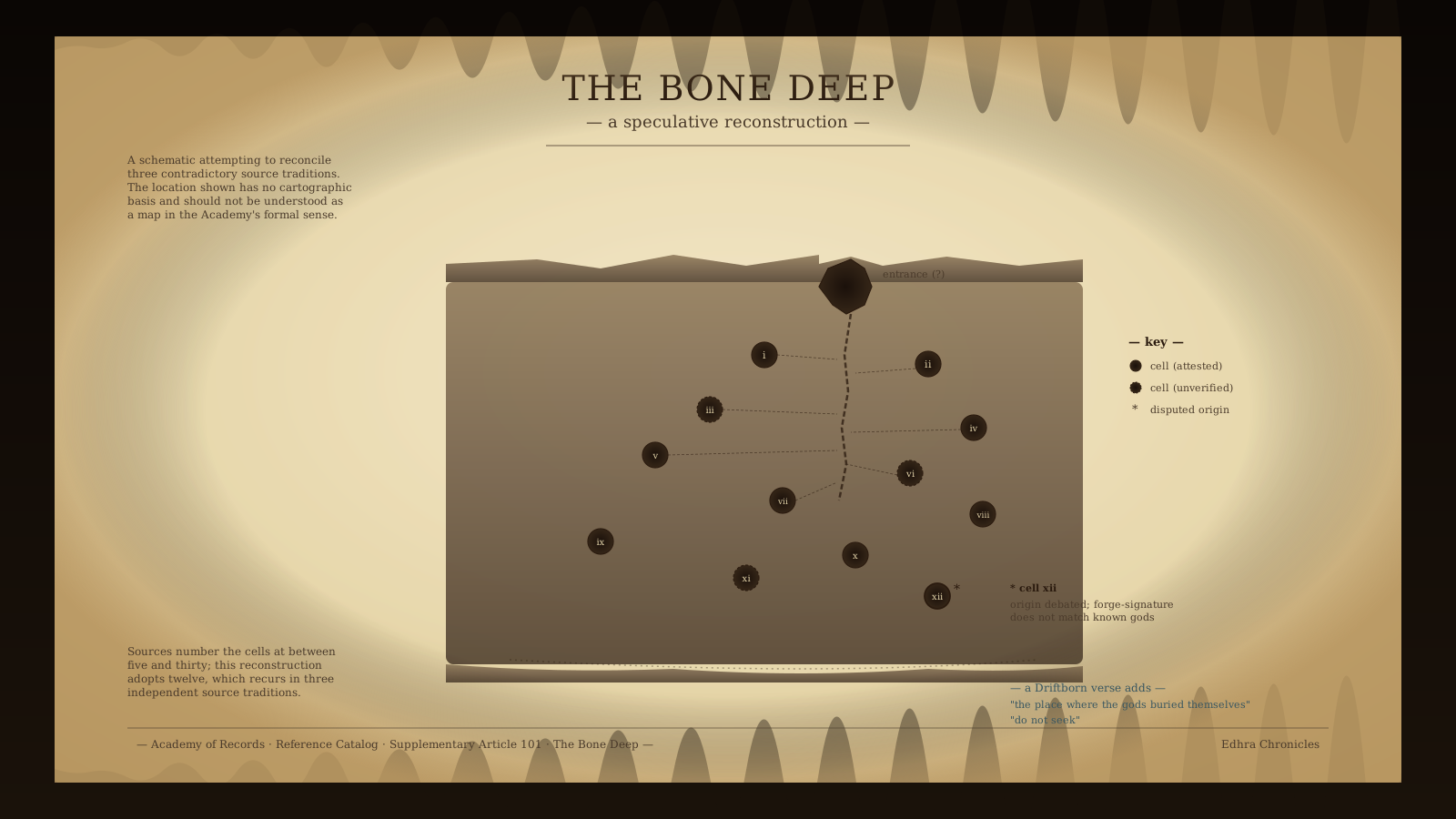
In most accounts, the Bone Deep is described as a cave network, not a single cavern. Sources disagree about the number of cells; figures range from five to more than thirty. A recurring count across several sources is twelve, which appears in three separate traditions and is worth flagging for later study.
Its cells are described as sealed by mechanisms attributed to the gods themselves. Specific mechanisms vary by tradition — doors, wards, thresholds, "a hand that must be known" — but the common element is that the sealing is divine rather than human. Every surviving tradition dates the sealing to the period before the Dissolution of Year 0.
What is said to be inside the cells, in every tradition that addresses it, is objects. Different traditions call these objects by different words — weapons, keys, tools, instruments, teachings-made-solid — but the common claim is that they were forged from the substance of the gods themselves during the final years of the pre-Dissolution period. According to these accounts, the purpose of sealing them was that the gods did not trust themselves to keep such objects in reach, and chose to bury them where they could not be retrieved without cost.
As for the name, in Coastal plain speech, "Bone Deep" is not elaborate and does not attach to any origin myth that the Academy has verified. Some sources propose that the cave's entrance is shaped like a skull's eye-socket and that "Bone" refers to the stone itself. Other sources propose that "Bone" refers to what the gods used as the base material for the forgings. In this telling, the artifacts were forged from divine substance, and this substance was called bone in the ritual language of the period. Neither explanation is considered conclusive by the Academy. The name is simply what the Coast calls the place, and has done for as long as there has been writing to record it.
——— ◇ ———
The Documentary Evidence
Within the Academy's own records, four documents bear on the question of the Bone Deep's existence, though none resolves it.
First, a fragmentary scroll from the collection of the Academy's oldest library, dated by the conservative methods to the first or second century after the Dissolution. It lists, in a formal hand, twelve items attributed to different gods of the Coast: three attributed to Aethis, two each to Maran and Ithros, one each to Veyra and Thessik, and three whose attributions are not legible. It does not say where these items are. It does not call them artifacts or relics. It calls them holdings, which is a Pre-Dissolution term whose precise meaning has been debated. The scroll is catalogued in the Academy's records as a devotional list of hypothetical offerings and is not formally considered evidence of the Bone Deep.
Second, a report from an Academy expedition in the seventh century to survey a Coastal province that is not named here. It was submitted, reviewed, and rejected for publication on the grounds that its methodology was unsound. Its author described an underground formation of substantial extent, encountered during the survey. The expedition's senior member described it as "an arrangement of cells whose interior perception resisted entry." That author was subsequently reassigned to administrative duties and did not write further on the subject. His report is preserved in the Academy's closed archive and is not publicly available. Its existence is mentioned here because a careful scholar should know that the report exists, not because the Academy accepts its contents.
Third, a group of personal letters, written by a scholar who was a peer of the Academy's founding generation and whose name is not included here for reasons of her descendants' privacy. Her letters, written over approximately thirty years, describe her repeated attempts to locate what she called "the deep below the Coast" and her repeated failures. Her final letter, written approximately one year before her death, is a single sentence: I believe now that it does not refuse to be found; it refuses to be found by me. Her letters are in the Academy's collection. Her other work is highly regarded.
Fourth, a set of Driftborn song verses, which the Academy does not catalog by document but which its ethnographic division has collected over the last two centuries. These verses describe, in consistent imagery, "the place where the gods buried themselves" and enjoin singers not to seek it. Driftborn tradition does not treat the Bone Deep as a place to be found. It treats the Bone Deep as a place to be not found, and treats the distinction seriously.
——— ◇ ———
The Dissenting Tradition
A smaller counter-tradition exists and should be noted for completeness.
This counter-tradition, which appears mostly in Anchored folk song from the eastern mainland, holds that the Bone Deep does not exist and never did. In this telling, the myth of a cave of forged divine weapons is a psychological projection. It is the collective imagination of a Coast that lived for three centuries under the shadow of gods who ultimately dissolved themselves, and whose followers could not believe the dissolution was complete. The counter-tradition treats the Bone Deep as the Coast's refusal to accept that the gods are gone. It is a story about where their leftover power is still waiting, told by people who cannot accept that there is no leftover power at all.
The Academy does not formally endorse the counter-tradition either. It is noted here because the tradition exists, some scholars find it persuasive, and the balance of the public record should include it.
——— ◇ ———
The Academy's Formal Position
The Academy's formal position on the Bone Deep has been unchanged for four centuries. No Academy publication recognizes the Bone Deep as a verified geographic feature. No Academy guidance recommends that scholars or expeditions attempt to locate it. No Academy budget funds research into it.
This position is sometimes misread as a claim that the Bone Deep does not exist. It is not that claim. The Academy's position is that the question of the Bone Deep's existence is not answerable by the methods available to the Academy, and that committing institutional resources to an unanswerable question is not a prudent use of those resources. A reader who wishes to believe in the Bone Deep may do so. A reader who wishes to disbelieve may do so. The Academy, in its formal capacity, holds neither position.
Readers who inquire further will find that the Academy's unwillingness to commit here is itself the tradition's most interesting feature. An institution of the Academy's scale does not usually sustain four centuries of formal neutrality on a question of simple folklore. Why the Bone Deep receives this unusual treatment is a question the present article does not attempt to answer.
——— ◇ ———
This article is part of the Cultures of the Shifting Coast reference series, supplementary articles. It was added to the reference catalog in response to documented reader interest. It supersedes no prior Academy publication.