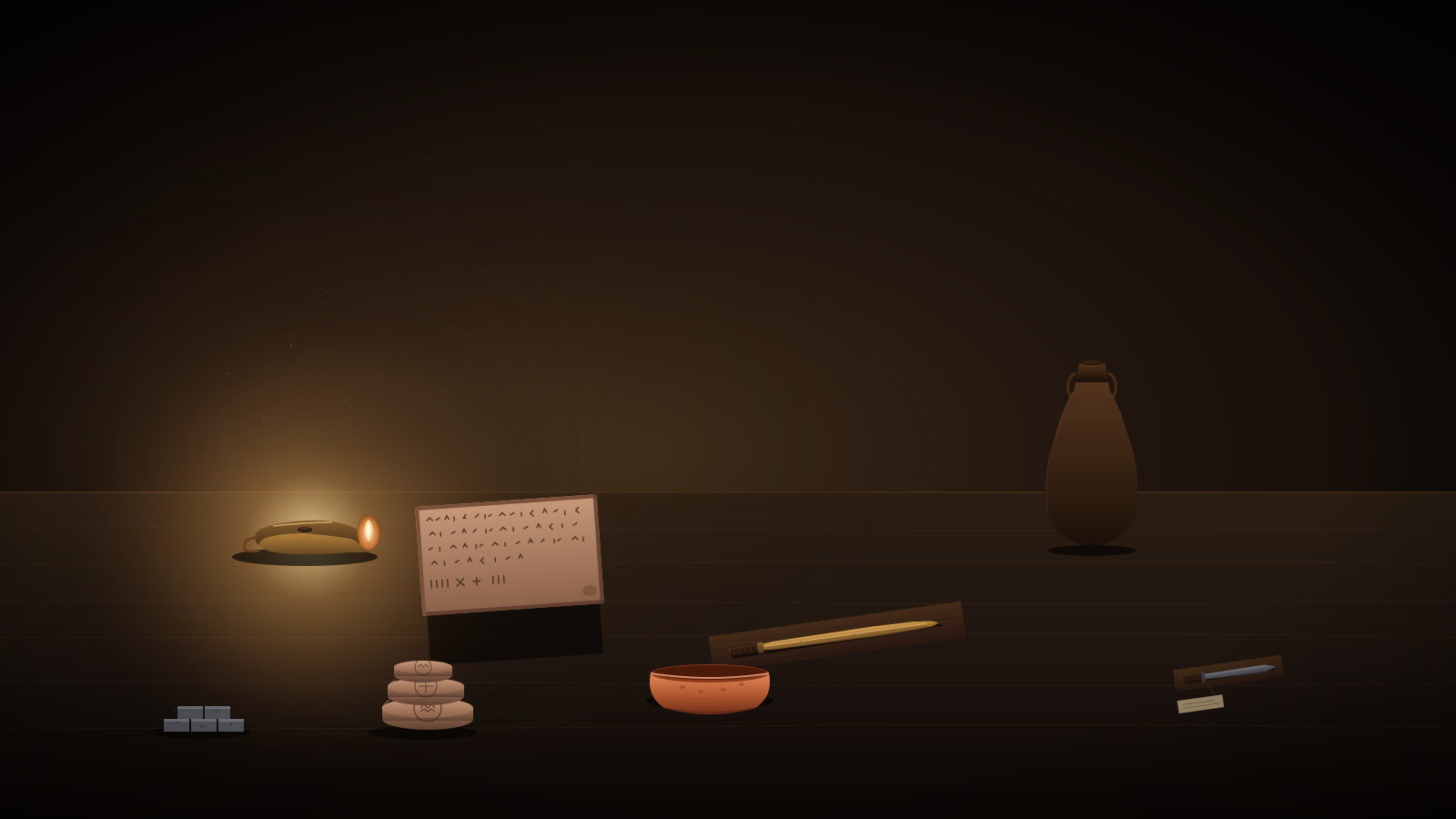
The material register of the Shifting Coast. What the world is made of.
——— ◇ ———
The Shifting Coast exists in what scholars of the Academy of Records have long classified as a stable bronze register. This phrase means something specific. It is not merely a description of what materials happen to be in use. It is an observation that the Coast has remained at this level of metallurgy, tool-making, and material economy for somewhere between eight hundred and a thousand years — far longer than any recorded civilization should, and long enough that the question of why has become its own field of scholarly inquiry.
Bronze is the defining alloy of this world. Tin and copper, when combined in the proper ratios, yield a metal strong enough for most weapons, most tools, most of the hardware of ordinary life. Iron exists — it is known, it is worked in small quantities, it appears in specialized applications — but it has never achieved the economic or cultural dominance that scholars reconstructing pre-Dissolution records suggest it should have. Something about the Coast resists the transition.
Materials of Daily Life
The material inventory of a typical Coastal household is straightforward. Bronze for blades, cookware, fittings, and fine tools. Copper for pipes, roofing in the wealthier districts, ornamental work, and the plating of official documents. Tin for finer vessels and for alloying. Lead for weights, seals, and the heavy plumbing of larger buildings. Stone, everywhere, for construction and for the grinding wheels that mill grain. Wood for ships, furniture, and the internal fittings of stone buildings, though never — as the Karath Compact insists — for structural walls in proper Anchored cities.
Pottery is universal. Fired clay serves for storage, cooking, lamps, water containers, and the tablets on which most administrative records are still kept. Parchment and bound codices are reserved for the Academy's scholarly work, but the everyday bookkeeping of the Coast — harbor manifests, customs receipts, fishermen's catch records — still happens on clay, scored with styluses and fired to preserve. A harbormaster's office looks less like a modern archive than like a library of bricks.
Glass is rare and expensive. Windows in ordinary buildings are shuttered openings; glass panes are a luxury of the High City. Lamps burn olive oil, fish oil, or — in the poorer districts — rendered fat. Wax candles exist but are reserved for ceremony.
What the Coast Has and What It Lacks
The Coast has good metallurgy within its register. Anchored smiths produce bronze of exceptional quality, and the Driftborn maintain their own forging traditions aboard their larger vessels. Weapons are well-made. Ship fittings are reliable. Copperworking from the Tri-Port is exported across the Inner Sea and commands premium prices. What the Coast does not have, what it has never sustained for long, is scaled iron production. Foundries are attempted; they fail. Blast furnaces are built; they break down or are abandoned after a generation. Iron tools exist but are rare enough that owning a set is a mark of status.
Steel, proper steel, is essentially absent. A few antique blades in private collections — pre-Dissolution, and of uncertain provenance — are the only examples most Coastal scholars have ever examined. No working smith on the Coast can reliably produce it.
Gunpowder is unknown. Printing presses do not exist. The wheel, the sail, the pulley, the lever, the simple water-mill — all present, all refined, all integrated into daily life. The more complex mechanisms of later ages are not.
The Economy of Metal
The metal trade shapes the Coast more than any other single economy. Tin comes from the northern islands, where deposits are shallow and readily worked. Copper comes primarily from the Iron Coast, which is named for the copper-rich mountains that rise from its interior despite what the name suggests. Tin and copper meet in Karath, in the foundries of the southern atolls, and in a handful of Driftborn floating smithies that move between ports as demand shifts. Bronze is the result, and it travels everywhere.
Because bronze is the defining material, the price of bronze is the price of nearly everything else. A bad tin harvest in the north affects weapons, tools, ship fittings, and currency simultaneously. Academy scholars maintain a Bronze Index — a weekly assessment of alloy costs — and merchants across the Coast adjust their prices by it. A farmer in the outer atolls who has never seen Karath still feels its calculations in the cost of his plow.
Why the Coast Has Stayed
The question that interests scholars most is not what the Coast has, but why it has not advanced. Several answers are commonly offered. None is complete.
The first answer is geological. Iron-rich deposits on the Coast are concentrated in regions that are, for reasons the Academy has not fully explained, difficult to work at scale. Foundries attempted in these regions suffer from accidents, equipment failures, and worker illnesses at rates far higher than comparable operations elsewhere. Most are abandoned within a generation.
The second answer is economic. The Coast's trade networks are optimized around bronze. A transition would impose enormous costs on merchants, smiths, and governments whose wealth and authority depend on the current equilibrium. Several Anchored councils have, over the centuries, actively suppressed experimental foundries that threatened to disrupt established metal markets.
The third answer, offered quietly and never by the Academy officially, is that the world itself prefers to stay where it is. The Driftborn say this openly. The Anchored do not.