An Academy of Records reference article. Part of the Peoples and Cultures series.
The Driftborn carry their knowledge in voice. This is the structural fact from which most of what follows proceeds: a civilization that does not commit its record to writing must maintain its record by other means, and the Driftborn have maintained theirs for as long as the Academy has been in a position to observe. This article describes what the oral tradition carries, how it is transmitted, and why the Driftborn have chosen to keep it unwritten. Readers are directed first to the articles on the Driftborn, on Driftborn mobile settlements, and on Driftborn customs and ceremony, all of which this article assumes.
——— ◇ ———
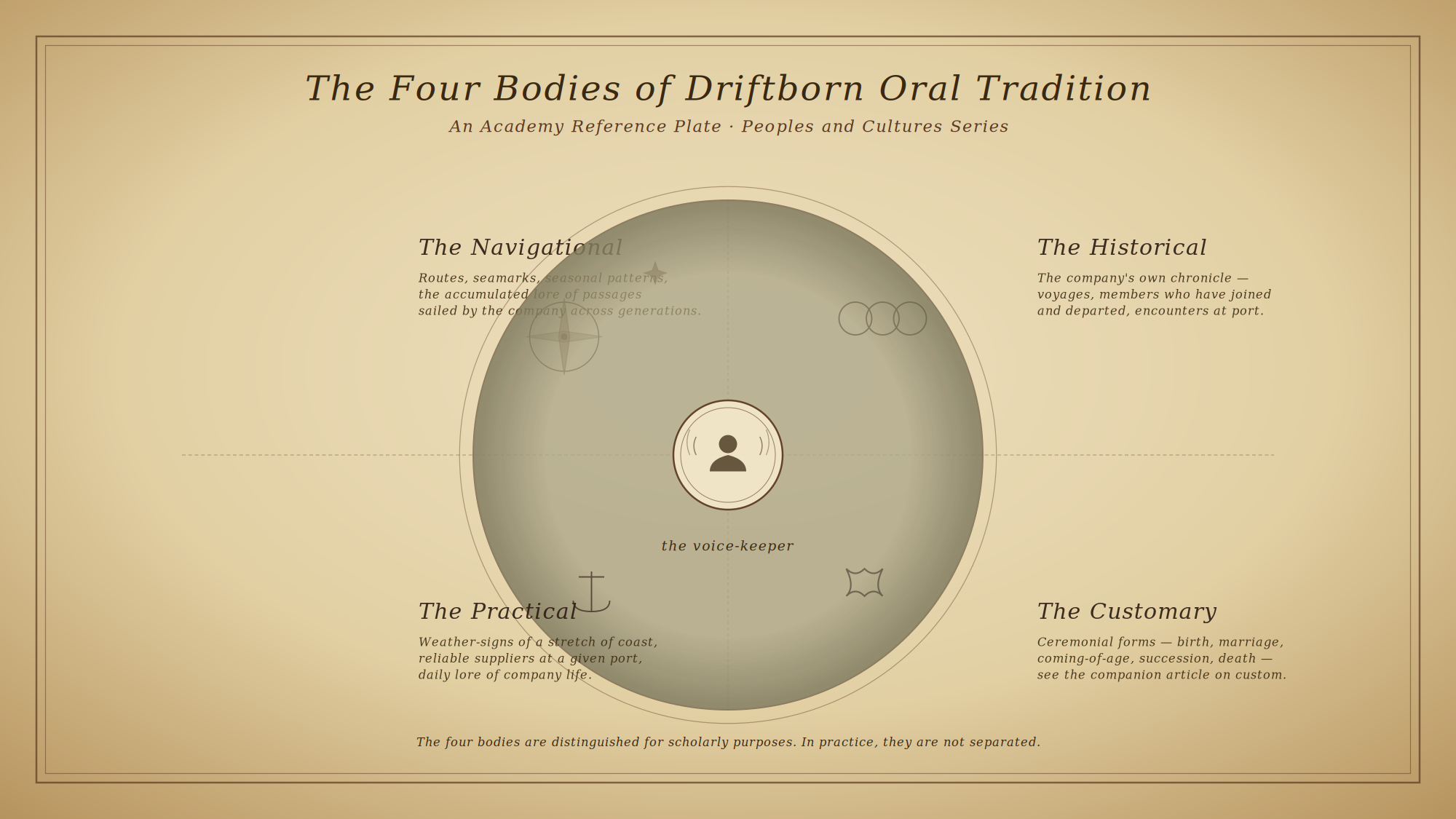
What the tradition contains. The oral tradition of a Driftborn company is not a single body of knowledge but several. Academy observers have found it useful to distinguish four. The navigational consists of routes, seamarks, seasonal patterns, and the accumulated lore of passages sailed by the company across generations. The historical consists of the company’s own chronicle — the voyages undertaken, the members who have joined and departed, the encounters with other companies and with Anchored ports. The customary consists of the ceremonial forms described in the companion article on Driftborn customs. The practical consists of everything from the weather-signs of a particular stretch of coast to the reliable suppliers of cordage in a given port. In practice, these four bodies are not separated. A voice-keeper asked for a route from memory will typically recite not only the course but the events of earlier sailings along it, the custom observed on departure, and the names of the shipmates who first sailed it. Driftborn tradition does not disaggregate.
——— ◇ ———
How the tradition is transmitted. Voice-keepers are trained from childhood, usually by the senior voice-keeper of their company, across a period of decades. Transmission is by recitation and repetition. A candidate for the role learns in ordered sequence, beginning with the portion of the tradition most often used in the company’s daily life and moving outward. Memorization techniques include cadenced delivery, association with specific physical places aboard the company’s vessels, and fixed opening and closing phrases that bracket each unit of content. As the customs article notes, the succession ceremony marks the point at which the trained successor is judged capable of carrying the tradition; it does not mark the end of learning. Most voice-keepers are still receiving portions of the tradition from their predecessors well into their second decade of formal practice.
——— ◇ ———
Why the Driftborn do not write. Academy observers have collected, over centuries, the reasons Driftborn voice-keepers have given when asked. They are not uniform, but three recur. The first is that writing preserves without remembering: a written record will sit on a shelf and be forgotten, while a spoken record must be recited to survive, and recitation maintains the company’s attention. The second is that writing fixes: a form committed to paper becomes difficult to revise, while a form carried in voice is revisable by the voice-keeper who holds it and is understood to have changed hands many times. The third is that writing is exposed: a written record can be taken, copied, or read by an outsider, while an oral tradition can only be received by those to whom it is transmitted. These reasons are given as practical rather than principled, though Anchored observers have sometimes taken them for the latter.
——— ◇ ———
Accounts of events. One function of the oral tradition that does not appear in the written records of the Anchored deserves particular note: the preservation of accounts of events that occurred at Anchored ports, witnessed by Driftborn and carried to the voice-keeper afterward. By Driftborn custom, such accounts are not offered to Anchored authorities unless specifically requested, and are not offered at all in matters considered internal to an Anchored household. Companies that have docked regularly at a given port over generations will often hold, in their voice-keeper’s tradition, an account of events at that port from a different angle than the one the Compact court has recorded. Access to such accounts, when the company has chosen to permit it, requires the formal arrival of a colleague or visitor — “I come to carry what you have carried” is the customary opening — and is conducted with the ceremonial object each voice-keeper maintains for the purpose.
——— ◇ ───
This article is a Paid-tier entry of the Academy of Records’ Peoples and Cultures series. A full treatment of the oral tradition would be the work of Driftborn voice-keepers themselves, and no such work has been published in a form the Academy can cite. Readers interested in specific adjacent topics are directed to the articles on Driftborn customs and ceremony, on Driftborn mobile settlements, and on the languages of the Coast.