An Academy of Records public reference article. On the mobile peoples of the Shifting Coast — their companies, their traditions, and their sea-bound way of being.
——— ◇ ———
The Driftborn are the peoples of the Shifting Coast who live on the sea. They are organized not as a single civilization but as a loose association of several hundred companies — mobile communities, each built around a fleet of ships, each carrying its own traditions and practicing its own version of a broadly shared way of life. They keep to no fixed place. They pass their knowledge down in voice rather than in writing. They follow the fish and the winds and the turn of the year, and consider the sea not as a medium between places but as the place itself.
This article is an Academy overview of Driftborn life. Readers should be aware from the outset that Academy scholarship on the Driftborn is written from outside — the Academy is an Anchored institution, and much of Driftborn oral tradition is either unavailable to Anchored scholars or available only in partial and mediated form. The companion article on the Anchored was written from inside that civilization; this one is not. Where the Academy has documented something directly, it is so noted. Where the Academy is working from second-hand testimony or from the reports of Anchored observers, it is so noted as well. A complete account of the Driftborn would be the work of Driftborn voice-keepers, and no such account has been published in a form the Academy can cite.
——— ◇ ———
Who and Where
The Driftborn population of the Shifting Coast is estimated at between forty and seventy thousand. This is a considerably smaller population than the Anchored, though it is distributed across a much larger area and is, by the nature of its mobility, more difficult to count precisely. The estimate is arrived at by the Academy through a combination of port-register surveys, fleet-count reports from the Port Watch, and direct testimony from Driftborn voices at the annual Kira Moot.
This population is organized into what the Driftborn themselves call companies. Academy record keeps track of approximately three hundred and fifty to four hundred companies of significant notation — meaning companies large enough to appear in port registers, to send voices to the Moot, and to maintain continuous traditions. Many smaller groupings exist below this threshold: family fleets of two or three vessels, breakaway groupings not yet formally constituted, companies in dissolution. The total number of Driftborn social units of any kind is certainly greater than the documented count, and may be considerably greater.
Companies range widely in size. The largest documented companies include between two hundred and three hundred members across a dozen or more vessels; the smallest maintained companies may have only thirty or forty members across three or four vessels. Company size is not a measure of standing. A small company of long tradition may carry more weight at the Moot than a large one of recent origin.
——— ◇ ———
What a Company Is
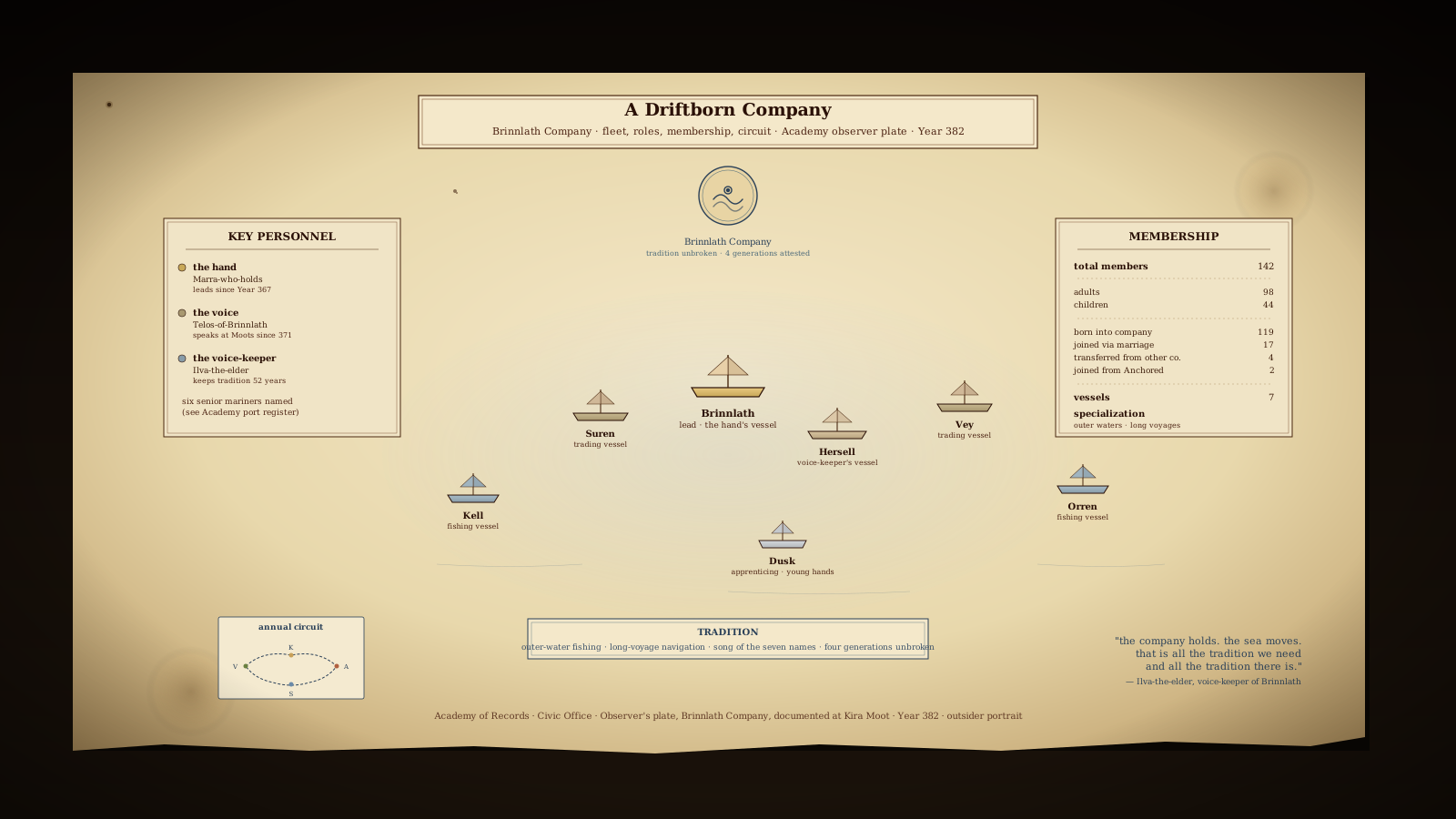
A Driftborn company is a mobile community organized around a fleet. Its members share vessels, work, seasonal circuits, meals, ceremonies, and a tradition. Company membership is partly hereditary — most Driftborn are born into the company their parents belong to — but is not exclusively so. Companies accept new members through marriage or transfer from other companies, occasionally from among the Anchored who have chosen a sea-bound life, and more rarely from individuals of unknown origin picked up at sea.
Each company is led in practical terms by a figure the Driftborn call its hand — the person responsible for day-to-day decisions about course, work, and the company's immediate direction. Hands are chosen by the company, not inherited. Selection varies by company and is not standardized; what remains consistent is that a hand serves only with the company's ongoing consent and can be set aside if that consent is withdrawn.
Distinct from the hand is a role the Driftborn call the company's voice. The voice represents the company at gatherings — at the Kira Moot and at smaller regional convocations — and speaks for the company when it must be spoken for. Voice and hand are sometimes the same person and often are not. In many traditions the voice is the company's oldest or most widely traveled member.
Each company carries its own tradition: a body of oral knowledge including navigation lore, weather-reading, fishing technique, genealogy, ceremonial practice, and a characteristic specialty. Some companies are known for particular routes, others for particular catches, others for particular song, others for particular skill at weather-prediction. A company that loses its tradition — through catastrophe, through failure to transmit — is considered to have dissolved even if its vessels and members remain.
Companies are fully independent of one another. No governing Driftborn body exists, no equivalent to the Karath Compact. Companies cooperate when their interests align and go their own ways when they do not. Disputes between companies are resolved at convocations or at the Moot; no formal mechanism exists to compel acceptance of a ruling, though persistent refusal carries reputational consequences that most companies are careful to avoid.
——— ◇ ———
The Working Year
A Driftborn company's year is organized around seasonal work. Veren, for most companies, begins the year's active labor: migration from winter shelter back into the productive waters, the resumption of commerce, the reopening of the fishing circuits. Kira is the peak season — long days, reliable weather, the Moot, and the bulk of the year's fish-work and trade. Arhen brings the black tides and a withdrawal into the more sheltered waters of the Inner Sea or, for some companies, into protected harbors arranged with specific Anchored ports. Siol is the quiet season, when companies winter at varied locations, mend vessels, teach the young, and conduct the ceremonial work that requires time.
This cycle is broadly consistent across companies, though specific routes and timings vary. A company that works the Inner Sea primarily follows a different annual pattern from one that works the outer waters or the atoll chains. What remains constant is the principle that the year is structured by seasonal work on the sea, not by cycles of planting and harvest. The Driftborn do not farm. They do not build in place. Their annual rhythm is the rhythm of following the fish, the winds, and the openings between storms.
Fishing is not the only Driftborn work. Many companies carry trade goods between ports — this is how the Coast's inter-port commerce is substantially conducted, with Driftborn companies serving as the moving component of a commercial system whose fixed component is the Anchored port network. Some companies specialize in hauling freight, some in carrying passengers, some in courier work, some in exploration of less-traveled waters. The distribution of specializations is stable enough that most Anchored port-masters can predict, based on the flag of an approaching company, what sort of business is likely being brought.
——— ◇ ———
Gatherings
The great annual Driftborn gathering is the Kira Moot, treated in more detail in the separate article on Driftborn mobile settlements. It assembles in mid-Kira at a rotating Inner Sea location, lasts two to three weeks, and is attended by a significant majority of the Coast's companies. At the Moot, companies trade, marry, settle disputes, exchange information, admit new companies to broad recognition, and confirm the ceremonial calendar for the year ahead. The Moot is the closest thing the Driftborn have to a coast-wide civic institution, and most Driftborn consider attendance at the Moot a defining mark of a functioning company.
Smaller gatherings, called convocations, occur throughout the year at varied locations. A convocation is an ad-hoc meeting of several companies — typically between five and twenty — to address shared concerns in a specific region or at a specific moment. Convocations can be called by any company that has cause and can persuade others to attend. Most convocations address immediate practical matters: a dispute over fishing grounds, a rescue coordination, a joint response to a dangerous weather pattern. A convocation's decisions bind only the companies that attend and consent; its authority extends no further.
The Academy has attempted, over the centuries, to establish regular observer access to Driftborn gatherings. Access varies by company and by year. At the Kira Moot, Academy observers are typically admitted on a limited basis — present for the trading and the public announcements, excluded from the ceremonial and internal-governance portions. At convocations, Academy presence is generally not welcomed. The Academy's written record of Driftborn internal proceedings is, accordingly, thin.
——— ◇ ———
Religion, Ceremony, and Tradition
Driftborn religious practice, like Anchored religious practice, has no unified form. Different companies observe different traditions. Shared features that Academy scholarship has been able to identify include an orientation of ceremony around lunar cycles rather than seasonal quarters, the importance of specific navigational events as ceremonial markers, and a strong emphasis on oral transmission from one generation to the next.
Many Driftborn companies maintain ceremonial observances at each new moon and at each full moon of Teska, with varying specific content. Passages through particular waters, first sightings of particular constellations, and certain tidal events are also ceremonially marked. Details vary widely by company, and the Academy has documented only the forms that companies have chosen to share with outside observers.
Post-Dissolution Driftborn religion includes the same range of positions found among the Anchored. Some companies maintain ceremonies referencing figures from the pre-Dissolution tradition. Others observe ethically-oriented ceremonial practice without specific invocations. A minority maintain explicitly pre-Dissolution forms; these companies are broadly respected though rarely imitated. A philosophical-skeptical position exists in Driftborn tradition as well. Religious diversity within the Driftborn is at least as great as that within the Anchored, and possibly greater.
The Driftborn transmit their tradition orally. Each company has a voice-keeper — distinct from the voice who speaks at gatherings — responsible for carrying and teaching the company's body of knowledge. Voice-keeping is considered the most demanding and most honored work within a company. Voice-keepers are trained from childhood, typically across many decades, and are expected to recite their company's full tradition on request. Writing is not unknown among the Driftborn — many can read and write — but tradition itself is not written down, and companies that have attempted to commit their traditions to writing have generally found the attempt difficult to sustain.
——— ◇ ———
The Driftborn and the Anchored
Driftborn understanding of the Anchored is, like Anchored understanding of the Driftborn, more complex than casual observers assume. Most Driftborn companies maintain working relationships with specific Anchored ports — for provisioning, for winter shelter, for trade, for marriages and other exchanges. These relationships are often long-standing; some companies have wintered at the same port for generations. The practical interdependence of the two ways of life is substantial.
At the same time, Driftborn and Anchored perceptions of one another do include the simplifications that simplified perceptions always include. Many Driftborn, when asked, will characterize the Anchored life as one of stationary imprisonment — spent, as Driftborn traditional phrasing puts it, in the same sight of the same shore. Many Anchored, when asked, will characterize the Driftborn life as one of rootless transience. Neither characterization captures the lived reality of either people, but both circulate, and both are occasionally accurate about the form of the other life that the characterizer has personally encountered.
Intermarriage between Driftborn and Anchored is uncommon but documented. The usual pattern when it occurs is that one partner joins the other's household or company, and the resulting family follows the adopted pattern thereafter. Children of such marriages are generally raised within the adopted tradition, though a minority maintain identifiable ties to both.
——— ◇ ———
What "Driftborn" Means
The word Driftborn refers, in its oldest documented usage, to someone born on the sea — born to parents who were themselves at sea at the time, and raised in that condition rather than put ashore at the first opportunity. The term has since broadened to include all members of the mobile sea-going companies, whether or not they happen to have been born literally at sea. Most contemporary Driftborn are, in fact, born at sea, though the term no longer requires it.
To be Driftborn, in the fullest cultural sense, is to have accepted that one is going somewhere, and that the going is itself the home. The sea is not, for the Driftborn, a medium between places. The sea is the place. The wind is the weather of the place. The tide is its breath. The company is its household, the vessel its hearth, the horizon its wall. A Driftborn does not travel across the sea from land to land; a Driftborn lives on the sea, which happens to have land in it.
This way of being has costs that Driftborn scholarship, insofar as the Academy has been able to sample it, does not pretend to overlook. The costs are those of impermanence — the difficulty of accumulating what cannot be carried, the vulnerability of small communities to specific catastrophes, the weight of transmitting by voice what cannot be written down without loss. The benefits are those of a different kind of continuity — the continuity of tradition rather than of structure, of practice rather than of place, of the company's shared knowledge rather than its inherited property. Whether the costs outweigh the benefits is a question the Driftborn have no more settled than the Anchored have settled the reverse, and for the same reason: it is the question each way of life consists in answering.
——— ◇ ———
This article is classified as a foundational public reference of the Academy of Records, Karath. It should be read alongside the companion article on the Anchored and the subsequent articles on specific aspects of Driftborn life. Readers interested in Driftborn navigation, the Kira Moot, individual notable companies, or the history of the Driftborn peoples are directed to the relevant articles in this series. The Academy welcomes correction or amendment of its Driftborn-facing scholarship from Driftborn voice-keepers willing to offer it.