An Academy of Records reference article. Part of the Factions series.
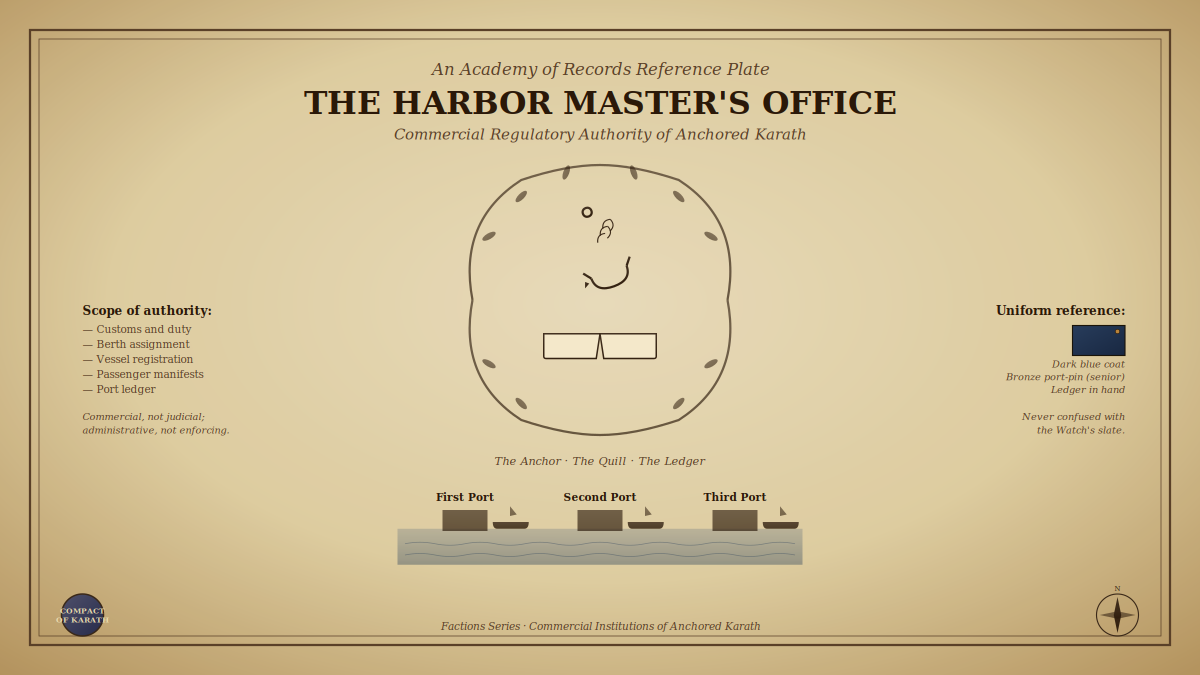
The Harbor Master’s Office is the commercial regulatory authority of Karath and, by long adoption of the Karath model, of most allied Anchored ports along the Shifting Coast. It administers customs, berth assignment, vessel registration, and passenger manifests. Its authority is derived from the Karath Compact and is exercised in parallel with the Port Watch, which handles enforcement.
Readers seeking the legal framework the Office operates within should consult the Anchored Law reference. For the civic-administrative body from which the Office draws its authority, see the Karath Compact article; for the enforcement arm of Karath civic life, see the Port Watch article.
——— ◇ ———
Authority and scope
Office authority is commercial rather than civic. It does not issue judicial rulings — that is the Compact’s function — and it does not command forces of enforcement — that is the Watch’s. What the Office controls is the daily machinery of the port: which vessels may berth and at what fee, which goods may be unloaded and under what duty, which passengers may disembark and under whose surety, and which captains may continue to trade at Karath under what ledger standing.
In practice, this authority is substantial. A captain may stand within the bounds of Anchored Law and within the standing of the Compact and still lose his berth if his ledger account with the Office falls into arrears. A merchant may be free of criminal suspicion and still find his consignment held at customs until assessment is settled. Most working captains and merchants of Karath accordingly interact with the Office more often than with any other civic institution.
——— ◇ ———
Uniform and identification
Officers of the Office are known by their dark blue coats — a deeper colour than the slate of the Watch, and by longstanding custom never mistaken for it. Senior officers wear a small bronze pin at the collar indicating their port of assignment; junior officers and collectors wear no pin but carry the ledger of their assigned pier at all times during working hours. The ledger is the most reliable field identification of an Office collector: a Harbor Master’s man without his ledger is a man off duty or a man whose duty has been suspended.
——— ◇ ———
The ledger and the manifest
Every vessel in port is recorded in the Office’s ledger — arrivals, departures, berth assignment, fee standing, and the summary of each vessel’s declared cargo and passenger manifest. This ledger is the Office’s foundational document. A vessel not in the ledger is a vessel whose presence at the pier has not been authorized, and the Watch is notified of such presence within the hour.
Passenger manifests are originated by the Office and copied, on a delay of several days, to the Watch, where specialist retired clerks maintain parallel records for criminal-referral and missing-person purposes. The existence of two independent copies of each manifest — one commercial and one civic — is a structural feature of Karath’s institutional design that predates the present Compact text.
——— ◇ ———
Berth assignment and collectors
Berth assignment at Karath’s three principal ports is the Office’s most visible public function. Assignments are made for defined terms and are renewable on settlement of standing fees. A vessel may occupy its berth while current on fees; a vessel whose fees have lapsed passes first to grace, then to warning, and finally to reassignment. A captain whose ledger account has fallen more than eight weeks into arrears may be informed, without further warning, that his berth will be transferred at the next dawn-bell unless settlement is received before then.
Collectors are the Office’s field staff. Each principal pier is assigned a collector who works the same ledger for years or decades at a time, and who is generally known by name to every captain working that pier. Collectors are trained to record every exchange — including every refusal, every lie, and every part-payment — in the ledger they carry. A collector who fails to record a conversation is a collector whose superior has ordered him not to record it, and the ordering of such a silence is itself a matter of record. Captains familiar with the Office watch the stylus as carefully as they watch the figure on the ledger.
——— ◇ ———
Relationship to the Compact and the Watch
As a Compact-licensed institution, the Office is subject to Compact regulation. Its practices, fee schedules, and customs-assessment rules are reviewed at the Compact’s annual sitting in Veren. The Office is not, however, an enforcement body: when commercial disputes exceed administrative settlement, they are referred to Compact-court; when criminal matters arise in the course of port business, they are referred to the Watch. Office staff are trained from their first year not to exceed the Office’s commercial remit.
——— ◇ ———
Allied ports
At allied Anchored ports, the Office’s pattern is reproduced at smaller scale. A coastal town’s Harbor Master may oversee a single pier and a staff of a handful of collectors; a mid-sized port will maintain a principal office and two or three assistants. Uniform, ledger, manifest, and berth-assignment procedures remain consistent across the Karath model, so a captain accustomed to working Karath will find the same institutional forms at any allied port.
——— ◇ ———
Reputation
Like the Compact and the Watch, the Office is understood as ordinary machinery rather than cherished institution. Its collectors are respected by the working pier in proportion to their professionalism. A collector known to keep his ledger honestly and to extend reasonable grace on fees in arrears is treated as a working neighbour; a collector known for petty corruption is shunned and eventually reported. Office reputation depends accordingly on the accumulated character of its collectors, one pier at a time — which is one reason, among others, why collectors at Karath are rotated infrequently, and why a single collector often works the same pier across a full working career.
——— ◇ ———
This article is a Free-tier entry of the Academy of Records’ Factions series. Readers are directed to the companion articles on the Karath Compact, the Port Watch, and Anchored Law for the institutional framework within which the Office operates.