An Academy of Records public reference article. The central body of water around which Coastal civilization is arranged.
——— ◇ ———
The Inner Sea is the broad, semi-enclosed body of water around which all Coastal settlement of any scale has been organized for at least four thousand years. Bounded on the north and west by the mainland, on the south by the major atoll chains, and on the east by the outer island groups, it extends approximately six hundred leagues at its greatest east-west span and four hundred fifty leagues north to south. Its waters are temperate, its tides regular for most of its shore, its commerce stable, and its Bleed activity — by the standards of the wider Coast — notably subdued. It is, for the civilization that lives along its margins, the sea.
The Academy of Records treats the Inner Sea as a single hydrographic entity despite its three principal openings to outer waters. This is partly a matter of convenience and partly a reflection of observed physical reality: the Inner Sea retains its water. Its internal circulation is self-contained in ways few enclosed seas on record can match, and the result is a body of water with unusually stable temperature, salinity, and biological character.
——— ◇ ———
Geography and Scale
At its widest, the Inner Sea measures approximately six hundred leagues from west to east — from the mainland coast at Karath to the easternmost outer islands — and between four hundred and four hundred fifty leagues from the northern coast to the southern atoll chains. Its surface area has not been precisely calculated; Academy hydrographers give a range of 180,000 to 210,000 square leagues, the uncertainty arising from ambiguities about where the Inner Sea ends and the atoll-archipelago regions begin.
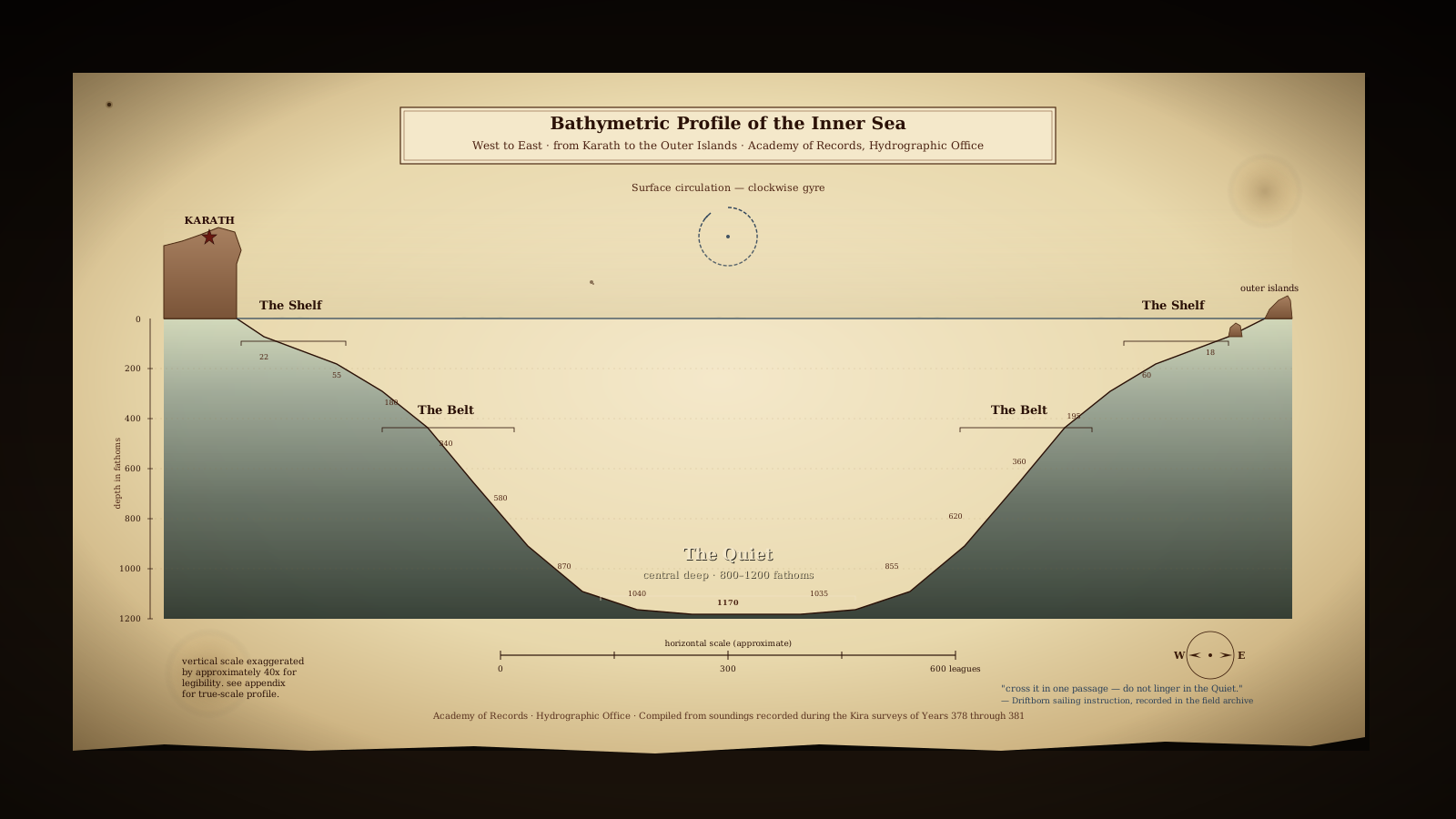
Bathymetry varies dramatically. Near the mainland, a broad continental shelf extends as much as forty leagues from shore before dropping off to deeper water. Along the atoll chains, the shelf is narrow or absent, and deep water lies close to the coral margins. The central Inner Sea is deep — between eight hundred and twelve hundred fathoms over most of its area — and rises toward the three principal openings as the seabed ramps up to connect with the outer waters beyond.
Broadly, the Inner Sea forms a triangular basin with rounded corners, deeper in the middle than at its margins, and it behaves hydrographically as such a basin would.
——— ◇ ———
The Three Openings
Three principal openings connect the Inner Sea to the outer waters of the Coast.
The Northern Strait lies between the northern mainland peninsula and the northernmost outer islands. At its narrowest it is approximately twelve leagues wide, and its depth across that narrowest section is between sixty and eighty fathoms — shallow by Coastal standards, but deep enough to accommodate any vessel of ordinary Coastal construction. This is the most frequented route for commerce moving between the Inner Sea and the open waters east of the Trench.
Widest of the three openings is the Eastern Passage — approximately forty leagues across at its mouth, gradually narrowing as it extends eastward between the outer island groups. Commercial traffic along the Eastern Passage is seasonal, following the prevailing winds of Kira and early Arhen; out of season, the passage is passable but less favorable for sail.
Most constrained is the Southern Gate — a gap of approximately eight leagues between two of the principal atoll chains, with variable depths and challenging tidal flow. Local pilots are required for commercial passage through the Southern Gate, and the Karath Port Watch maintains a list of captains it certifies for the route. Its location on the route to the southern atolls and beyond makes it commercially important despite its difficulty.
——— ◇ ———
Internal Regions
Internal conditions in the Inner Sea are not hydrographically uniform. Academy publications recognize three principal sub-regions, defined less by sharp boundaries than by characteristic water, tide, and productivity.
The Shelf
Extending outward from the mainland to a depth of about eighty fathoms, the Shelf is a broad band of continental shelf water. It is warm in summer, cold in winter, and supports the dense fish populations on which Karath's civic economy depends. Most Anchored fishing is conducted within the Shelf; most Anchored wreck recovery, salt works, and harbor construction takes place here. This region is also where most Coastal Bleed activity below severe-zone classification is observed — low-level cognitive and biological effects that fishermen and harbor workers consider background conditions of their trade.
The Belt
Beyond the Shelf, where the seabed begins to drop toward deep water, lies the Belt — a ring of intermediate water that circulates slowly around the central basin. The Belt carries the Inner Sea's clockwise gyre, identified in the Academy's hydrographic surveys and referenced in the drift tables of the Karath Tide Office. Commercial traffic between Karath and the atoll ports crosses the Belt; its water is moderately productive, supporting mid-depth fisheries that Anchored and Driftborn crews alike work in season.
The Quiet
At the Inner Sea's center, where the gyre's radius approaches zero, lies a region the Academy's hydrographic office calls the Central Deep and the Driftborn call the Quiet. It is a circle of perhaps sixty leagues across where the surface is reliably calm — current near zero, wind disrupted by no local topography, the depth below between eleven hundred and twelve hundred fathoms. Ships crossing the Quiet typically report an absence of wake visible a hundred yards behind them. Fish populations in the Quiet are sparse by Inner Sea standards. The Academy classifies the region as unusually placid but otherwise unremarkable. Driftborn tradition holds that the Quiet is not a place ships should remain in overnight, and Driftborn navigational practice is to cross the Quiet in a single continuous passage rather than camp upon it. The reason, when asked, is given variously, and the Academy has not formally catalogued the Driftborn view.
——— ◇ ———
Bleed Character
From the Academy's hydrographic perspective, the Inner Sea's most distinctive feature is its relatively low Bleed activity. Compared to the Outer Deep, the coastal approaches to the mainland, and the waters beyond the Trench, the Inner Sea is quiet. Documented Bleed zones within it are rare — fewer than a dozen stable zones are recorded within the entire basin, and most of these are low-intensity and marginal to normal commerce. No severe-class Bleed zone has ever been documented within the Inner Sea's boundaries.
Why this should be the case is a question the Academy has returned to periodically without reaching settled conclusions. Proposed explanations include the enclosed geometry, the stable salinity, the slow water exchange, the resonance of the basin, and — less formally — the proximity to Karath and other continuous Anchored settlement, on the theory that sustained habitation somehow stabilizes what might otherwise bleed through. All of these explanations have defenders. None has achieved consensus. What is agreed is that the Inner Sea is quieter than it has any obvious reason to be, and that this quietness is why Coastal civilization is here and not somewhere else.
——— ◇ ———
Maritime Character
Commerce on the Inner Sea is routine in ways commerce on the outer waters is not. Routes between Karath, the atoll ports, and the outer island settlements are well-established, well-charted, and reliably navigated. Most captains working the Inner Sea never leave it, and never need to. The risks are ordinary maritime risks — storms in Arhen, the Bar at Karath, the Southern Gate's tidal flow — rather than the categorically different risks of the outer waters. A Coastal family can live by fishing the Shelf, a merchant can build a fortune in atoll trade without ever crossing a severe Bleed zone, and the Academy can maintain its offices in a city that does not require extraordinary navigation to reach.
This is the ordinary scale of Coastal life. It is, by design and by accident both, the world that Karath's civic order was built to keep intact.
——— ◇ ———
This article is classified as a standard public reference of the Academy of Records, Karath. Current hydrographic charts and seasonal Inner Sea passage advisories may be obtained at the Tide Office or at the Port Watch. Driftborn navigational tradition is preserved in the field-research archive and should be consulted for specific questions regarding the Quiet and the deeper Belt.