An Academy of Records reference article. Part of the Factions series.
The Karath Compact is the governing council of Anchored Karath and, by long imitation, the model for the governance of most allied Anchored ports along the Shifting Coast. This article treats the Compact as an institution — its authority, its annual sitting, its registry system, its judicial procedure, its relationship to licensed investigators, and the practical boundaries of its reach.
Readers seeking the enforcement arm of the Compact’s authority should consult the companion article on the Port Watch. For the commercial regulatory framework within which the Compact sits, see the Harbor Master’s Office article. For the legal code the Compact administers, see the Anchored Law reference.
——— ◇ ———
Foundation and authority
The Compact was founded at Karath in the settlement period following the Great Shift. Its founding document, the First Compact, established the civic authority of Anchored Karath as a body of licensed councillors empowered to settle disputes, to issue binding judgments, and to maintain the standing institutions of the city.
Compact authority is civil and administrative rather than executive. It does not command forces in the field — that function falls to the Port Watch — and it does not directly control commerce, which is administered by the Harbor Master’s Office. What the Compact does control is the legal framework within which those institutions operate, the licensing of individuals who perform Compact-facing work, and the judicial settlement of disputes that exceed the authority of lesser bodies.
——— ◇ ———
The sitting
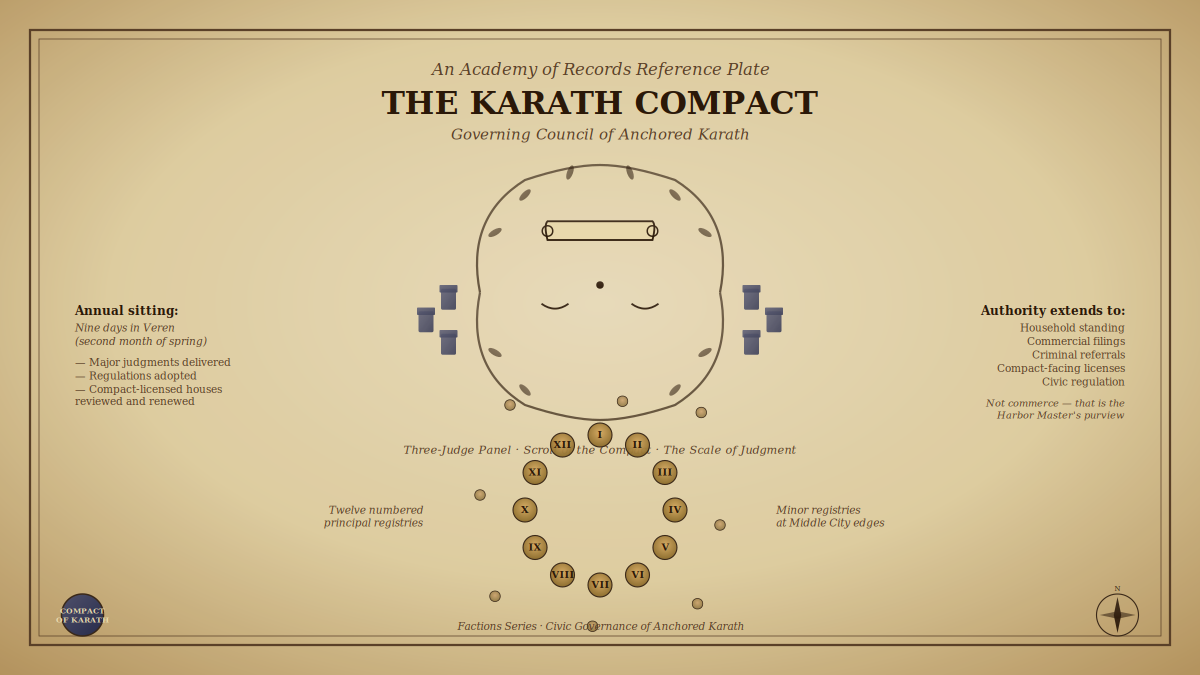
The Compact sits formally for nine days in Veren, the second month of spring. During the sitting, all councillors must be present in Karath. Compact business that has accumulated through the year is processed during the nine days: major judgments are delivered, new regulations are adopted, appointments confirmed, and the financial accounts of Compact-funded institutions — the Port Watch foremost among them — are reviewed and signed into the next year’s standing.
Outside the sitting, a standing committee of the Compact — drawn from senior councillors resident at Karath — handles business that cannot wait for the annual sitting. Most Compact business of public interest, however, passes through the registries rather than through the committee, and most Karath-dwellers will never encounter a Compact councillor in the course of their civic lives.
——— ◇ ———
The registry system
The Compact administers its work through a numbered system of registries. Each registry is a small administrative office, separately staffed, that handles a defined class of filing: the First Registry handles household and inheritance matters, the Second Registry handles commercial contracts, the Third Registry handles criminal referrals from the Watch, and so on through the principal registries. There are currently twelve numbered registries in the Karath system, with further minor registries — unnumbered, referred to by location — distributed at the edges of the Middle City.
A commission record, contract, or complaint submitted to the appropriate registry begins a formal process with predictable stages. Routine filings are acknowledged within two days. Matters requiring judicial attention are forwarded to a three-judge panel within a week. The identity of the originator of a filed document need not be disclosed to opposing parties — a protection that serves both commercial confidentiality and, in some cases, the personal safety of the filer. The filing investigator, however, must be a Compact-licensed individual in good standing.
——— ◇ ———
Minor registries and private-room procedure
The minor registries at the edges of the Middle City fulfil a particular civic function. Parties who have agreed to meet on neutral Compact ground — for negotiations, dispute resolution, or the transfer of documents between persons who cannot meet openly — may book a private room at a minor registry.
Procedure in these rooms is strict. Both parties are searched for weapons on entry. The door is locked from the outside for the full duration of the meeting. No third party is permitted to hear the proceedings. Bookings may be made under false names on payment in Compact scrip. The registry staff record only that a meeting took place, not its participants or content.
This procedure originated in the old century, when Karath’s commercial feuds occasionally required neutral ground, and has survived as an institution because it continues to serve cases in which the ordinary machinery of negotiation would fail. It is occasionally used, less formally, for personal matters — reconciliations, agreements between estranged relatives — though its most frequent contemporary use is commercial.
——— ◇ ———
The three-judge panel
Cases forwarded from the registries to judicial attention are heard by a panel of three Compact judges. Panels are composed of current councillors holding judicial appointment, selected from the standing roster by a rotation principle that prevents the same three judges from sitting on consecutive cases. A panel’s judgment, once delivered, is binding within the Compact’s jurisdiction and may be appealed only to the full Compact at its annual sitting.
Three-judge panel procedure is characteristic of Anchored legal practice and is described more fully in the Anchored Law reference. For the Compact specifically, it is the principal mechanism by which Compact authority is exercised on particular matters: disputes between merchant houses, challenges to commercial filings, and — occasionally — the dissolution of a household whose affairs have exceeded the bounds of Anchored Law. Dissolutions are rare but consequential; a Compact court dissolution is held to be the most severe civic sanction short of exile, and its effects are recorded permanently in the Compact archive.
——— ◇ ———
Compact-licensed investigators
The Compact does not employ a body of investigators directly. Instead, it licenses small private houses that contract with Compact-court, with merchant houses, and with private clients. These Compact-licensed investigator houses — the Telvir house of Karath is one of the long-established examples — are staffed by career investigators who specialize in the sort of documentary and archival work that Compact-court cases often require.
A Compact-licensed investigator must be in good standing to file on Compact-court’s behalf. Licenses are reviewed annually during the Veren sitting. An investigator whose license is suspended cannot take Compact-facing work until the suspension is resolved, though the investigator house as a whole may continue to operate if other staff members hold standing licenses.
——— ◇ ———
The domain of Compact authority
The Compact’s authority extends across Anchored Karath and — through its adoption as a governance model — across the allied Anchored ports that have signed on to the Karath system. Its reach is clear on civic matters: household standing, commercial filings, criminal referrals, licensing of Compact-facing professions, and the regulation of standing institutions.
Its reach is more limited on matters that cross into other domains. The Touched fall under the Order of Vyn; commercial transit is the Harbor Master’s purview; Driftborn companies, who do not hold Anchored standing, are not directly subject to Compact judgment. The Compact has jurisdiction only over Anchored persons and the Anchored institutions in which they participate. The old prohibition on wood as a structural walling material — ships excepted — is a Compact regulation and is enforced through the city’s building inspectorate, itself a minor office under Compact authority.
——— ◇ ———
Reputation
The Compact is respected rather than loved. Karath-dwellers understand it as the ordinary machinery of civic life — the place where disputes are settled, where contracts are filed, where licenses are renewed. Encounters are routine for merchants and householders of the Middle City, less frequent for the lower tier, and a matter of courteous formality for the upper. The institution’s reputation for procedural rigour is its most important civic virtue. A Compact judgment, even one a party disagrees with, is understood to have been reached through predictable means, and that predictability, more than any single judgment, is what makes the Compact the institution upon which the civic life of Karath rests.
——— ◇ ———
This article is a Free-tier entry of the Academy of Records’ Factions series. Readers are directed to the companion articles on the Port Watch, the Harbor Master’s Office, and Anchored Law for the institutional framework within which the Compact operates.