An Academy of Records public reference article. On the living languages of the Shifting Coast — their families, their regional distribution, their points of contact, and the limits of what the Academy has been able to document.
——— ◇ ———
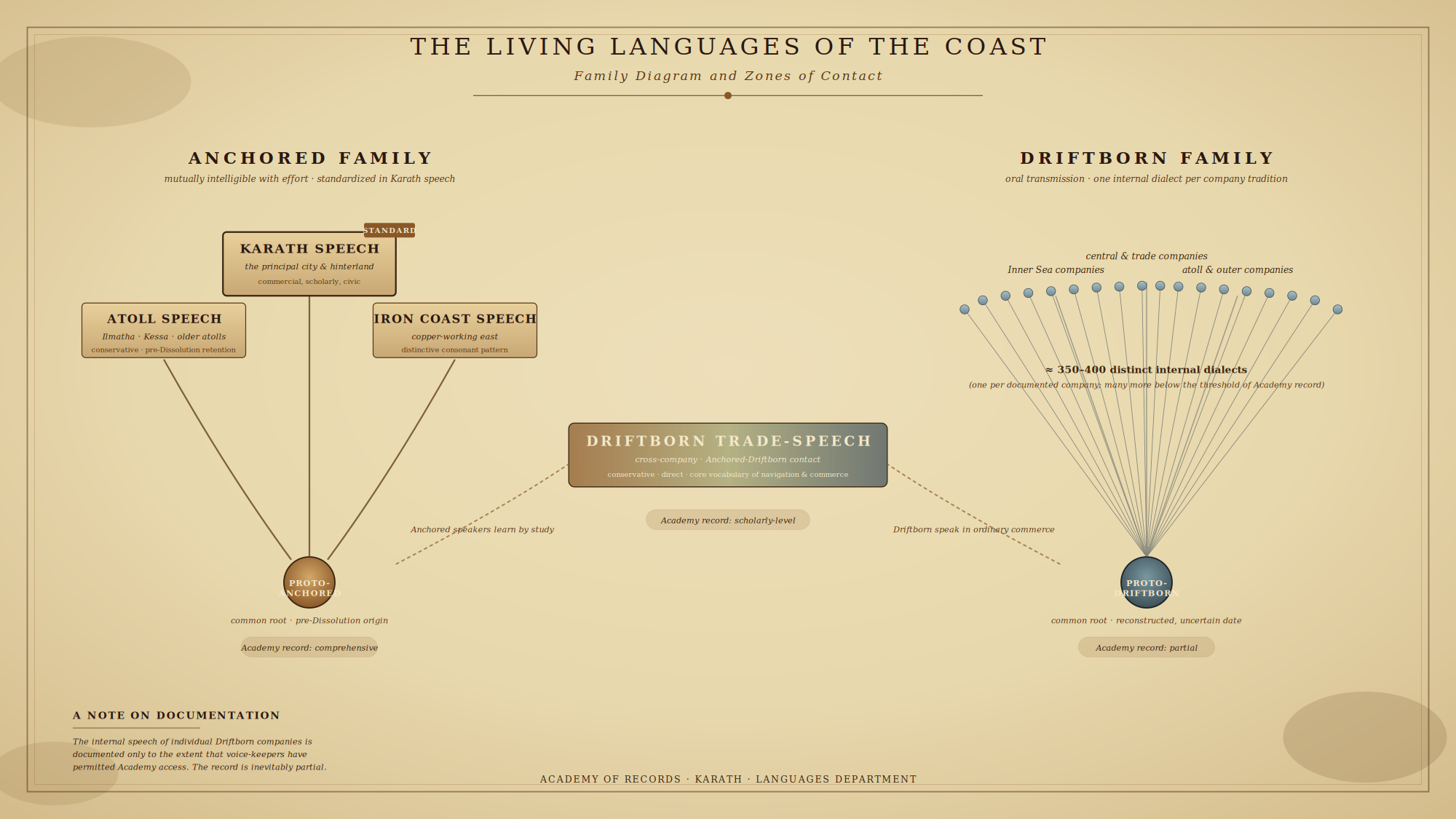
The Coast supports two principal living language families: the Anchored languages, closely related dialects spoken across the settled populations, and the Driftborn languages, a more varied body of speech carried primarily in voice among the mobile companies. A third linguistic phenomenon, the Driftborn trade-speech, serves as the principal means of cross-company and Anchored-Driftborn communication and is, strictly speaking, neither a single language nor a simple dialect of any other.
This article describes each in turn, notes the regional accents and social registers within each, treats literacy and written script across the Coast, and closes with an honest statement of what Academy linguistic scholarship has not documented and cannot document. The companion article on the dead languages of the Coast should be read alongside this one; its scope is complementary, and the two articles together give the fuller picture.
——— ◇ ———
The Anchored Languages
The Anchored languages of the Coast form a single family of related regional dialects, mutually intelligible with some effort across most pairs of speakers and with significantly greater effort across the extremes of regional variation. Karath's urban dialect serves as the commercial and scholarly standard, and most Anchored speakers can understand it even where their home speech differs substantially. Academy records of the Anchored languages are comprehensive, and most of what follows is asserted with the confidence that comes from direct scholarly access.
Three principal regional varieties are ordinarily distinguished. Karath speech, the dialect of the principal city and its immediate hinterland, is the form used in civic business, scholarly publication, and long-distance commerce. It is considered, by its own speakers, plain and practical; by outsiders, variously clipped, formal, or cold, depending on the speaker's own regional point of reference. Atoll speech, encompassing the Anchored dialects of Ilmatha, Kessa, and the older-settled islands, is notable for its conservative grammar and its retention of several pre-Dissolution forms that have been lost elsewhere. An educated speaker of atoll Anchored can ordinarily understand Karath speech without difficulty, though the reverse is sometimes not quite true. Iron Coast speech, the dialect of the copper-working communities of the eastern shore, is known for a distinctive consonant pattern that affects a dozen of the most commonly used words. A traveler from Karath, hearing Iron Coast speech for the first time, will often believe the speaker to be foreign until the ear adjusts.
Regional accents are more finely distinguished than these three broad varieties suggest. Within Karath itself, the three tiers have distinct accent patterns — the upper tier's more deliberate articulation, the middle tier's neutral form, and the lower tier's working inflection — that a Karath-born listener can identify within a sentence or two. Smaller communities carry accents that are often markers of the specific settlement rather than of the broader region, and Anchored social perception draws on accent as a standard cue for a speaker's origin.
The Academy's Languages department maintains detailed records of regional variation and of the changes each dialect has undergone across the centuries of documentation. The department's standard reference work, updated at intervals, is considered the authoritative linguistic account of Anchored speech; its successive editions themselves constitute a record of how the languages have evolved under continuous scholarly attention.
——— ◇ ———
Driftborn Speech: Trade and Tradition
Driftborn linguistic practice is more complex, and the Academy's record of it is more uneven. Two broad registers must be distinguished.
Driftborn trade-speech is the form most often encountered by Anchored observers. It is used between Driftborn companies whose internal traditions differ, between Driftborn and Anchored parties, and in any situation requiring intelligibility across the full range of Driftborn speakers. Trade-speech is conservative, direct, and built around a core vocabulary of navigation, commerce, weather, and social relation. It differs substantially from any Anchored language, sharing a number of old loan-words but diverging in grammar, in phonology, and in the habits of construction that give a language its characteristic feel. An Anchored speaker and a Driftborn trade-speaker meeting for the first time can ordinarily establish communication within a few exchanges; a Karath scholar, having studied trade-speech as an academic subject, can usually hold a full conversation.
Internal speech within individual companies, by contrast, varies considerably from one company to another. Each company's voice-keeper carries the company's tradition in a specific linguistic form, and that form, transmitted orally across generations, has developed in directions that other companies' forms have not followed. Companies whose voice-keeping traditions trace to common origins often retain substantial mutual intelligibility; companies of more distant derivation can have significant difficulty understanding each other's internal speech, even when both are fluent in trade-speech. The Kira Moot is the one annual occasion on which a significant range of company internal speech is heard in close proximity, and voice-keepers there make deliberate use of trade-speech among themselves when the range of internal variation would otherwise prevent understanding.
A characteristic feature of Driftborn working speech is its distinctive handling of the Coast's shared stock of working curses. "By Ithros's knees," "by the Trench," and "by the bones of Telor" are encountered across both Driftborn and Anchored speech, though the tonal and situational use of each differs substantially between the two populations. The curse "Thessik's teeth" is specifically characteristic of Driftborn working dialect and reflects, in its form, the Driftborn relationship to the pre-Dissolution figure Thessik — which differs from the Anchored relationship in ways the companion article on Driftborn culture treats more fully.
——— ◇ ———
Writing and Script
Writing on the Coast uses a single script, developed from pre-Dissolution prototypes and standardized in the early centuries after the Dissolution by the Academy and its predecessor institutions. The script is used for Anchored and Driftborn speech alike where either is committed to writing, though the frequency of such commitment differs sharply between the two peoples.
Among the Anchored, literacy is widespread. Most Anchored children of the middle and upper tiers learn to read and write in the course of ordinary schooling, and a majority of lower-tier Anchored are functionally literate for the common purposes of civic life — signage, accounts, civic notices, simple correspondence. Commercial and scholarly literacy is at a level above the common, and the network of Karath-trained scribes provides professional writing services where the literate capacity of the parties involved is insufficient for the document at hand.
Among the Driftborn, literacy is present but is not the vehicle of tradition. Most adult Driftborn of long-established companies can read and write; many can do so fluently. Ship's records, commercial correspondence, navigational notes, and personal letters are written and read without comment. What is not written is the tradition itself — the body of company knowledge carried by the voice-keeper. Several companies have attempted, across the centuries, to commit their traditions to writing. These attempts have generally either been abandoned as unsustainable or have produced documents that the company's voice-keepers themselves do not consider complete. Consensus within Driftborn culture is that the tradition resists commitment to paper in a way that is not merely a matter of convention, though the Academy's linguists have not been able to identify a technical feature of the language that would fully account for this.
——— ◇ ———
Accent, Register, and Social Perception
Within both language families, speakers use accent and register to mark and to read a range of social information. The regional cues are the most obvious: an Iron Coast accent will be identified as such by a Karath listener within a sentence, and the speaker will be, in most social contexts, placed accordingly. Within-region cues are finer: the three tiers of Karath, the distinct dock and dry-dock speech of the working harbor, the careful articulation of Academy-trained speakers, and the various small registers associated with particular trades or civic functions.
Driftborn listeners read similar cues within Driftborn speech — a voice-keeper can often identify a speaker's company within a short exchange, and in some cases the specific voice-keeper under whom the speaker was trained. These cues are more opaque to Anchored ears, and Academy scholars working in this area rely significantly on Driftborn collaborators to interpret what the Academy's own ears cannot reliably distinguish.
A particular social subtlety concerns the use of trade-speech by Driftborn speakers in Anchored company. Most Driftborn in ordinary Anchored settings use trade-speech. The use of internal company speech in an Anchored setting is unusual and is ordinarily read as a signal of some kind — of intimacy among the speakers, of a private conversation not meant for overhearing, or, more rarely, of a deliberate exclusion. Anchored observers who have learned to hear the distinction sometimes treat its occurrence as socially significant; Driftborn speakers, for their part, do not always consider it remarkable.
——— ◇ ———
What the Academy Has Not Documented
Living languages on the Coast are documented asymmetrically. The Anchored languages are recorded in considerable detail, both currently and historically, by the Academy's Languages department. The Driftborn trade-speech is recorded at a useful scholarly level, though the department acknowledges that aspects of its ordinary use remain imperfectly captured. The internal speech of individual Driftborn companies is documented only to the extent that specific voice-keepers have permitted Academy access, and the department's file on this material is, inevitably, partial.
There is also the matter of what may exist outside the Academy's current knowledge entirely. Occasional references in older documents suggest the possibility of additional linguistic forms — dialects of isolated communities, specialized registers of particular trades, or speech forms associated with geographic regions the Academy has not fully surveyed. Some of these may be recoverable with further scholarly work; some may not. The Languages department notes these cases when it encounters them and does not overstate its confidence in cases where the record is incomplete.
——— ◇ ———
This article is classified as a standard public reference of the Academy of Records, Karath. It should be read alongside the foundational articles on the Anchored and the Driftborn, the companion article on the dead languages of the Coast, and the forthcoming reference work on Driftborn trade-speech currently in preparation at the Languages department.