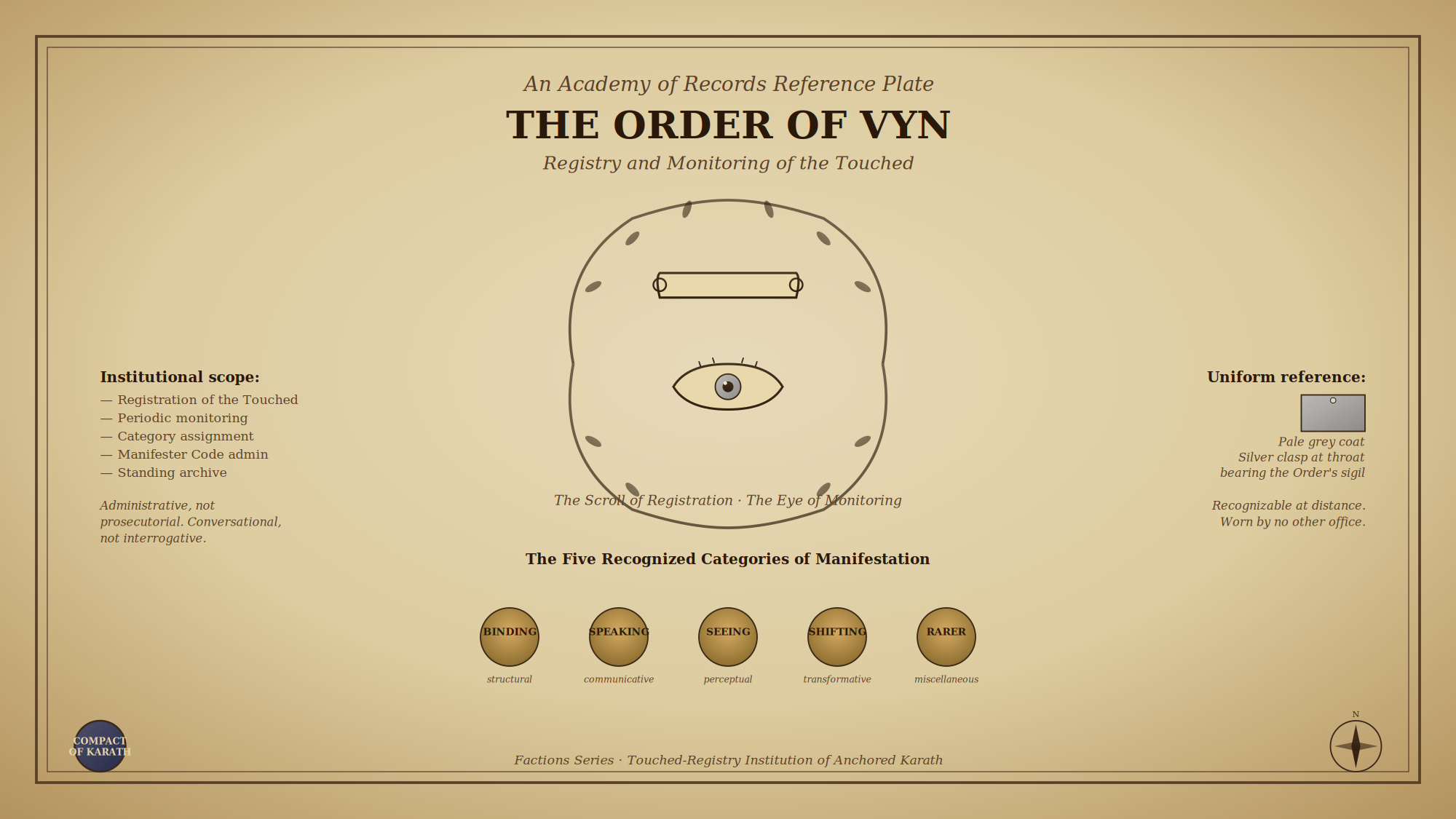
An Academy of Records reference article. Part of the Factions series.
The Order of Vyn is the institution of the Karath Compact charged with registering and monitoring the Touched — those persons in whom manifestation has emerged and been formally identified. It administers the provisions of the Manifester Code, maintains the standing registry of the Coast’s Touched, and oversees the practical working relationships between the Touched and the civic life of the Anchored ports.
This article treats the Order as an institution. Readers seeking the legal framework within which the Order operates should consult the Anchored Law reference. For the phenomenology of manifestation itself, see the Magic and the Touched articles of the bestiary and magic series.
——— ◇ ———
Foundation and authority
Founded at Karath in the settlement period following the Great Shift, the Order was chartered alongside the First Compact and the early structures of Anchored governance. Its charter was signed by the first Compact councillors and by the first generation of Touched who consented to identify themselves formally. Under Compact license through every revision since, the Order’s working authority has grown steadily as the Manifester Code has been elaborated through successive Compact sittings.
Order authority is administrative and protective rather than judicial or commercial. Prosecution belongs to the Watch and Compact-court within the Code’s provisions; commercial manifestation work passes through the Harbor Master’s Office where it touches trade. What the Order controls is the register: who is formally identified as Touched, what category of manifestation they express, what restrictions apply, and what civic arrangements are in place.
Within that remit, Order authority is absolute. A person registered with the Order is known to the Compact, to the Watch, and to the Harbor Master’s Office. A person unregistered but manifesting is, by the terms of the Manifester Code, a matter of urgent Order concern.
——— ◇ ———
Registration and category
A person in whom manifestation has emerged and been witnessed is presented to the Order — either voluntarily, or through referral by the Watch, the Academy, or the Harbor Master’s Office. Registration records identity, place of origin, witnessed phenomena, and provisional assignment to one of the recognized manifestation categories: binding, speaking, seeing, shifting, or one of the rarer forms grouped under the Code’s miscellaneous designation.
Category assignment is not fixed for life. The Order’s archive records many reclassifications as a registered person’s manifestation has been better understood through years of observation. Reclassification is routine and carries no particular stigma.
Each registration is a document of several pages, kept in the Karath archive and copied to the Compact standing archive. A small extract — identity, category, date of registration — is shared with the Watch for criminal-referral purposes, following the same two-record pattern that governs Harbor Master manifests.
——— ◇ ———
Monitoring practice
The Order’s working practice is often described in Anchored discourse with language borrowed from policing, but the comparison is imprecise. Monitoring consists of periodic check-in interviews at intervals set by category and history. Low-category registered persons with no incident history may be seen once every several years. Registered persons whose category involves powers treated by the Code as presenting elevated risk are seen more often. Persons bound by specific Code restrictions are monitored continuously.
A check-in interview is procedurally routine. The registered person attends an Order office, meets with a monitoring officer, answers a standardized set of questions about the preceding interval, and signs the continuation of the registration. Interviews are not adversarial by design; Order monitoring officers are trained to a conversational register rather than an interrogative one.
——— ◇ ———
Officers and uniform
Order officers wear a pale grey coat with a small silver clasp at the throat bearing the Order’s sigil. The coat is recognizable at a distance and is never worn by other Anchored officers. Junior officers spend several years in training under a senior before conducting independent interviews, with emphasis placed on the Manifester Code, the recognized categories, the conversational register of the check-in, and the protocols for the rarer category cases in which monitoring may need to be joint with the Watch.
By the scale of the Watch or the Harbor Master’s Office, the Order is small. Its Karath staff numbers in the low hundreds, and at allied ports a single Order officer may serve a whole coastal town, travelling out from Karath on a set circuit two or three times a year.
——— ◇ ———
Relationship to the Compact and the Watch
As a Compact-licensed institution, the Order is subject to Compact regulation and to annual review at the Veren sitting. Registration procedures, interview schedules, and category-assignment protocols are reviewed in that cycle. The Order is not, however, an enforcement body: when a registered person is alleged to have committed an offence under the Manifester Code, the matter is referred through Compact-court. When a registered person is alleged to have caused harm outside the Code, the matter is referred to the Watch. Joint work between Order and Watch does occur, but only under specific protocols established by the Manifester Code.
——— ◇ ———
Reputation
Among the Anchored, Order reputation is generally one of procedural fairness and quiet competence. The Touched registered with the Order have, over long centuries, come to speak of monitoring officers who conduct themselves with discretion in the small networks through which the registered exchange information about their interactions with the Anchored state. Officers who do not conduct themselves well — rare, but not unknown — are reported through the Order’s internal review process, and such reports are treated seriously.
Among the unregistered population of the Coast, reputation is more mixed. Rumour attaches to the Order’s archive, as rumour always attaches to archives that hold information about persons whose abilities are not fully understood. The Order’s response to such rumour is, as a matter of institutional culture, silence.
——— ◇ ———
This article is a Free-tier entry of the Academy of Records’ Factions series. Readers are directed to the companion articles on the Karath Compact, Anchored Law, the Port Watch, and the Magic and the Touched references for the institutional and phenomenological context within which the Order operates.