An Academy of Records reference article. Part of the Factions series.
The Port Watch is the civic security force of Karath and, by adoption of the Karath model, of most allied Anchored ports along the Shifting Coast. Its authority as the enforcement arm of Anchored Law is described in the companion article on Anchored Law; this article treats the Watch as an institution — its scale, its organization, its working practice, its equipment, its specialist roles, and the civic position it occupies. Readers seeking the legal framework within which the Watch operates should consult the Anchored Law reference first.
——— ◇ ———
Scale and deployment
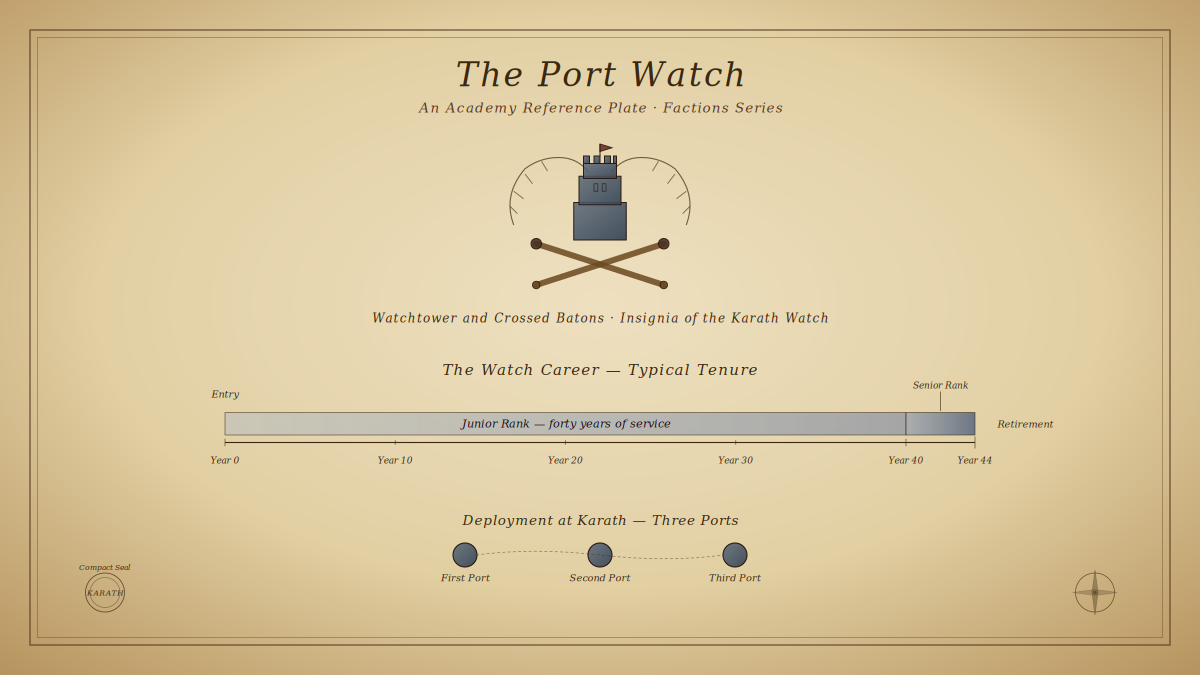
At Karath, the Watch operates across the three principal ports — First, Second, and Third — and across the civic tiers of the city. An officer count in the low thousands is usually cited for Karath, though precise numbers vary by season and are not publicly posted. The force is substantially smaller at allied settlements: at mid-sized coastal towns, a watch of thirty to sixty officers is typical, and at the smaller Coastal settlements the watch may consist of no more than a handful of officers answering to the local assembly.
The Watch is funded by Compact levy at Karath and by municipal assessment at allied settlements. It is answerable to the civic authority, not the judiciary, and this separation — described in the Anchored Law reference — is one of the features the Karath model exports along with its legal framework.
——— ◇ ———
Rank and tenure
Watch service is long. An officer who enters the Watch in early adulthood will ordinarily serve until retirement between forty and forty-five years later, and careers spanning more than four decades are common rather than exceptional. Among Anchored civic institutions, the Watch’s tenure profile is unusual; where the Academy expects turnover through appointment and the Harbor Master’s Office through the commercial cycle, the Watch retains its officers for most of their working lives.
Rank within the Watch is hierarchically strict. Senior officers — those with forty or more years of service — occupy the upper tier; junior officers, regardless of age, occupy the lower. The seniority distinction is marked by uniform detail and by working practice. A senior does not ordinarily address a junior by first name, does not conduct casual conversation on duty, and does not share meal tables with juniors except at formal occasions. Juniors address seniors by rank and surname. The custom is not written into Watch regulations; it is maintained by practice and by the weight of long tenure.
One consequence is that the Watch’s institutional memory is held in a small number of aging officers who have served through several Compact sessions and through the careers of several magistrates. Another is that Watch succession is a deliberate, long-planned process: most seniors train their successors over a decade or more before retirement, and the formal handover of responsibilities on the retirement day is ceremonial rather than practical.
——— ◇ ———
Equipment and practice
Uniform and batons are described in the companion article on Anchored Law. Beyond these, working officers carry the tools of their duty: signal horns for coordination across distances, oil-burning lanterns for night patrol, whistles for close-quarters signalling, and the small leather-bound notebooks in which officers record their observations for later entry into Watch records. Patrols are ordinarily conducted in pairs. Night patrols in the lower tier are conducted in pairs of pairs — four officers moving together — except in the quietest hours before dawn, when smaller parties resume.
The Watch maintains barracks at each of the three Karath ports and a central administrative building in the Middle City. Watch records — patrol logs, arrest records, incident reports — are kept at the central building, under the care of specialist record-keepers described below.
——— ◇ ———
Specialist roles
Not all Watch officers work the streets. A significant portion of the force holds specialist positions. Passenger-manifest clerks maintain the Watch’s copies of Harbor Master records. Customs liaison officers coordinate with the Harbor Master’s Office on goods-related cases. Magistrate liaisons attend court sessions and handle the transfer of prisoners to judicial custody. Records-keepers manage the Watch’s own archive.
Many specialist positions are held by officers who have reached senior rank and no longer wish to work the street. The Watch encourages this as a retention mechanism: an officer who has walked the lower tier for thirty years may continue in Watch employment for another decade as a manifest clerk or records-keeper, preserving institutional knowledge that would otherwise be lost. Some specialist roles continue past formal retirement: a retired manifest clerk may be retained as a consultant for a period after retirement, particularly in matters requiring specific historical knowledge.
——— ◇ ———
Civic position and reputation
Karath-dwellers regard the Watch with a mixture of respect, wariness, and practical acceptance. The Watch is not loved in the manner of a festival or a cherished temple, but it is generally trusted. Officers are understood to be professionals, to know their tier, and to act within established procedure. Incidents of serious Watch misconduct are rare enough that they remain public knowledge for years when they occur.
Working Karath-dwellers interact with the Watch most frequently at the lower tier, where patrols are visible throughout the daylight hours. Middle-tier residents encounter the Watch less often; upper-tier residents, who handle most of their civic business through appointment, seldom encounter a patrol at all.
——— ◇ ───
This article is a Free-tier entry of the Academy of Records’ Factions series. Readers are directed to the companion articles on Anchored Law, the Karath Compact, and the Harbor Master’s Office for the institutional context within which the Watch operates.