An Academy of Records public reference article. A phrase of disputed referent and persistent currency along the Coast.
——— ◇ ———
The Seven Islands is a phrase that appears in Coastal sources of every period since at least the Dissolution, and arguably for several centuries before it. Its meaning is less settled than its currency would suggest. Anchored merchants use it to name a destination. Driftborn elders use it to name a voyage. Academy cartographers use it with quotation marks, or avoid it entirely.
What the phrase refers to, and whether it refers to anything singular at all, has been a matter of scholarly debate for at least four hundred years. The Academy's current formal position, published and revised twice per generation, is that there is no single authoritative set of seven islands to which the phrase properly refers. A minority of scholars dispute this. Driftborn tradition has never recognized the Academy's position. The disagreement is, by any measure, older than the Academy itself.
——— ◇ ———
What the Academy Means by the Phrase
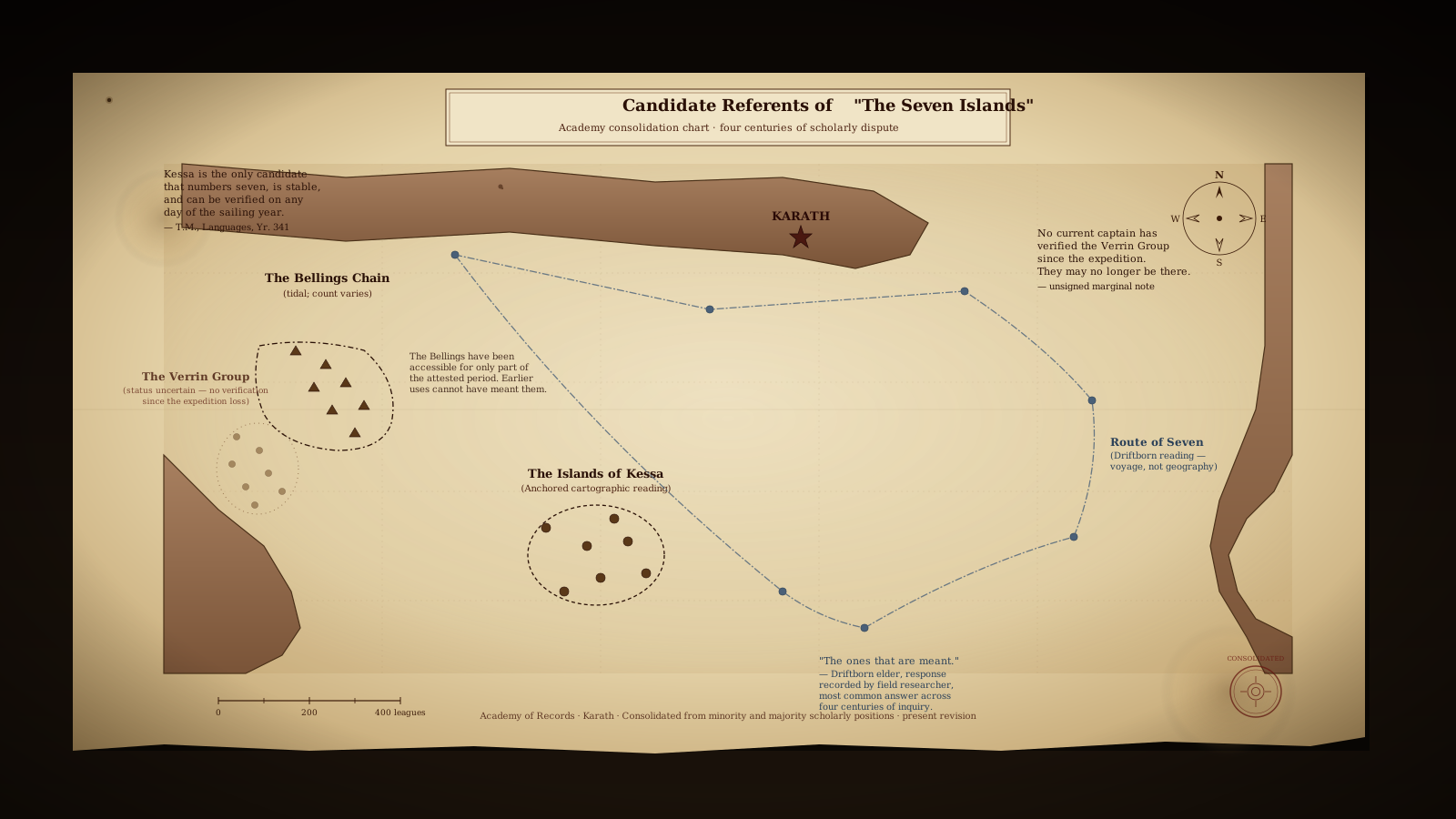
Current Academy practice, where the phrase appears in public documents, is to gloss it as "a popular designation of uncertain cartographic referent." Where greater specificity is required, Academy documents name the particular candidate grouping under discussion. Four such groupings have been proposed by scholars over the past four centuries, each with a constituency of defenders. None has achieved general acceptance. The Academy's official position is that the phrase's authority is mythic rather than geographic, and that pursuit of a definitive cartographic referent is unlikely to succeed.
This position is not uncontested within the Academy itself. A minority — mostly in the Languages department and, to a lesser extent, among the historians — argue that the persistence of the phrase across so many centuries and cultural contexts indicates a real underlying referent that has become obscured rather than a purely mythic construct. This minority view has not gained majority support but has not been suppressed, and appears in the Academy's public record as a recognized alternative.
——— ◇ ———
The Four Candidate Groupings
The Islands of Kessa
The most widely mapped candidate. Seven small atolls lying roughly two hundred leagues south of Karath, in the southern reach of the Inner Sea. Named for Kessa, a legendary pre-Dissolution navigator whose voyages are recorded in several surviving manuscript passages and are commonly assigned to the ninth or tenth century before the Dissolution. The atolls are stable, well-charted, and commercially active, with small Anchored settlements on three of them. Scholars who favor this identification point out that the Islands of Kessa are the only candidate grouping that actually numbers seven, is stable over time, and can be sailed between on any given day. Scholars who reject it point out that no Driftborn source refers to these atolls as the Seven Islands, and that the Anchored application of the phrase to them is traceable only to the last two centuries.
The Bellings Chain
A reading preferred by some Driftborn captains and a smaller group of Academy field researchers. Within the Bellings Bleed zone (see separate article), there exist a number of small rocky outcrops whose exposure above the waterline is tidal. At high tide, seven of these are reliably visible. At low tide, eleven or twelve, depending on the season. At certain exceptional tides, none. Advocates of this reading argue that the phrase's persistent use across centuries is explained by the Bellings' own persistence, and that the impermanent seven-ness of the chain reflects the mythic rather than fixed character of the phrase. Critics note that the Bellings have been accessible for only part of the period in which the phrase is attested, and that earlier uses of the Seven Islands cannot have referred to them.
The Verrin Group
Seven small islets, recorded in pre-expedition Academy charts, off the southwestern approach to the Wasted Shore (see separate article). The Verrin Expedition, lost two hundred and thirty-seven years ago, was provisioned in part on the basis of these islets serving as intermediate stopping-points on the approach. No subsequent expedition has verified that the islets still exist, and Coastal instability in the intervening centuries has made their current state a matter of informed speculation. A small but persistent school of scholars identifies these as the Seven Islands of older usage, on the grounds that the phrase appears in pre-Dissolution sources alongside references to routes that plausibly traversed this region. This reading is currently out of favor but has not been formally retired.
The Route of Seven
The least specific and most Driftborn of the candidate readings. On this view, the Seven Islands refers not to a fixed geographic chain but to a sequence of stopping-points along an ancient trading route, each island distinct, separated by days or weeks of open-water passage, and not necessarily connected to each other except as stages of a single completed voyage. Driftborn songs contain references to the route of seven that are consistent with this reading, and some of these songs are considerably older than the pre-Dissolution period. Academy scholars have generally found this reading too loose to accept as cartography, though a number of linguists have argued that the looseness itself is the point.
——— ◇ ———
The Driftborn View
Driftborn tradition does not, as a rule, treat the question of which particular islands are the Seven as a question that requires answering. The phrase appears in several Driftborn contexts — in songs, in ceremonial navigation chants, in certain rites associated with coming-of-age voyages — and in each context the referent is clear from the setting rather than by external identification. When Driftborn elders have been asked, by Academy researchers across four centuries, which seven islands are meant, the most common answer recorded is some variation of "the ones that are meant." This is not, in Driftborn terms, evasion. It is a different theory of what a name is for.
A smaller number of Driftborn sources offer a more specific claim: that the Seven Islands are those islands through which a certain voyage, traditionally undertaken once in a generation, is said to pass. The identities of these islands shift over time, in this view, because the voyage itself is responsive to the Coast's instability. The Academy treats this reading as metaphorical. Several Driftborn captains have indicated, in interviews on record, that the Academy's judgment on this point is not binding on them.
——— ◇ ———
Current Usage
In Anchored commerce, the Seven Islands is used loosely to refer to the Islands of Kessa, unless the context indicates otherwise. Port Watch manifests use the phrase in this sense. Merchant shippers use it interchangeably with the southern atolls. No legal document of the Karath Compact uses the phrase; its commercial application is informal.
In Driftborn usage, the phrase retains ceremonial weight, and appears in contexts where an Anchored speaker would expect a more neutral term. A Driftborn navigator may describe a voyage as going to the Seven when, to an Anchored observer, the voyage is obviously bound for a specific named destination that has nothing to do with atolls or tidal outcrops. This usage should be understood as cultural and not cartographic.
In Academy publications, the phrase appears with quotation marks and a cross-reference to this article. In older Academy publications, before the Languages department's review of the question in the fourth century after the Dissolution, the phrase appears without quotation marks, and scholars reading those texts must supply their own interpretation of what was meant.
——— ◇ ———
This article is classified as a foundation-tier public reference of the Academy of Records, Karath. Readers seeking deeper engagement with the individual candidate groupings are directed to the separate articles on the Islands of Kessa, the Bellings Chain, the Verrin Group, and the Route of Seven in Driftborn oral tradition. Revision history and minority opinions are maintained in the Academy's internal record.