An Academy of Records reference article. Part of the Gods and Religion series.
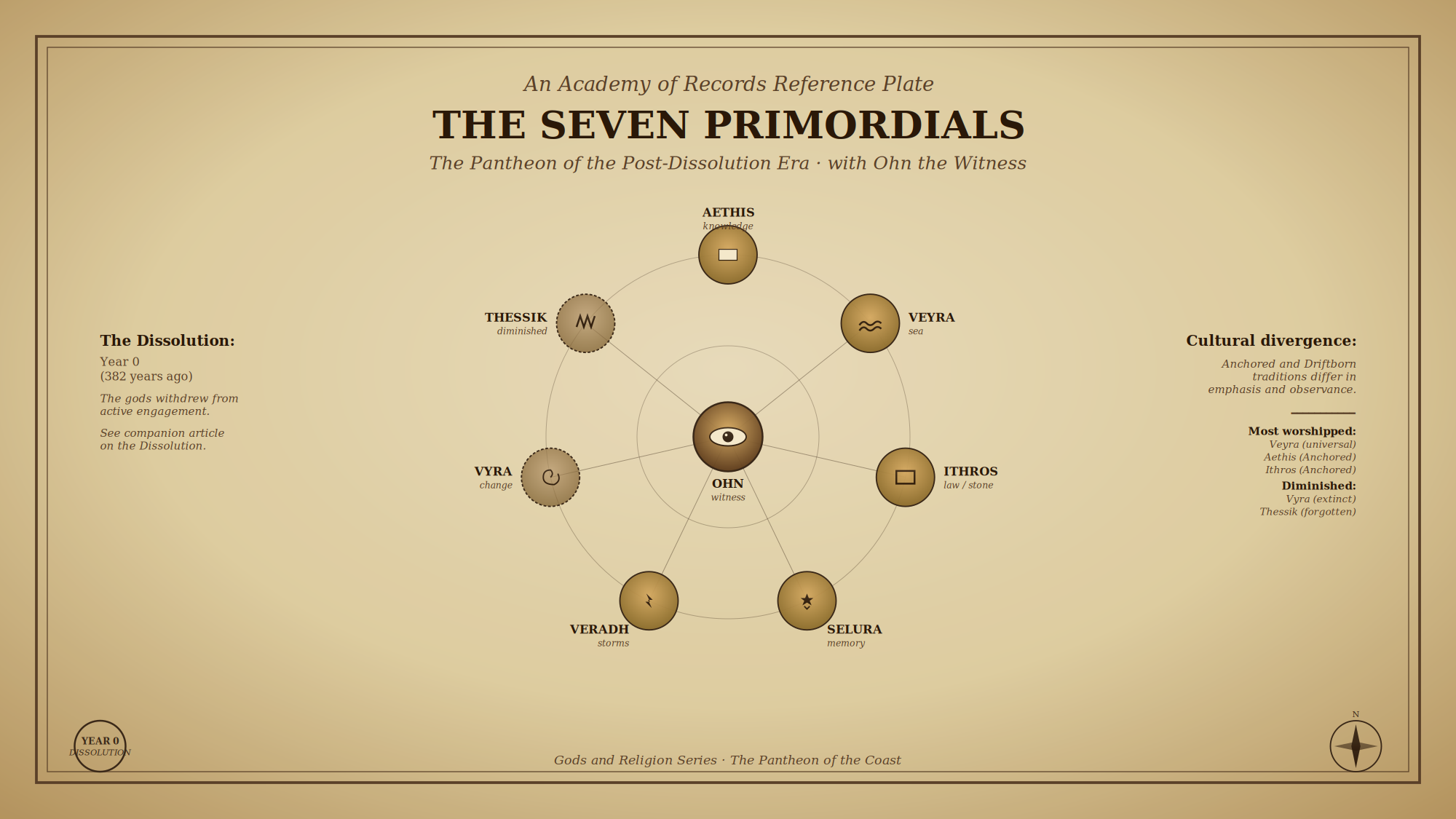
The Seven Primordials are the seven foundational deities of the post-Dissolution era, together with the witnessing god Ohn. The eight figures comprise the principal pantheon recognized by both Anchored and Driftborn religious traditions, though the two cultures hold the figures in markedly different proportions of regard. This article treats the eight gods as a public-knowledge set, with each entry recording the god’s name, principal domain, current state of worship, and noted variations between cultures.
This article is the foundation of the Academy’s Gods and Religion series. Readers seeking detailed treatments of individual gods are directed to the relevant subsidiary articles. Readers seeking the events of the Dissolution itself, or the doctrinal differences between Anchored and Driftborn cosmology, should consult the Dissolution and Cosmology articles respectively.
——— ◇ ———
The pantheon as a set
Eight figures comprise the recognized pantheon of the post-Dissolution era: seven Primordials whose decisions are remembered, and one witnessing god whose role was to record. Each Primordial holds a domain — a sphere of being or human concern over which the god’s authority is held to extend. Each is associated with characteristic acts of presence, rituals of acknowledgement, and the residual traces of belief that have persisted in the centuries since the gods withdrew.
Worship of the pantheon is uneven. Several Primordials remain widely acknowledged across the Coast and have active cults, regular ritual observances, and standing temples or shrines. Others are honoured chiefly in formal civic contexts. One is essentially absent from contemporary practice. The witnessing god Ohn occupies a distinct role and is treated separately at the close of this article.
The Dissolution — the event in which the gods withdrew from active engagement with the world — occurred in the year now reckoned as Year 0, three hundred and eighty-two years before the present. Eight figures of the pantheon were active participants in the events of that period, and the records preserved by the Academy and by Driftborn voice-keepers concern principally those events. Detailed treatment of the Dissolution itself is found in a separate reference.
——— ◇ ———
Aethis · knowledge and compromise
Aethis is the god of knowledge and of the negotiated settlement. Anchored tradition holds Aethis as the principal architect of the Dissolution — the figure who proposed the terms under which the gods withdrew. This continuing prestige in Anchored civic life is reflected in institutional practice. The Academy of Records holds Aethis as its patron, the great Lecture Hall preserves an Aethis-shrine maintained by the History department, and public observances on Aethis-feast (third week of Veren) include the formal opening of the Academy’s annual sitting.
Driftborn tradition acknowledges Aethis with more reservation. Voice-keepers preserve the Aethis material but treat it as one tradition among several rather than a central pillar. The bargain Aethis proposed is, in some Driftborn retellings, less the saving compromise it is held to be in Anchored doctrine and more the loss of something the Driftborn would have preferred to retain.
——— ◇ ———
Veyra · the sea
Veyra is the god of the sea, of all open water, and of the lives lived upon it. Veyra is the most universally honoured of the Primordials: every Coastal port has at least one Veyra-shrine, every working ship carries a Veyra-token of some kind, and Veyra-oaths remain the binding form for maritime contracts. The Anchored civic shrine at Karath stands at the head of First Port. Driftborn observance is more elaborate and is conducted aboard ship at recognized intervals, most prominently at the opening and closing of the Kira Moot.
Both cultures hold Veyra in equal regard, though the practice differs substantially in form. Anchored Veyra-worship is largely civic and shrine-based. Driftborn Veyra-worship is communal, embodied, and inseparable from the working life of a Driftborn company.
——— ◇ ———
Ithros · law and stone
Ithros is the god of law, of permanence, and of foundations both literal and figured. Anchored tradition holds Ithros as the foundational god of civic order: the original Karath Compact was signed in the presence of an Ithros-priest, and Compact-court judgments are still pronounced with the formula by Ithros’s standing. The phrase by Ithros’s knees is a common Anchored civic oath of weight.
Driftborn tradition is reserved on Ithros. Stone is, by working-dialect understanding, the Anchored element; the Driftborn element is water. Driftborn voice-keepers preserve the Ithros material but rarely teach it as central, and Ithros-oaths are not used in Driftborn working life.
——— ◇ ———
Selura · memory and navigation
Selura is the god of memory and of navigation — the linking of place to recollection, and of past to present. Selura’s domain has the unusual feature of bridging the two cultures: Anchored archives invoke Selura on the marker page of long-keeping volumes, and Driftborn voice-keepers invoke Selura at the opening of the formal recitation that preserves the oral tradition. Selura is the most explicitly cross-cultural of the Primordials, with rituals at Anchored Academy openings and at Driftborn voice-keeper successions invoking very similar formulae.
Worship is moderate but stable. Selura does not have the universal reach of Veyra, but the cult remains active in both cultures and is unlikely to diminish.
——— ◇ ———
Veradh · storms and chaos
Veradh is the god of storms, of disruption, and of the violent transformation of states. Veradh is acknowledged with caution rather than affection. Anchored shrines to Veradh exist at most major Coastal ports — typically smaller than the Veyra-shrines and located at less prominent positions — and offerings are made before voyages into known storm seasons. The Karath shrine is at the eastern end of Second Port.
Driftborn observance of Veradh is more developed than the Anchored, particularly in late Arhen, when the autumnal storm systems run. Voice-keepers preserve Veradh-traditions that are more elaborate than the Anchored civic forms. A Driftborn captain who has weathered a major Veradh-season storm without loss is held to have been seen by Veradh and continues to enjoy a quiet prestige in Driftborn working circles.
——— ◇ ———
Vyra · transformation and change
Vyra is the god of transformation — of becoming, of change of form and identity, of the threshold between states. Vyra-worship is essentially extinct in Anchored civic practice. Scholars debate the reasons. Some hold that Vyra’s domain became culturally untenable after the Dissolution as the Anchored civilization adopted permanence as its central virtue. Others hold that the small surviving Vyra-cults of the early post-Dissolution period were absorbed by the Order of Vyn, which took its name from the goddess and may originally have been a Vyra-priesthood reorganized for a civic function. The Order of Vyn does not, in its modern form, conduct any Vyra-ritual.
Driftborn tradition retains Vyra-material in voice-keeper preservation, though contemporary Driftborn working life does not invoke her. A small number of remote Driftborn companies are reported by reliable Academy informants to maintain quiet Vyra-rituals, but no formal record is held.
——— ◇ ———
Thessik · the diminished god
Thessik is the least worshipped of the seven Primordials in contemporary Coastal practice. Anchored scholars hold the formal record of Thessik’s domain and the canonical accounts of his role in the events surrounding the Dissolution; the Academy preserves these in the History department’s archive. Public Anchored observance of Thessik is, however, virtually absent. There is no Thessik-shrine of standing at any Coastal port, and Anchored civic life does not invoke him.
Driftborn working-dialect treats Thessik as a god nobody remembered. The diminished oath by Thessik’s teeth is used in working circles as a curse of moderate emphasis, less weighted than oaths by gods more actively worshipped. Driftborn voice-keepers, however, preserve more elaborate Thessik-material than the working dialect would suggest. In some traditions, Thessik is associated with the working of tidewater, and the oath by Thessik’s teeth is held by voice-keepers to refer to the action by which Thessik turns the deep water at the height of a strong-tide event.
Both cultural treatments coexist in a manner the Academy describes as stable: Driftborn working life forgot Thessik; Anchored scholarship remembered him but stopped speaking of him publicly. Reasons for this coordinated reduction in Thessik’s public profile are a matter of unsettled scholarly debate.
——— ◇ ———
Ohn · the witnessing god
Ohn is the eighth figure of the pantheon and is held to occupy a distinct role from the seven Primordials. Where each Primordial holds a domain of action and decision, Ohn’s role was to witness — to record what passed and to remember what was done. Ohn was not a participant in the events of the Dissolution; Ohn was the recorder.
Worship of Ohn is restrained and formal. There is no Ohn-shrine of standing at any Coastal port, and no Ohn-priesthood is known in Anchored or Driftborn tradition. Ohn-invocation is used at the opening of formal records, in particular by the Academy at the dedication of new archive volumes and by Driftborn voice-keepers at the formal recitation of the oral record. The phrase invoked is by the witness Ohn, used both in Anchored and in Driftborn practice with very similar formulae.
——— ◇ ———
Reading the pantheon
Modern scholarly practice does not hold the eight figures to form a single coherent system. Each god is the subject of distinct traditions, distinct sources, and distinct degrees of contemporary regard. Worship has shifted across the centuries since the Dissolution, and the figures most prominent today were not necessarily the most prominent in the immediate post-Dissolution period.
Subsequent articles in the Gods and Religion series treat each Primordial in detail, with attention to surviving sources, ritual traditions, regional variations, and the points at which Anchored and Driftborn understandings diverge.
——— ◇ ———
This article is a Free-tier entry of the Academy of Records’ Gods and Religion series. Readers are directed to the companion articles on the Dissolution, Coastal Cosmology, and the individual Primordial entries for fuller treatment of the topics introduced here.