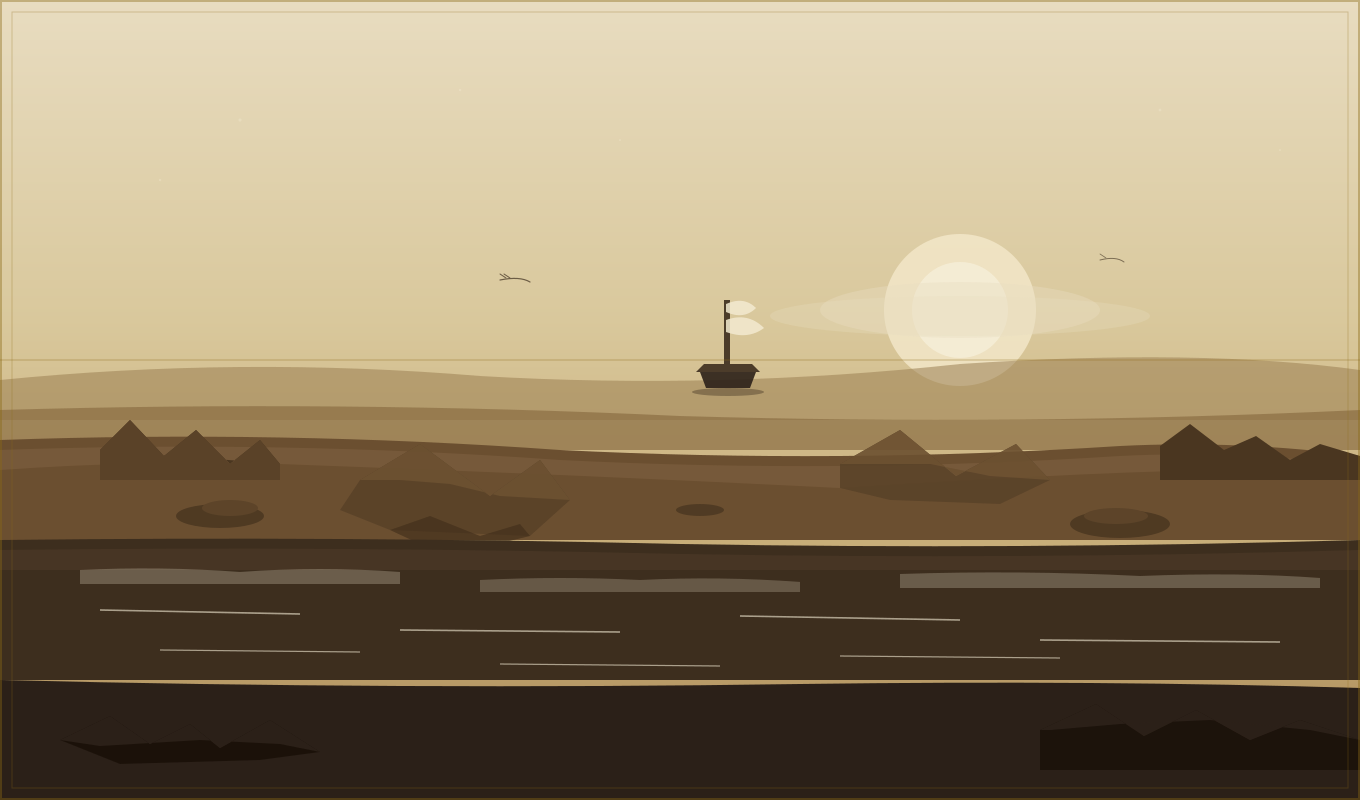
The stretch of world where the water will not stay in one place — and neither will anything else
——— ◇ ———
The Shifting Coast is the long, fractured stretch of coastline that runs along the eastern edge of the known world, where land and sea refuse to keep their boundaries. Islands surface and sink within a single lifetime. Harbors silt closed and reopen elsewhere. Reefs appear where charts show deep water. For the roughly two million people who live along its length — Anchored city-dwellers, Driftborn mobile settlements, and the countless mixed communities between them — the Coast's instability is not a disaster to be solved. It is the condition of being alive here.
This is the most geologically and cosmologically active region in the known world. Nothing else quite matches it. The rest of the world has coastlines; the Coast has a coastline that moves.
Geography and Extent
The Coast runs roughly fifteen hundred leagues from the Northspur — the cold, pine-forested headland that marks its upper boundary — to the scattered volcanic atolls of the Southreach, where warm currents finally pull the geography back into something resembling stability. Along this length, the shoreline rarely matches itself from one generation to the next. Old maps of the Coast are studied as history, not navigation. The Academy of Records in Karath maintains a department whose sole function is updating charts; the department's output is always months behind the reality it tries to describe.
Three broad regions define the Coast. Its northern third is rocky and ship-eating, with deep water running close to cliff walls. The central third — where most human settlement concentrates — is an archipelago of seven major islands and hundreds of smaller ones, threaded by currents that no two captains ever describe the same way. Further south, the waters turn shallow, warm, and thick with reefs; this is where the Driftborn first settled when they arrived on the Coast centuries ago.
Why the Coast Shifts
No one living fully understands the mechanism. The scholarly consensus, maintained by the Academy of Records and disputed only at the edges, is that the Coast sits atop a region of unusual tectonic activity — a zone where the earth itself is younger and more mobile than elsewhere. Volcanic subsidence, rising magma pockets, and the slow collision of deep-water plates all contribute to the shifting. This is the explanation taught in Anchored schools and published in every geography text the Academy has approved for general distribution.
Driftborn tradition offers a different explanation. The oral narratives passed down by the settlement-elders describe the Coast as a place where the world itself has not finished being made — where the boundary between what is real and what might yet become real is thinner than elsewhere. Ships cross this boundary unknowingly, they say. Some return. Some do not. Those that do return sometimes bring things with them.
The two explanations are not necessarily incompatible. Ordinary citizens, asked to choose, usually choose whichever answer their parents gave them.
Bleed Zones and the Veil
Certain stretches of water along the Coast are known as Bleed zones — places where unusual phenomena concentrate. Ships in these waters report lights that move against the wind, sounds that arrive with no source, fish that are not quite the expected shape. At their worst, Bleed zones kill crews outright. At their mildest, they merely confuse navigation. Every experienced Coastal sailor can name at least a dozen Bleed zones they avoid on principle, and at least two they have entered anyway and regretted.
The Bleed zones are what readers in Anchored scholarly circles call evidence of a weakening Veil — the conceptual membrane that, in most cosmological traditions, separates the surface world from a deeper reality beneath. Whether the Veil is literal or metaphorical is the subject of furious theological argument among the priesthoods. What is not disputed is that the strange things happen. What happens, what it means, and who is responsible are open questions the Coast has been asking itself for three hundred years.
Peoples of the Coast
Two major civilizations share the Coast: the Anchored and the Driftborn. The distinction between them is one of philosophy as much as geography.
The Anchored build fixed cities, with stone walls, harbor chains, and generations of family occupying the same rooms. Their largest settlement, Karath, is the political and economic capital of the Coast. Anchored culture values continuity — the stable record, the inherited trade, the place where one's great-grandmother also lived. That continuity requires enormous ongoing effort in a region where the ground and water themselves refuse to stay still. The Anchored invest that effort. It defines them.
The Driftborn, by contrast, do not fight the shifting. They accept it as a condition of life and build accordingly. Their settlements are ships, or tethered ship-clusters, or floating platforms designed to be disassembled and reassembled on a new shoreline when the old one fails. They carry their culture with them. Their wealth is in rigging and in knowledge, not in stone. They look at Anchored permanence and see a kind of willful blindness. The Anchored look at Driftborn mobility and see a kind of cowardice. Neither is entirely wrong.
A third category exists in practice: the mixed settlements. Smaller ports where Anchored families live alongside Driftborn vessels, where the harbor is half fixed docks and half floating piers, where the children of the two cultures grow up understanding both. These settlements are the most ordinary places on the Coast, and also the places where the cultural tension plays out most honestly.
The Coast and the Wider World
Beyond the Coast, the rest of the known world continues normally. Stable coastlines. Predictable tides. Islands that stay where they are. Travelers from inland kingdoms who visit the Coast for the first time are often astonished to learn that not everywhere is like this. To Coastal inhabitants, by contrast, the idea of a shoreline that does not move feels faintly suspicious — as if something must be holding it in place artificially.
Trade with the inland regions happens, but at a limit. Inland ships rarely venture past the Coast's outer margins; the navigation is too treacherous, the charts too unreliable. Most long-distance trade passes through Karath or one of its sister cities, where goods are transferred from inland vessels to Coastal ones. This bottleneck has made Karath wealthy. It has also made the Coast culturally insular. Most Coastal inhabitants will never meet an inland foreigner in their lives. Most inland foreigners will never see a Bleed zone.
Living on the Shifting Coast
Daily life here is shaped by a series of accommodations to instability. Buildings in Karath are built with flexible foundations designed to survive small tremors. Wells are dug in clusters because any single well may go bad overnight as the water table shifts. Family records are kept in multiple copies, in multiple buildings, because a fire or a collapsed house can erase a generation of legal documents otherwise. Driftborn children are taught to swim before they are taught to walk; Anchored children are taught to count escape routes before they are taught to read.
Out of this instability, a specific character emerges. Coastal people are pragmatic to the point of superstition. They distrust written guarantees and prefer oral agreements made in front of witnesses. They keep multiple small obligations going at once rather than relying on any single relationship. They are not fatalistic, exactly — they work hard, they plan, they build — but they hold their plans loosely, knowing that a storm or a tremor can erase a year of effort in a single night. The phrase a Coastal person will use, when something has gone terribly wrong, is: "The sea took it." The phrase is not resignation. It is a refusal to assign blame to anyone who cannot be blamed.
Why the Coast Matters
The Shifting Coast has produced, per capita, more of the world's navigational innovation, more of its strange religious movements, more of its finest scholars and most notorious criminals, than any other region of comparable size. Instability selects for adaptability, which selects for risk-taking, which selects for both brilliance and catastrophe. The Academy of Records exists here because nowhere else required such intensive record-keeping. Major religious orders of the known world all maintain outposts here because something about the Coast produces unusual theological phenomena. Independent merchant ships that carry long-distance trade almost all originate here because the sailors of the Coast are simply the best in the world at reading water that cannot be predicted.
The Coast is also, by every measure available, becoming more unstable. The shifting has accelerated measurably over the past century. Bleed zones are wider than they were in records from sixty years ago. Tremors happen more often. The seven major islands have been less consistent in their positions than any previous generation has recorded. What this means is a matter of fierce debate. Whether it means anything is, among some of the older priests, no longer debated at all.
Those who live here continue to live here. Leaving the Coast is difficult — inland cultures view Coastal refugees with suspicion, and Coastal people abroad often describe themselves as homesick for reasons they cannot articulate. The Coast gets into you. That is one of the things everyone agrees on, Anchored and Driftborn alike. The Coast gets into you, and after a while you cannot imagine living anywhere the ground stays still.