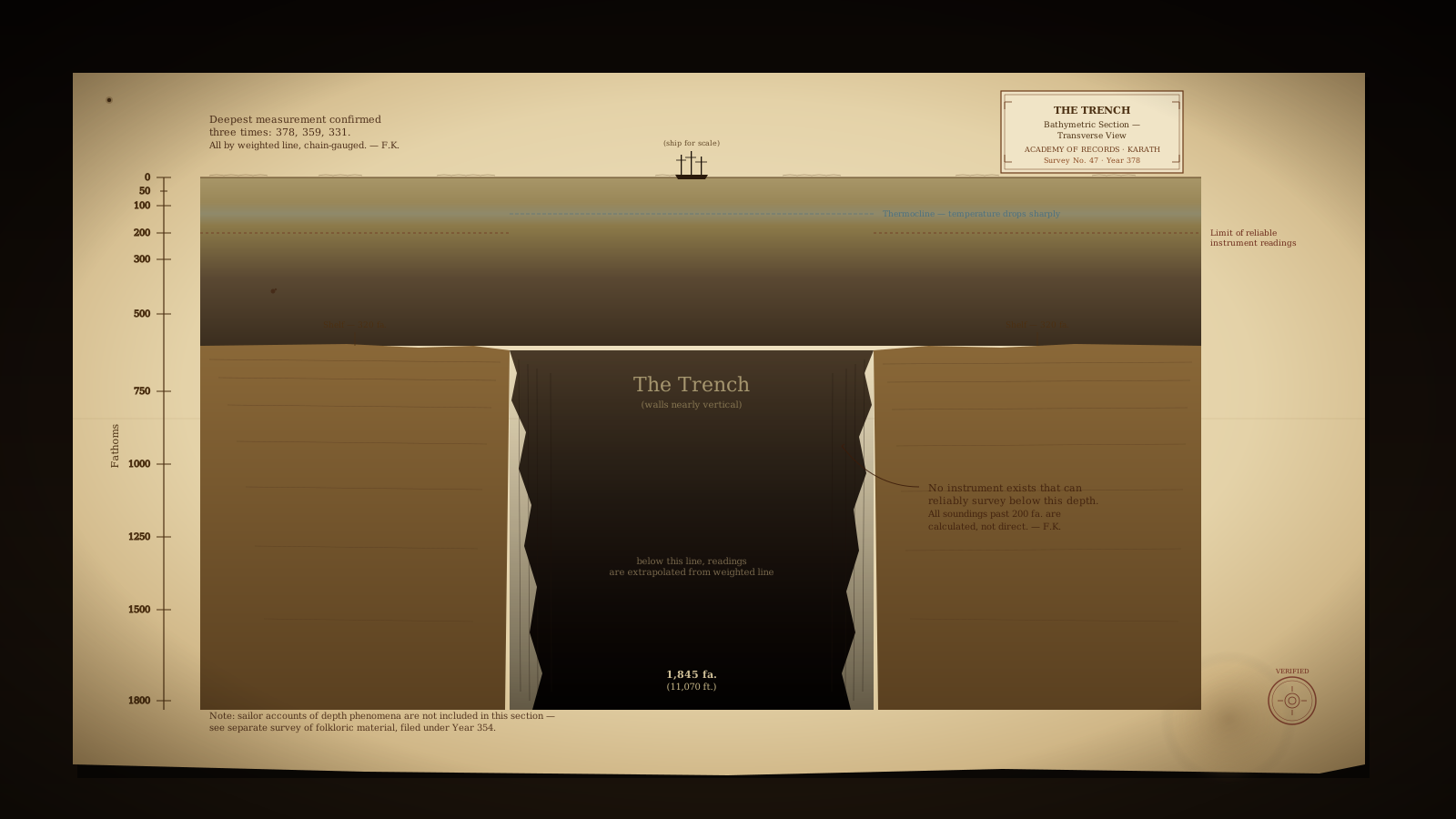
The deepest known point on the Shifting Coast. What the water holds, and what sailors say about it.
——— ◇ ———
The Trench is a chasm in the seabed off the northeastern reach of the Shifting Coast, roughly one hundred and ninety leagues east-northeast of Karath. At its deepest measured point, the Trench descends eleven thousand and seventy feet below sea level — a measurement the Academy of Records has confirmed by weighted line three separate times across the last eighty years, and which remains the deepest known point in the known world. Nothing else on the Coast comes close. A basin off the southern atolls, the second-deepest known point, reaches only three thousand feet.
What this means practically is that the Trench is not something any ship can fish, chart completely, or investigate past a certain depth. Academy instruments can measure the water to roughly twelve hundred feet with any reliability. Below that, everything is rumor.
What the Academy Knows
The Trench is approximately forty leagues long and, at its widest, nine leagues across. Its walls are nearly vertical for much of their length — a feature unusual enough that Academy geologists have devoted considerable attention to explaining it, without reaching full agreement. Most scholars now accept that the Trench is a tectonic fissure, far older than the Dissolution, formed by the slow separation of two deep basalt plates. A minority view holds that the Trench is younger — perhaps only thousands of years old — and that something happened to carve it rather than form it. Academy publications generally treat the first theory as settled and the second as speculative.
The water above the Trench is cold. Measurably colder than surrounding water, sometimes by several degrees, and the temperature difference persists throughout the year. This produces weather anomalies: unexpected fog banks, sudden drops in air temperature for ships passing overhead, and a reliable updraft that Coastal sailors have used for centuries as a navigation cue. A captain who loses the stars in bad weather can often find the Trench by feeling the cold rise from it.
Unsurprisingly, the Trench is also a Bleed zone — classified as stable and moderate by the Academy's standard taxonomy. Its Bleed effects are predominantly cognitive and structural. Ships crossing it report minor disorientation, unusual patterns in how sound travels across the water, and the rare but documented phenomenon of compass needles briefly pointing inward toward the Trench rather than toward north. These effects are mild enough that the Trench is not quarantined, and crossings are routine. The discomfort is temporary.
What the Trench's Bleed classification does not address is its character — the reason why, despite the Academy's calm taxonomies, most Coastal captains prefer to route around it rather than through it.
What Sailors Say
The Trench is the subject of more surviving folklore than any other single location on the Shifting Coast. Some of it is probably ancient. Some of it is clearly recent. Very little of it is consistent with itself.
The Driftborn know the Trench by three names. The oldest is Thrae, which in older Driftborn means something like the deep place that is owed to. A more recent name, used since perhaps the second century after the Dissolution, is the Cold Throat. The most commonly used name is simply the Trench, which the Driftborn share with the Anchored and with most Coastal mariners regardless of origin.
Sailor lore holds that the Trench is inhabited. Accounts vary wildly. Some claim the thing that lives there is enormous — as long as a warship, one story says, though warships vary considerably in length and no teller ever specifies. Others describe it as a cluster of smaller creatures that behave collectively. A third tradition insists there is nothing living in the Trench, only something older than living, which is not the same thing.
The Academy, officially, holds that the Trench is uninhabited by anything larger than the deep-water fauna common elsewhere at similar depths. This is the position maintained in all current Academy publications. Academy publications also maintain that no sailor's account of what lies in the Trench has ever been independently verified, which is true, and that sailor accounts should therefore be treated as folklore, which is one reasonable way to read them.
What no scholar, Academy or otherwise, has ever fully explained is why the stories agree on one specific point. Across all three Driftborn traditions and all recorded Anchored maritime folklore, the accounts agree that whatever is in the Trench, it is asleep. Captains debate what it would mean for it to wake, but on the fact that it is currently sleeping, there is unusual consensus.
Crossing It
For most captains, the Trench is a thing to be routed around rather than through. Standard Coastal charts mark it with the Academy's stable-zone symbol plus a secondary advised route deviation notation — an indication that, while crossing the Trench is legal and not actively dangerous, Coastal custom holds that experienced captains go around it unless time is critical.
The route around the Trench adds two days to most eastbound journeys from Karath, and rather more in bad weather. Captains who cut the time by crossing directly sometimes report no anomalies at all. Others report the compass effect, the cold, the fog, or — rarely — a low sound carried through the hull that no one on deck can identify. The sound is never reported by instruments. It is heard only by sailors, and usually by only one or two sailors at a time.
Ships have been lost crossing the Trench. Academy records list forty-one confirmed losses across the last two centuries, with another hundred and nine suspected. This is a higher loss rate than any other non-quarantined stretch of the Shifting Coast. It is also lower than it would be if crossings were attempted as often as they could be. Most captains, for reasons they cannot fully articulate, choose the longer route.
A Driftborn captain, asked by an Academy surveyor in Year 331 why her fleet always routed north of the Trench, reportedly answered that she saw no reason to bother a thing that was not yet bothering her. The surveyor recorded this as superstition with practical effect. The captain is said to have found that phrase funny.