An Academy of Records public reference article. Ordinary weather, local anomaly, and the wrong weather.
——— ◇ ———
The Shifting Coast has weather, as any region of the known world has weather — winds that blow from predictable directions in predictable seasons, rains that arrive on familiar schedules, storms that build off familiar seas and break against familiar shores. Each spring and autumn, the Academy of Records publishes a seasonal almanac summarizing what captains, farmers, and harbor authorities may reasonably expect from the following half-year. These almanacs are, by the Academy's own admission, useful but incomplete. They cover ordinary weather. They do not cover the rest.
What the almanacs omit is a category of phenomena unique to the Shifting Coast and its neighboring waters — weather whose cause, effect, or schedule does not behave as weather is ordinarily observed to behave. The Academy's scholarly position is that these phenomena are expressions of the Bleed, and that the Coast's elevated Bleed activity accounts for their frequency here. Driftborn tradition calls them, collectively, the wrong weather, and treats them as a distinct category of experience that should not be confused with storms.
——— ◇ ———
The Ordinary Weather
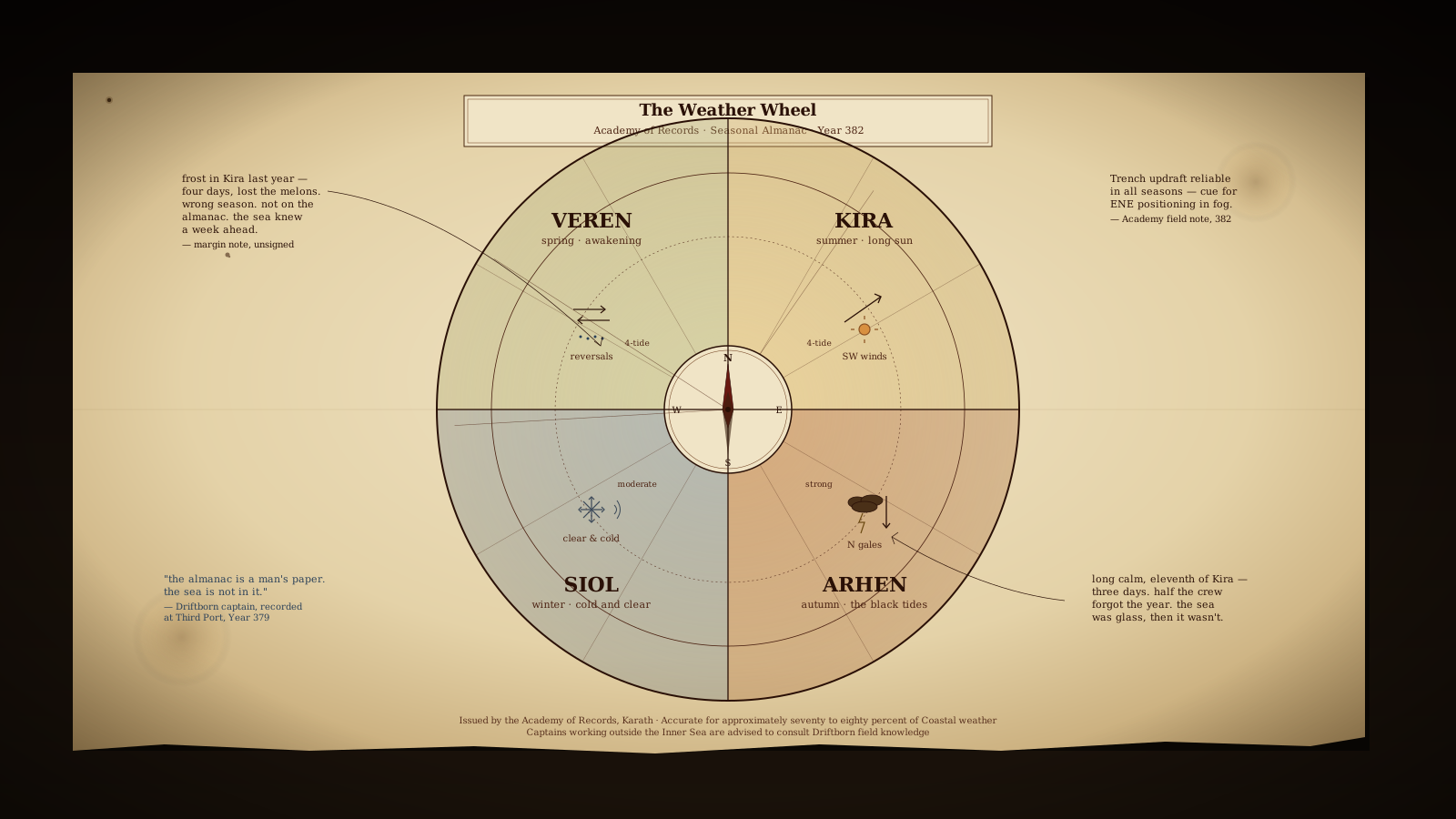
The Coast's ordinary weather follows a recognizable pattern. Prevailing winds in spring and summer blow from the southwest, carrying moisture inland from the Outer Deep and producing the reliable afternoon showers that make the Coast's agriculture possible. In autumn the wind shifts, and northerly systems begin to dominate — bringing colder air, longer rains, and the great storms of the season, which the Driftborn call the black tides and which the Academy catalogues as principal autumnal systems. Winter is cold and clear, with occasional northerly gales. In spring the weather is mixed and unpredictable — a four-week season of reversals during which the previous year's storm track yields to the coming year's prevailing pattern.
Tides on the Coast are moderate to strong, varying by region and by local seabed topography. The Tri-Port of Karath experiences four tides of approximately equal height per day — a pattern the Academy ascribes to the unusual basin geometry of the Inner Sea, though the explanation has been challenged in every generation by scholars who believe the pattern is Bleed-related. Most outer ports experience the more typical two-tide cycle.
Along the southwestern approaches — and particularly near the Wasted Shore — the prevailing winds are reliably from the southwest, driving the coastal current northward and accounting in part for why that stretch of cliff has never been successfully landed.
——— ◇ ———
Local Anomalies
Certain stretches of the Coast present weather anomalies that are reliable — that is, they occur consistently in the same places under the same conditions, and a prudent captain plans for them. These are understood to be local Bleed effects rather than pure meteorology, but they are stable enough to chart.
The Trench, for example, generates a persistent updraft of cold air that can be sensed at distance, and a series of fog banks that drift north and east from its position. Experienced captains have used the Trench's cold rise as a navigation cue for at least three centuries; Academy charts include it as a reliable local condition rather than as an anomaly. Similarly, the Bellings zone produces a sustained acoustic effect that penetrates hulls and has been mistaken, by inexperienced sailors, for an approaching storm. It is not a storm. It is the Bellings.
Regions around the larger atoll chains often show weather that lags the general Coast by a day or two — storms that arrive at the atolls a day after they arrive at Karath, or a day before, depending on the configuration. Academy scholars ascribe this to local topography. Driftborn captains, who sail between atoll and mainland most frequently, treat the lag as expected and do not inquire into its cause.
——— ◇ ———
The Wrong Weather
The category of phenomena to which Driftborn tradition assigns this name is diverse, and the Academy's taxonomy of it is still developing. Three forms are well-documented and appear in public Academy publications.
Long Calms
A long calm is a cessation of wind extending from several hours to, in extreme cases, several days, in which the air becomes entirely still, the sea glassy, and the horizon indistinct. Ships caught in a long calm cannot sail, cannot row effectively — the water itself seems reluctant to move — and experience a characteristic dulling of purpose and attention among the crew. This dulling is related to, but distinct from, the cognitive effect known as the weight that afflicts ships near the Wasted Shore. Crews in a long calm often report having forgotten why they were sailing, where they were going, or what the current year was. The effect dissipates when the calm lifts.
Long calms are not predictable. They occur, by Academy estimate, several times a year across the Coast, most often in the deep water between the Inner Sea's principal atoll groups. Driftborn sailing traditions include specific rituals for enduring them, which the Academy has documented and which are available in the field-research archive.
Salt Rain
Salt rain is precipitation that falls as fresh water ought to fall but tastes of seawater and leaves salt deposits on surfaces it touches. It has been documented, occasionally, many leagues inland — in some cases well beyond the distance that ordinary sea-spray could carry. Salt rain is generally mild — enough to discolor stonework, enough to spoil a harvest if sustained, not enough to threaten life — but its occurrence is considered an indicator of elevated local Bleed activity. The Academy's harvest-risk advisories reference salt-rain frequency in assessing which inland regions should carry reserve grain.
Driftborn oral tradition holds that salt rain falls when the sea has something to say and no one is listening. The Academy has not formally engaged with this interpretation.
The Wrong Season
The most dramatic and rarest of the three, the wrong season is a sustained weather pattern that does not belong to the time of year in which it occurs. A four-day frost in the middle of summer. A week of warm rain in deep winter. A full autumn storm arriving in early spring, complete with black skies and the full northerly wind-shift, and then departing again as if it had never been there. Wrong-season events are uncommon — the Academy records perhaps one confirmed instance per decade — but their occurrence is disruptive to agriculture, to shipping, and to civic order, since most Coastal institutions rely on seasonal expectation. Provisions in the Karath Compact addressing crop failure were drafted in the aftermath of a wrong-season winter rain two hundred and eleven years ago that destroyed most of the southern grain crop.
Driftborn tradition holds that the wrong season is not weather at all but time out of place — a leakage of a different season from somewhere the Veil is thin — and that the appropriate response is not meteorological but devotional. The Academy's position is that the Driftborn interpretation is culturally significant and should not be interpreted literally.
——— ◇ ———
Limits of the Almanac
The Academy's seasonal almanac is issued with a standard disclaimer that captains should read and attend to: the foregoing predictions apply to ordinary weather only and should not be relied upon in conditions of elevated Bleed activity or in the vicinity of active Bleed zones. The almanac is accurate, within normal limits, for approximately seventy to eighty percent of Coastal weather. For the remaining fraction, no almanac currently published is reliable. Captains who sail outside the Inner Sea, and particularly captains who work the Driftborn routes, supplement the Academy almanac with traditional Driftborn knowledge — knowledge that the Academy respects as field-relevant even while it declines to formally endorse it.
The practical effect, for anyone who sails the Coast, is that weather is known and planned for in two ways at once. The almanac handles the ordinary; Driftborn tradition handles what the almanac cannot. Captains who rely on only one source, in either direction, are overrepresented in the Academy's casualty records.
——— ◇ ———
This article is classified as a standard public reference of the Academy of Records, Karath. Current seasonal almanacs may be obtained at the Port Watch office and are reissued each equinox. Traditional Driftborn weather knowledge is preserved in oral tradition and in the field-research archive; inquiries regarding specific phenomena should be directed to the Academy's field office rather than to its publication wing.