An Academy of Records public reference article. How the sea moves, and how the Coast's captains have learned to move with it.
——— ◇ ———
The sea along the Shifting Coast moves in patterns that are, for the most part, regular enough to be predicted, tabulated, and sailed. The Academy of Records maintains a Tide Office whose staff produce and publish annual tables for every established port on the Coast, issued each winter for the following year and revised as needed. Navigators who sail the Inner Sea take these tables as authoritative. Navigators who sail outside the Inner Sea use them as a starting point and supplement them with Driftborn knowledge for what the tables do not cover.
What complicates this picture is the combination of three factors that distinguish the Coast's hydrography from that of any neighboring region the Academy has surveyed. These are: an unusual basin geometry in the Inner Sea, a persistent north-flowing current along most of the mainland approaches, and a small but persistent category of phenomena the Academy classifies as Bleed-related and the Driftborn regard as the sea's own affairs.
——— ◇ ———
The Tides
The Coast's tides fall into two broad patterns. Along the outer ports — the southern atolls, the eastern peninsulas, and the reach beyond the Trench — the tidal cycle is the familiar two-tide-per-day pattern found in most of the known world, with tidal ranges of between eight and fourteen feet depending on season and local basin conditions. Spring tides during the new and full moon reach the upper end of this range; neap tides during the first and third quarters fall to the lower end. These patterns are stable and have been reliably tabulated by the Academy's Tide Office for four centuries.
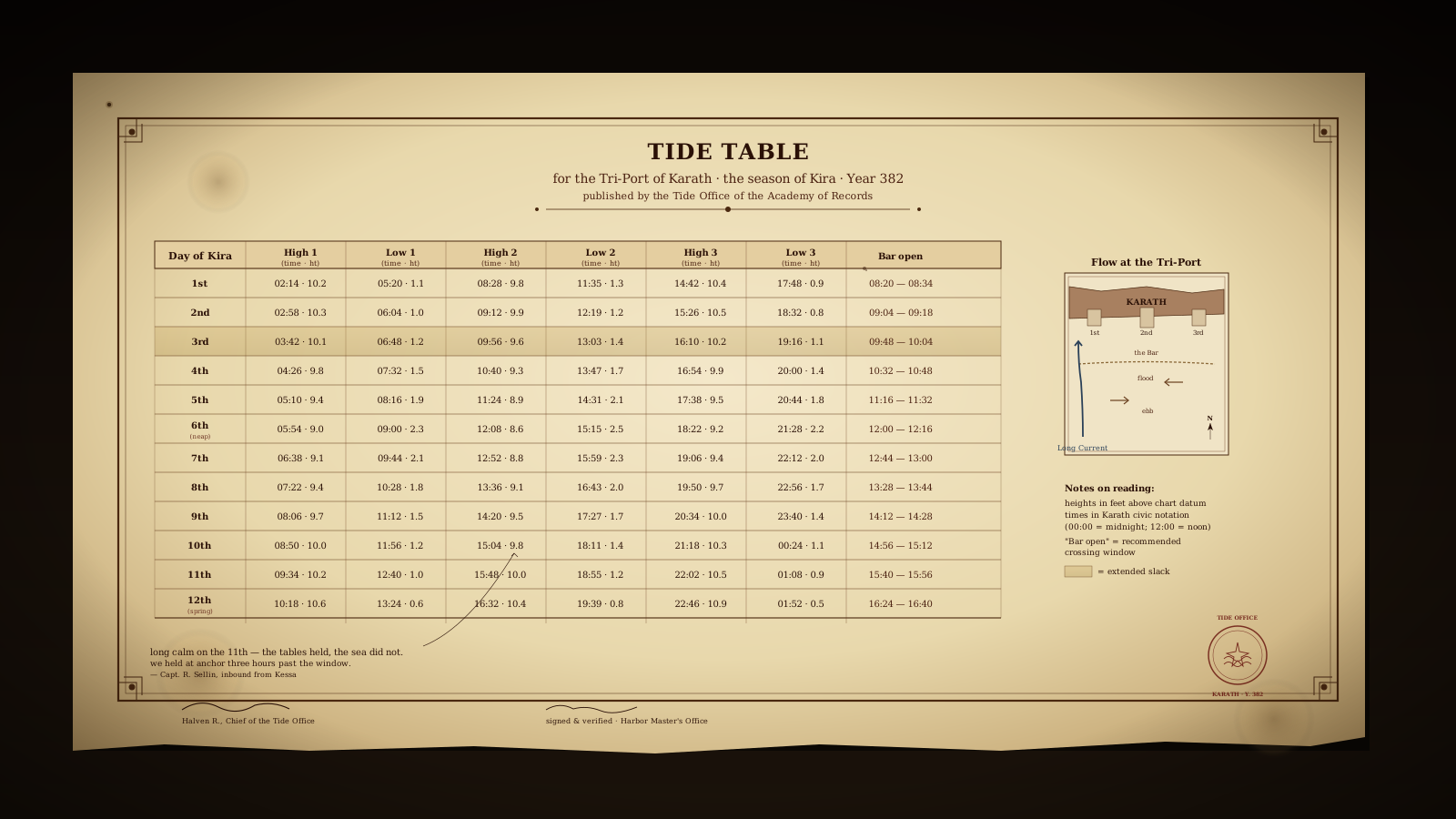
Inside the Inner Sea, and particularly at the Tri-Port of Karath, the pattern is different. Karath experiences four tides of approximately equal height per day, with a typical range of nine to eleven feet and a cycle time of six hours from high to high. This four-tide pattern is anomalous — the Academy knows of no other port in the wider region that experiences it — and its explanation remains formally unsettled. The majority view among Academy hydrographers is that the Inner Sea's basin geometry, combined with the resonance characteristics of its three major openings, produces a harmonic that reinforces a semidiurnal pattern into a quarterdiurnal one. A minority view, persistent across generations, holds that the Inner Sea's tidal anomaly is Bleed-related, and that the geometry explanation is incomplete. Both readings appear in Academy publications.
Slack water — the brief period of minimal flow between ebb and flood — is the most-used navigational window along the Coast. Karath's four-tide cycle produces four slack-water windows per day, typically of eight to twelve minutes each, during which ships may enter or leave the harbor against otherwise-unfavorable flow. The Port Watch of Karath's harbor master coordinates arrivals and departures around these windows. Driftborn captains working outside the Tri-Port's regulation plan their own arrivals against slack water by tradition rather than by the posted schedule, and the results are rarely different.
——— ◇ ———
The Principal Coastal Current
A continuous current flows northward along the mainland approaches of the Coast, beginning in the southern reach below the Islands of Kessa and extending up past the Wasted Shore, around the northeastern mainland, and eventually dissipating into the Outer Deep somewhere east of the Trench. This current is the Coast's dominant hydrographic feature. Its typical speed is one to three knots in open water, rising to five or more knots in certain narrow channels along the mainland. Driftborn tradition calls it the Long Current. Academy publications call it the Principal Coastal Current, abbreviated in older texts to PCC.
Understanding of the Long Current's origin is incomplete. Scholars have proposed several explanations — thermal driving from the cold water of the Trench, salinity differentials with the Outer Deep, or the rotational effect of the wider world's daily motion — without reaching consensus. What is agreed is that the current is stable, has been running in its current form for at least the Academy's entire recorded history, and shows no sign of weakening.
Practically, the Long Current is both navigational asset and hazard. Northbound ships sailing the mainland approach benefit from two to three knots of assistance, making passages from the southern atolls to Karath notably faster than the reverse route. Southbound ships must either work against the current in deep water or hug the coastline, where counter-eddies in certain inlets provide brief southward assistance. Along the Wasted Shore, the current's pull toward the cliff face has contributed to the region's impassability for at least nine hundred years.
——— ◇ ———
Inner Sea Circulation
The Inner Sea, bounded on the north and west by the mainland and on the south and east by the major atoll chains, has its own circulation pattern that is not directly fed by the Long Current. Water enters the Inner Sea through three principal openings — the Northern Strait, the Eastern Passage, and the Southern Gate — and exits by the same routes under the opposite tidal condition. The net flow through any opening over a full day is small; the Inner Sea, on the whole, retains its water rather than exchanging it.
Within the Inner Sea, a slow gyre circulates clockwise around the central deep. Its speed is modest, typically a quarter to half a knot, but its direction is stable enough that drift calculations for vessels lost at anchor or adrift in calm conditions are based on it. The Karath Tide Office publishes drift projections each season for use in recovering lost ships or, more often, in predicting where floating wreckage is likely to arrive.
——— ◇ ———
Tide-Races and Dangerous Waters
Where tidal flow passes through narrow channels, the water accelerates sharply. The Coast has three well-charted tide-races that can exceed the ability of any ship under sail to make headway against them, and several smaller ones that are regionally known.
The Karath Bar — the shallow sandbar at the approach to the Tri-Port — is the most-managed of these. Tidal flow across the Bar during ebb can reach six knots, and the combination of fast water, variable depth, and heavy commercial traffic makes the Bar the single most hazardous point of routine Coastal navigation. The Port Watch issues daily Bar crossings at posted times, and experienced pilots are available for a fee.
The Velland Race, between two of the northern atolls, can reach eight knots at mid-ebb under certain conditions. Local captains know the race's schedule and avoid it. Outside captains occasionally do not, with results that have made the race's name grimly familiar in Academy casualty records.
The Thrae Passage — between the Bellings zone and the southern mainland — is less a tide-race than a sustained current of four to five knots that runs reliably northward and does not reverse. Southbound ships do not use it. Northbound ships use it gladly.
A fourth category, the dead water regions, occurs where currents and counter-currents cancel near zero. Ships in dead water may find themselves becalmed with no wind and no flow — a condition distinct from the atmospheric long calms of Bleed-weather, though the two can combine. Dead water is mapped, when mapped at all, only by the Driftborn, who call it the still middle and regard it as a feature of the sea to be respected rather than a problem to be solved.
——— ◇ ———
Anomalies
A small number of documented hydrographic phenomena do not fit the framework above. The Academy classifies these as hydrographic Bleed effects and publishes them in a separate appendix to the tide tables, updated annually.
The most common is the turn — the Driftborn name for a localized reversal of the Long Current, in which a stretch of perhaps five to fifteen leagues of the coastal current runs southward for several hours, then northward again, for no cause the Academy has identified. Turns are recorded perhaps three or four times per year, most often near the Trench, and are usually brief. Academy publications call the phenomenon reversed coastal flow. Ships caught in a turn generally note it, log it, and continue.
Rarer and more disruptive are double tides — tide cycles in which a flood is followed, without an intervening ebb, by a second flood of similar height, producing sustained high water for twelve or more hours. Double tides have been documented at Karath three times in the Academy's records. On two of those occasions the Tri-Port was flooded to the Middle City. On the third, a double tide at the new moon produced a sustained high that allowed a heavily-laden merchant fleet to clear the Bar at an otherwise-impossible draft. Double tides are not predicted by any current method.
Driftborn tradition holds that both the turn and the double tide are the sea's own decisions, and that the Academy's pursuit of predictive models for them reflects a misunderstanding of what the sea is. The Academy's formal position on this reading is that Driftborn interpretation is culturally significant and should not be mistaken for navigation advice.
——— ◇ ———
This article is classified as a standard public reference of the Academy of Records, Karath. Current tide tables may be obtained at the Tide Office on the Middle Tier or at any Port Watch office. Inquiries regarding specific anomalies should be directed to the Tide Office's appendix, updated each winter.