CHAPTER 2 - A Body at the Tide's Edge
The knocking woke him. Not the polite kind — the Watch kind, slow and heavy, with a palm flat against the hull. Cassian had slept in his clothes. The oiled cloth was pressed flat against his ribs through his shirt. That was the first piece of luck he had earned in two months.
The knocking woke him.
Not the polite kind. Watch kind — slow, heavy, a palm flat against the hull so the wood carried the sound down through the ship. Cassian had heard it before, in the years when he’d been a different kind of captain, and he had promised himself he would never hear it again.
He sat up in the dark of his cabin.
The oiled cloth pressed flat against his ribs through his shirt, where he’d slept with it. He’d slept in his clothes, too, which was the first piece of luck he had earned in two months, because a captain who opens his hatch buttoning his coat looks like a man with something to hide, and Cassian had a great deal to hide this morning.
“Captain Vor.”
A woman’s voice on the pier. Level, carrying, pitched to an authority Cassian recognized before he’d identified the speaker. “Open up.”
The second palm struck the hull, a little harder.
Cassian’s mouth tasted of bad Tri-Port red and iron. He’d bitten the inside of his cheek somewhere in the night — probably when his body had finally accepted that last night had happened and he was in it. He wiped his mouth with the back of his hand.
“Coming,” he called, loud enough to carry through the deck.
He swung off the bunk. The deck was steady under his feet — dawn tide, slack water, the only thing about the morning that was. He pulled his coat on over his shirt, over the cloth, without taking the cloth out. He didn’t slide it under a floorboard. He didn’t move it to the chart-table drawer.
A ship about to be searched by the Watch was a ship where every drawer was about to become evidence. The only safe hiding place was the one he was wearing.
He climbed the ladder.
——— ◇ ———
Three Watch officers stood on the pier in the grey half-light before sunrise.
The woman at the front wore the slate coat of the Second Port Watch. Middle-aged, with close-cropped hair gone iron-grey at the temples, and a baton at her belt that was worn leather and clearly not ornamental. Behind her stood two younger officers — a man with a crooked nose and a tall woman who held her hands behind her back in the posture of someone who had been told, many times, not to fidget.
None of them were looking at Cassian.
They were looking at the water.
That was the first thing he noticed, and the second thing was that the Watch never came to Third Port at dawn-bell unless somebody was dead.
“Inspector Kann,” the woman on the pier said. “Second Port Watch.”
“Captain Vor.”
“I know who you are, Captain. Come with me, please.”
“Where?”
“Second Port. Eastern pier.”
Cassian’s hand went flat against the hatch frame without his asking it to. He made it stop. The cloth was warm against his ribs where he’d lain on it, and he could feel it there now, a small rectangle of contraband pressed against his own skin, and he had to remind himself that she couldn’t see it.
“Why?” he said.
“I’d rather show you.”
She said it the way a Watch inspector said something she’d said many times before, at many docks, in the grey hour after dawn. Cassian nodded once, because there was nothing else to do.
“Give me a minute.”
“You have it.”
He went below. He splashed water on his face from the basin, ran wet hands through his hair, did the small rituals of making himself look like a man who had slept some of the night instead of none of it. He avoided the bronze mirror on the way back out, because he already knew what he would see. He had known from the moment the Watch-palm struck his hull.
He had known the name she would say before she said it.
He climbed back up onto the deck.
“After you, Inspector.”
——— ◇ ———
They walked the piers in silence.
The harbor was half-dark. The dawn-bell had rung already from the Observatory — Cassian had slept through it, which was new — and the sun hadn’t cleared the eastern ridge. Gulls were working the fish-market runoff at First Port in long ragged spirals. A haul-boat somewhere in the inner anchorage was winching a catch up with the squeal of a pulley that needed tar. The harbor was making all its morning noises, and the three Watch officers walking beside him were making none of theirs.
Cassian counted his footfalls between piers, because counting meant he wasn’t thinking, and he needed very badly not to be thinking yet. He made it from Third Port to the end of First Port without thinking of anything but numbers.
At the landward end of First Port, Kann turned her head toward him for the first time.
“You’re walking easily, Captain.”
“I walk this route often.”
“A man summoned by the Watch at dawn usually asks me who’s dead.”
“You’ll tell me when you’re ready.”
She looked at him for one more step, then turned her face forward again. She didn’t answer. She didn’t need to.
They reached Second Port.
At the eastern pier a quarter-mile off, there was a crowd — the wrong kind of crowd, the wrong shape. Too many people for a fish haul at dawn, too few for a ship-launch. The shape of something that had happened in the dark.
“Inspector,” he said.
“Captain.”
“I’d prefer to know before I see.”
Kann stopped walking. She turned to face him. Her expression wasn’t sympathy, and it wasn’t suspicion — it was something between the two, something a Watch inspector kept in a drawer for mornings like this one.
“Her name was Sethra,” she said. “She was pulled out from under the eastern pier at the second bell of the morning by a fish-haul crew. The Harbor Master’s office identified her. I’m told she came to see you yesterday afternoon at Third Port. Is that correct?”
“Yes.”
“Come with me, Captain.”
He came with her.
——— ◇ ———
The crowd parted when Kann approached.
Three more Watch uniforms in slate stood around a shape on the boards. Two fish-haulers in oilskin hung back, watching their own feet. Somebody had laid a coarse brown cloth over what was on the boards, which meant it had been on the boards long enough for somebody to go and fetch a cloth.
The shape was too still.
It had stopped being Sethra sometime in the night. Cassian had sailed the Coast for long enough to know that drowned bodies on the Coast didn’t look like the people they had been. They looked like something else, something the water had made of them. He had carried one once, two years and four months ago — a young deckhand named Tor who had gone over the side in a squall off Second Atoll. He had not forgotten the weight.
He breathed in. He breathed out. He made his face do whatever it was going to do, because the alternative was trying to control it, and trying to control it in front of Kann was a worse tell than any expression he could have produced.
Kann pulled back the cloth.
Cassian looked.
Sethra’s eyes were closed. The harbor had taken her some hours ago — the skin told him that much, and he knew enough about harbor bodies not to pretend he didn’t. Her jaw was set in a way he recognized: the set of a woman concentrating hard on something difficult. Her left hand was closed. Her right hand was open.
She was still wearing the too-short grey cloak she had walked onto his deck in.
Cassian didn’t speak.
Grief would come later, in the cabin, alone, when he could afford it. Not here. Not with Kann watching.
“Captain,” Kann said, and her voice had gone soft — not gentle, but measured, the way a doctor measured a dose. “Did she say anything yesterday about where she was going next?”
“No.”
“Did she mention anyone she was meeting?”
“No.”
“What did she come to Third Port to ask you?”
There it was.
Cassian had known the question was coming since Kann had said Sethra’s name. He had spent the walk from Third Port rehearsing the answer. He had it clean, laid out in the part of his mind that kept inventories: an old Academy friend had come by to see how he was. They had talked about nothing in particular. The wine had been bad. The Grey Tide needed a new mainsail. He hadn’t seen her in months. Pleasant conversation, unremarkable. The lie was seven sentences long. He had practiced its tone.
He opened his mouth to begin.
Kann was watching him with the particular stillness of a woman who had interviewed a great many liars. Her right forefinger tapped, once, against the leather sheath at her belt. Not impatient. Counting.
Sethra is dead, Cassian thought. Lying to the Watch won’t save her. Lying to the Watch will protect someone.
And he didn’t know who.
He closed his mouth. He reopened it.
“She wanted to commission a voyage,” he said. “I declined.”
“A voyage to where?”
“She didn’t say. I declined before she got to it.”
“Why did you decline?”
“Because I’m two months behind on my berth fees, Inspector, and I don’t take commissions from the Academy.”
“The Academy. You knew she was from the Academy.”
“She was always from the Academy.”
“And the voyage.”
“I’ve told you. I don’t know the destination. I declined.”
Kann’s tapping finger kept time. Cassian watched it without looking at it.
“Captain Vor. The woman at your feet came to you yesterday afternoon, alone, in a cloak that had been dyed at home. She asked you for a commission. You turned her down. She left your pier. And between the hour she left you and the hour before dawn, she was killed and dropped in this harbor with enough weight on her ankles to keep her under until she wasn’t. Does that seem to you like a woman who was asking for an ordinary voyage?”
“No.”
“No. It doesn’t. Did she tell you she was afraid?”
“She said she might not be alive in the morning.”
He had not planned to say it. The tapping finger and the pace of the questions had unbalanced him somewhere between answering and not-answering, and the truth had come out in a place he hadn’t budgeted for. He heard his own voice saying the words and thought, there, that’s one — give her one truth and she may believe the rest.
“And you did nothing.”
“I was drunk, Inspector. I thought she was being dramatic.”
“She didn’t strike me as the dramatic type, Captain.”
“She wasn’t. That was my mistake.”
Kann watched him for a long moment. The tapping had stopped. She had filed his answer somewhere behind her face, in a place he couldn’t see.
“What was the voyage?”
“I’ve told you. She didn’t say.”
“You knew her for twelve years.”
“I didn’t ask her to guess.”
Kann held his eyes a heartbeat longer than was comfortable. Then she bent, drew the brown cloth back over Sethra’s face — slowly, carefully, the way a woman draws a blanket up over someone who has fallen asleep on a long journey — and stood up.
“Would you come to the Watch house today, Captain? To make a written statement.”
“If you require it.”
“I don’t require it. Yet. I may.”
She paused.
“Thank you, Captain Vor.”
“Am I free to go?”
“For now.”
——— ◇ ———
He walked away before she could say anything else, and he didn’t look back.
He didn’t stop walking until he reached the landward end of Second Port and turned the corner into the chandler’s lane. There he stopped, and put his palm flat against the stone of the chandler’s wall, and stared at the paving-blocks between his boots until he could remember how to breathe in the ordinary way.
She wanted to commission a voyage. I declined.
He had lied to the Watch, cleanly, about a dead friend. It was the kind of lie you could not take back.
He had not lied for himself. He had not lied for Sethra — she was past being helped by any lie now. He had lied, he realized, for whoever had killed her. Because a captain who confessed to Sethra’s actual errand would be handing the Watch the thread that led to her killer, and he could not do that, because if the Watch pulled that thread first, whatever Sethra had died for would be buried in a ledger and lost.
That was the shape of the trap she had put him in without meaning to.
He stood with his hand on the stone until his breathing slowed. Then he walked the long way home, because he didn’t want to pass Kann again, and because his legs had decided they weren’t ready to go home yet. He let them decide.
——— ◇ ———
The Grey Tide sat where he had left her.
Nobody had boarded her while he was gone. He could tell from the stern line — he had tied it himself last night, and it was still tied his way: three turns and a back-pinch, a knot he’d learned from a Second Atoll deckhand a decade back and had never seen used by anyone else in Karath. Most Karath sailors used two turns. Whoever had boarded him at dusk yesterday had either not come back, or had come back and been careful enough to know that touching his lines would tell him they had been there.
He couldn’t tell which. But the knot told him one thing: whoever knew enough to find the fragment on his ship had not yet boarded the ship to find it. They were still guessing.
That was something.
He climbed aboard, checked the hatch — not disturbed — and went below.
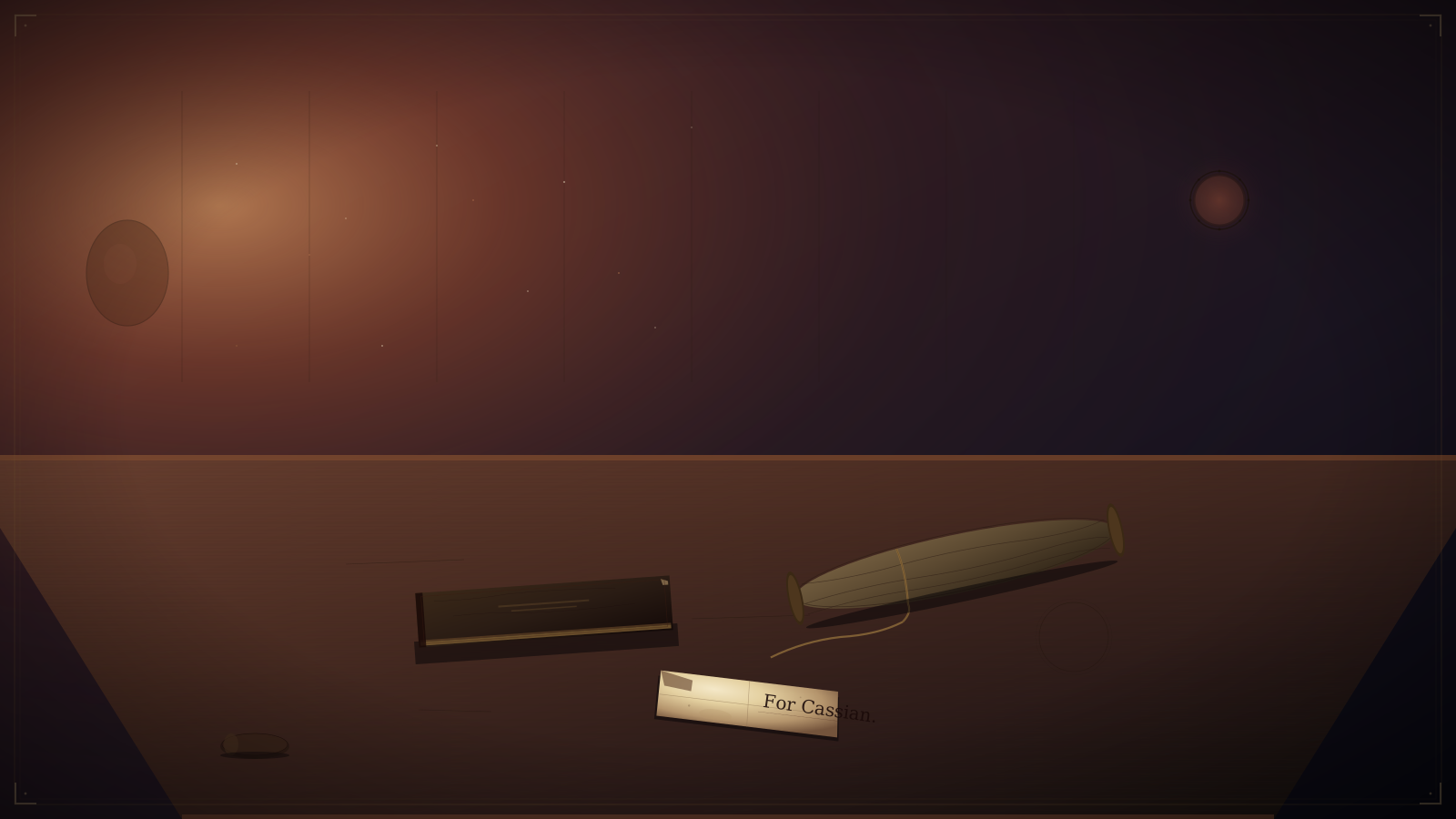
He took the oiled cloth out of his shirt and set it on the chart-table. He didn’t unfold it. He sat across from it on his sea chest, and for the first time in two years and four months, he didn’t pour himself wine.
He didn’t want wine.
He wanted, very badly, to be sober when he decided what came next.
He looked at the cloth on the table.
And then he saw the paper.
——— ◇ ———
It was folded small, about the size of his thumb, half-slid between a weathered almanac and the edge of the chart-table. He would have missed it if he’d sat down any other way. He had not noticed it this morning when he’d come down at dawn, and he had been in the cabin last night before going up to meet Kann, and the paper had not been there then.
It had been there.
He had been in a hurry at dusk, after the two strangers left, and he had not looked carefully at his own table.
Sethra had put it there. She must have — she had been the only person on his deck yesterday besides himself, and she had walked off his ship without once glancing at the table where she would have had to slide it. She had hidden it, the way she hid everything: without drawing attention, in a place a searcher would not think to look.
Cassian reached for it.
He drew it out from the edge of the table.
Sethra’s handwriting. A small, even hand he hadn’t seen in twelve years.
For Cassian.
——— ◇ ———
END OF CHAPTER 2.